Showing posts with label cannibalism. Show all posts

Thursday, February 6, 2014

Anchorage Crab Extravaganza!

Last week 2 weeks ago (time flies!) I attended the 2014 Alaska Marine Science Symposium, and boy was it crab-tastic! I went to present a couple posters on my work with the Gulf of Alaska Project (my portion is studying baby fish body condition), but you better believe I stopped at all the crab posters I could find!

Here's a run-down of some of the neat crabby things I learned:

Snow crabs are loving detritus up in the arctic! Lauren Divine looked at Chionoecetes opilio stomach contents from crabs collected in the Chukchi and Beaufort Seas. Along with detritus, crabs were eating polychaetes, bivalves, brittle stars (you can see a pile of them from this post), and other crabs including opies!

Lauren showing off her poster and special friend

that's a larger-than-life snow crab ready to show you...

...its stomach contents!

Alaska Department of Fish and Game is mapping Tanner crab (Chionoecetes bairdi) habitat to better understand their distribution off of Kodiak. The fun part of this: underwater pictures of crabs in action!

(download the abstracts here)

Ocean acidification will affect larval Tanner crabs as the ocean's pH drops. Here's Chris Long presenting his work where they exposed brooding females to different levels of pH (the lower the pH, the more "acidified" the water is). The greatest effect was toward larval survival. He also gave a talk on how a similar experiment affected the embryos of Tanner crabs (there's a difference... I can explain further if you'd like) and they weren't doing too well either.

over-achiever: giving a poster presentation AND a talk!

Remember how I said aging crabs was near-impossible? Alexei Pinchuk, Ginny Eckert, and Rodger Harvey are out to prove me wrong!

"Development of Biochemical Measures of Age in the Alaskan Red King Crab:
Towards Quantifying Thermal Effect on Aging"

Last but not least, I learned about ZOMBIE CRABS!!! (No, not these zombie crabs.) Leah Sloan, a UAF grad student, is looking at the distribution of that nasty parasite, the rhizocephalan, and how it may be affected by temperature. The infected king crabs she's studying are referred to as 'zombie crabs' because their bodies have basically been hijacked by the parasite to be a walking, eating, parasite-brooding machine! She's answering her temperature question by exposing larval rhizocephalans (aka parasitic barnacles) to different temperatures and tracking their survival. I'll interview her soon for an "Ask a Grad Student" post so we can all learn more.
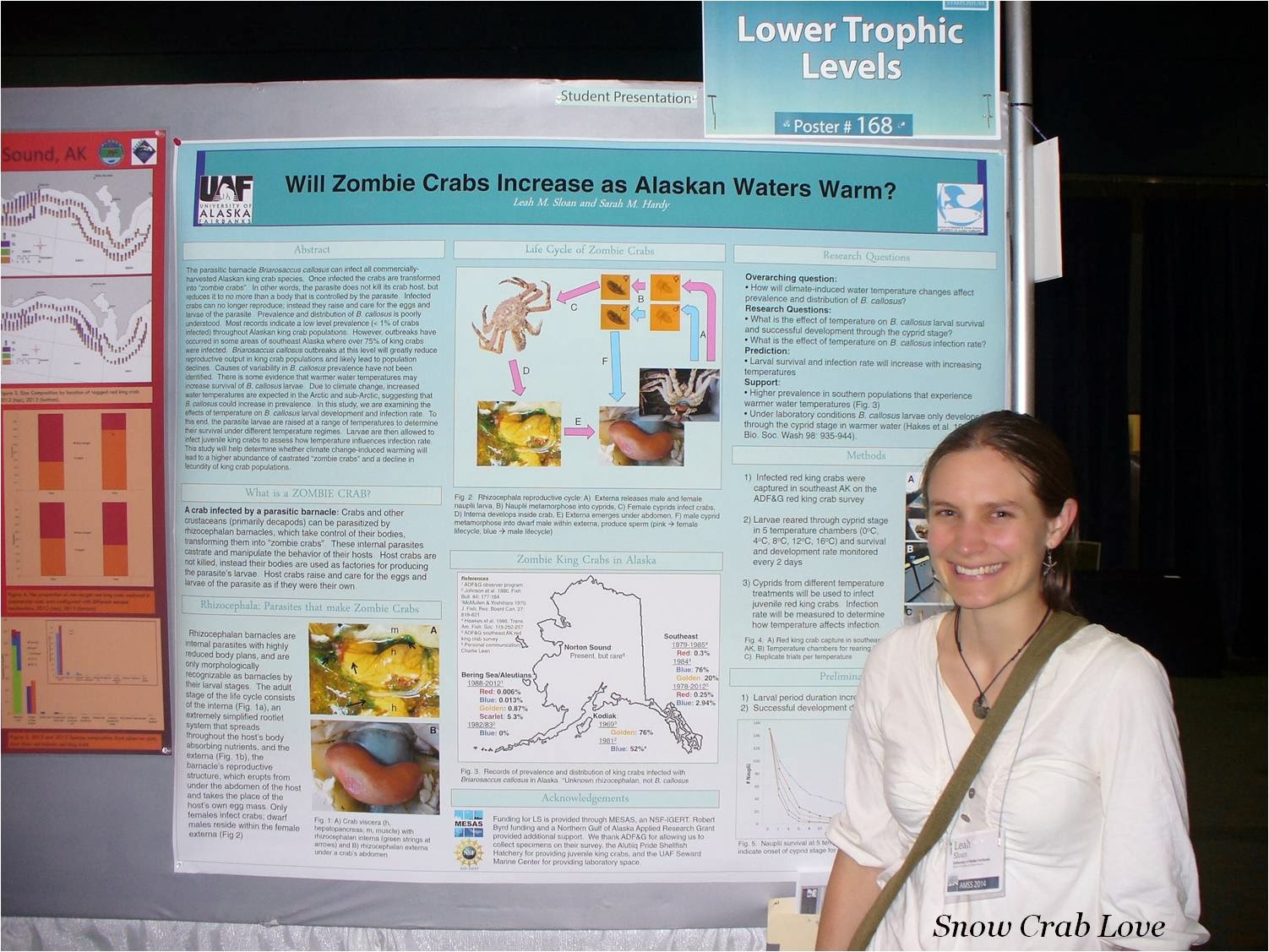
she had me at "Zombie"!

I took so many other crab notes, so we'll see if I can share them all with you over the next... year!?!? By then I'll be ready for another round of Marine Science Symposium fun!

Tuesday, November 9, 2010

"Sea-Fever" tribute to Legoless

Well friends, Legoless has finally succumbed to his injuries, may he rest in peace. Please know that his last moments were eating herring with one of the female crabs.


I know he wasn't really a sailor, but the last stanza of "Sea-Fever" kind of made me think of all my past crabs (I had to memorize this poem when I was living on a schooner).

Sea-Fever

I must down to the seas again, to the lonely sea and the sky,
And all I ask is a tall ship and a star to steer her by,
And the wheel's kick and the wind's song and the white sail's shaking,
And a grey mist on the sea's face, and a grey dawn breaking.

I must down to the seas again, for the call of the running tide
Is a wild call and a clear call that may not be denied;
And all I ask is a windy day with the white clouds flying,
And the flung spray and the blown spume, and the sea-gulls crying.

I must down to the seas again, to the vagrant gypsy life,
To the gull's way and the whale's way where the wind's like a whetted knife;
And all I ask is a merry yarn from a laughing fellow-rover
And quiet sleep and a sweet dream when the long trick's over.

~John Masefield

Friday, August 27, 2010

It's a crab-eat-crab world

I’ll admit it: I’m an etsy junkie. I like to type in “crab” or “nautical” and just window-shop away! Check out some of these beauties that I’m dreaming about:


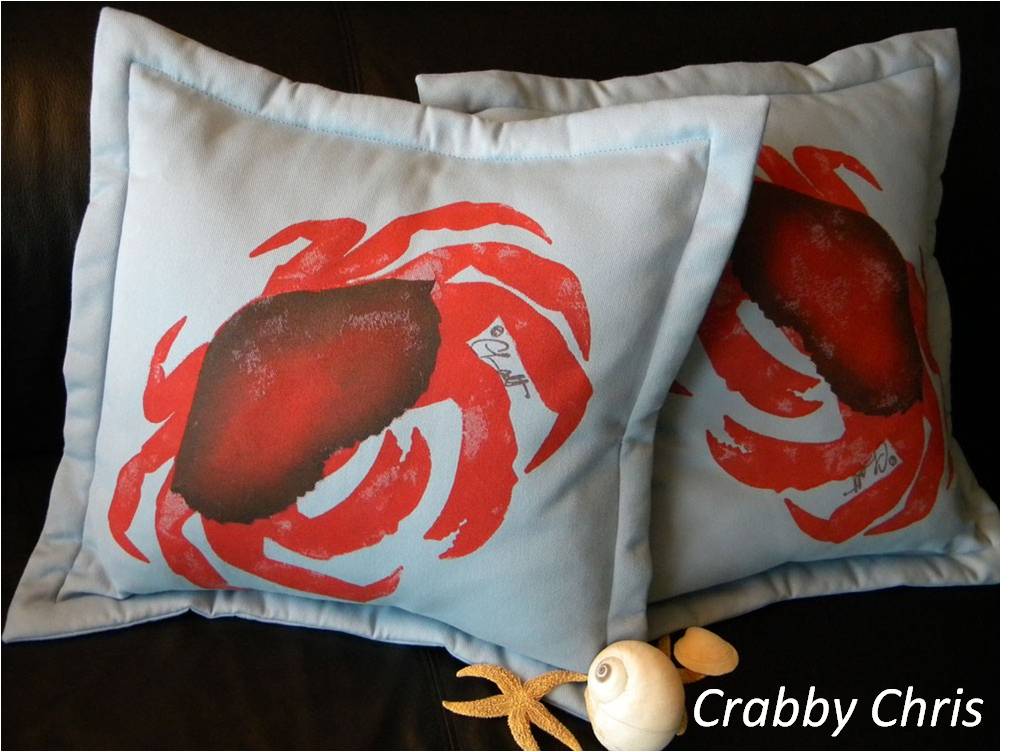
I can picture these on my couch!

dictionary pages are becoming a popular surface for amazing drawings, and I LOVE them!

How cute is this pin cushion???

I recently broke down and bought two prints from this seller!

While there, I stumbled upon this awesome picture by Heidesphotos:

"Crab eating crab"

It made me think about how common cannibalism is in crabs, and just how important it is for snow crabs. Opies are benthic forage feeders who mostly feed on polychaete worms, clams, and the like (I feed my guys herring mostly, and occasionally treat them with salmon and blue mussels). But their stomach contents have included small crabs, mostly found in large adult males. Because of the small amounts of crabs found, scientists don’t think these large males need the little crabs for their nutritional benefit, but their cannibalism may be an important type of population control. It’s as if they read Jonathon Swift’s A Modest Proposal and followed through on it!

Monday, August 2, 2010

Why I'm glad I'm not a female snow crab

Understanding any hormonal differences between new- and old-shell males is one thing, but getting to see a new-shell male compete with an old-shell male for a female is the icing on this project's cake! Imagine my excitement when my first female molted (and wasn't eaten by her girlfriends) and was ready to mate - females mate after they've molted to maturity and are still soft. It was 6 pm and the experiment needed to be filmed for 12 hours, so instead of just waiting to start the next morning, I did what any normal person would do: asked my husband to get the sleeping bags and some Chinese take-out, and got started!

Adam at the lab

I put my new, precious, soft-shell female into the tank with two males and some herring (you know, in case they wanted a snack...) and started taping. Things were really slow for the first 6 hours, then things got crazy!


The small crab is the female, playing the edible rope in a medieval tug-of-war: the old-shell male (with white barnacles attached to his back) ate 2 1/2 of her legs! Don't worry, I took her out and put her in her own little hospice area. And then I sampled the males for their gonads.

But how representative is this behavior compared to opies in the wild? Maybe more representative than you'd think. This carnage was captured in the Bering Sea by ADF&G:


And that's why I'm glad I'm human.

Thursday, July 22, 2010

The Tale of Legoless

Legoless was a recently-molted crab wandering the benthos of the eastern Bering Sea, when all of a sudden he was snatched up by a trawler! But this wasn't any trawler, it was the Aldebaran, searching the sea floor for groundfish and crabs during the NMFS trawl survey. And on the Aldebaran was a grad student, hoping to find a new-shell male snow crab to complete her project.


Flash forward to a marine research wet lab, where Legoless is in a saltwater tank with his fellow male snow crabs. They've been promised an opportunity to mate with some females in the spring, but these guys are getting anxious, and maybe a little bored with the herring, mussels, and salmon the grad student keeps feeding them. Legoless, being the sweet crab that he is, tries to calm everyone with a stirring rendition of Don't Worry Be Happy; crab pandemonium ensues.

Somehow, Legoless was able to escape alive (the grad student hoisted him from the tank and put him in his own special area), but he had lost so much: the others had eaten 6 of his 8 walking legs. Thank goodness he still had both of his claws for eating and flashing crab-signs.

Legoless in his sanctuary

You may be asking, crabs can regenerate their legs, so won't Legoless be fine? Can't he become Legolots? Unfortunately, friends, as a snow crab Legoless will terminally molt. Crabs and lobsters regenerate their legs with each successive molt as they grow, but because Legoless may only molt once more, he won't ever fully regenerate his missing legs.

And so Legoless sits, occasionally scooting over to a neighboring urchin, whistling as he goes.