Showing posts with label ocean acidification. Show all posts

Thursday, February 6, 2014

Anchorage Crab Extravaganza!

Last week 2 weeks ago (time flies!) I attended the 2014 Alaska Marine Science Symposium, and boy was it crab-tastic! I went to present a couple posters on my work with the Gulf of Alaska Project (my portion is studying baby fish body condition), but you better believe I stopped at all the crab posters I could find!

Here's a run-down of some of the neat crabby things I learned:

Snow crabs are loving detritus up in the arctic! Lauren Divine looked at Chionoecetes opilio stomach contents from crabs collected in the Chukchi and Beaufort Seas. Along with detritus, crabs were eating polychaetes, bivalves, brittle stars (you can see a pile of them from this post), and other crabs including opies!

Lauren showing off her poster and special friend

that's a larger-than-life snow crab ready to show you...

...its stomach contents!

Alaska Department of Fish and Game is mapping Tanner crab (Chionoecetes bairdi) habitat to better understand their distribution off of Kodiak. The fun part of this: underwater pictures of crabs in action!

(download the abstracts here)

Ocean acidification will affect larval Tanner crabs as the ocean's pH drops. Here's Chris Long presenting his work where they exposed brooding females to different levels of pH (the lower the pH, the more "acidified" the water is). The greatest effect was toward larval survival. He also gave a talk on how a similar experiment affected the embryos of Tanner crabs (there's a difference... I can explain further if you'd like) and they weren't doing too well either.

over-achiever: giving a poster presentation AND a talk!

Remember how I said aging crabs was near-impossible? Alexei Pinchuk, Ginny Eckert, and Rodger Harvey are out to prove me wrong!

"Development of Biochemical Measures of Age in the Alaskan Red King Crab:
Towards Quantifying Thermal Effect on Aging"

Last but not least, I learned about ZOMBIE CRABS!!! (No, not these zombie crabs.) Leah Sloan, a UAF grad student, is looking at the distribution of that nasty parasite, the rhizocephalan, and how it may be affected by temperature. The infected king crabs she's studying are referred to as 'zombie crabs' because their bodies have basically been hijacked by the parasite to be a walking, eating, parasite-brooding machine! She's answering her temperature question by exposing larval rhizocephalans (aka parasitic barnacles) to different temperatures and tracking their survival. I'll interview her soon for an "Ask a Grad Student" post so we can all learn more.
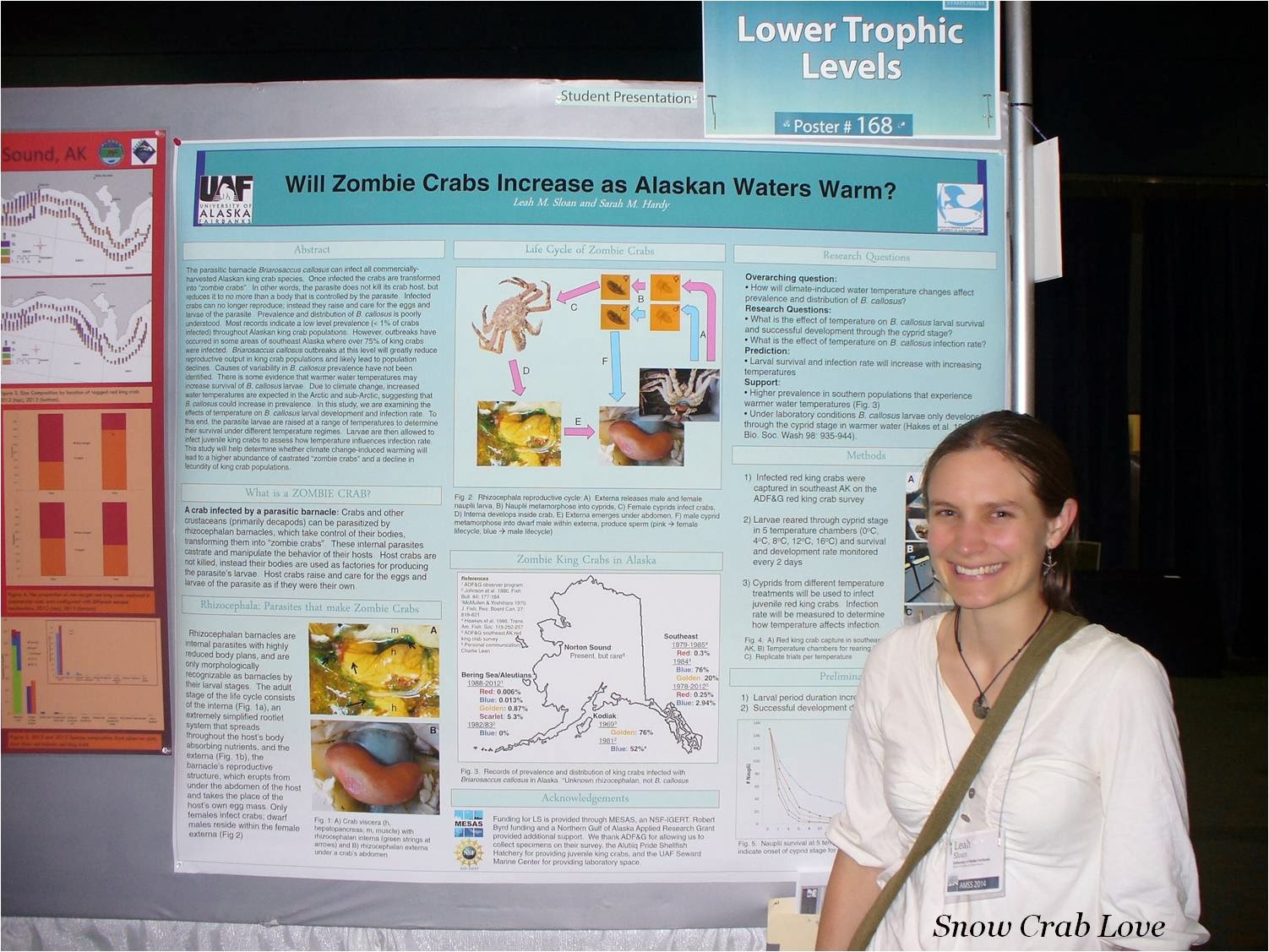
she had me at "Zombie"!

I took so many other crab notes, so we'll see if I can share them all with you over the next... year!?!? By then I'll be ready for another round of Marine Science Symposium fun!

Tuesday, April 3, 2012

Ask A Grad Student: Raphaelle Descoteaux

It's been a while since we've had an interview with a grad student, but this one was worth the wait. Raphaelle is on the cutting edge of ocean acidification work, which we learned a little bit about here and here, and won for best student poster presentation at this year's Alaska Marine Science Symposium. Oh yeah, and she can speak English and French!

Age: 24

Degree: M.S. Marine Biology

Current City: Fairbanks, AK

1. Describe your project, in 4 sentences or less.

My project looks at the effects of ocean acidification on the development of crab larvae (Tanner, Dungeness, and black-clawed cancer crabs). Part of the carbon dioxide we emit in the atmosphere gets dissolved in the oceans and reacts with water molecules to form an acid, causing the oceans to become more and more acidic. So I performed experiments in the lab in which I placed newly-hatched crab larvae into waters of different pH, or acidity. I am now at the stage of measuring things like body length, weight, and shell composition to assess whether the different pH conditions in which the young crabs were raised affected their development.

And in French…

Le but de mon projet est de déterminer si l’acidification des océans aura un impact sur le développement des crabes an Alaska. Une bonne partie du dioxide de carbone que nous produisons se dissous dans les océans et réagit avec les molécules d’eau, formant un acide. Ainsi, plus nous émettons du dioxide de carbone, plus nos océans deviennent acides. J’ai effectué une expérience dans laquelle j’ai placé des larves de crabes dans des eaux de différent pH et je suis présentement au stade de mesurer différents paramètres comme la longueur, le poids et la composition de la carapace de mes jeunes crabes. En comparant ces paramètres parmi les crabes qui ont grandit dans les eaux de différents pH je pourrai déterminer si l’acidification des eaux aura un impact sur le développement des crabes dans le futur.

closely-monitored flow-through systems

2. What has been your biggest challenge with this project so far and how have you overcome it?

One of the big challenges so far has been dealing with logistical difficulties of working with such small animals. The crab larvae I am looking at are very small. They are about 1-2 mm long and weigh a fraction of a milligram. Measuring, weighing, and analyzing their shell chemistry at this scale has required a lot of team work, patience, and imagination!

can you believe how cute these little
Tanner crabs (Chionoecetes bairdi) are!?!

3. Why Alaska? Are you from here, or did the project lure you here, or was there something else about AK that brought you here?

I am originally from Quebec, Canada and came to Fairbanks as an exchange student for the senior year of my undergraduate degree. I was studying at McGill University in Montreal and felt like I needed to experience something different. Wow! Fairbanks was definitely different and I just fell in love with it. I knew I had to stay! I met my current advisors, Katrin Iken and Sarah Hardy, and we came up with this great ocean acidification project for my Master’s degree.

4. Which was harder: finishing the Equinox marathon or keeping larval crabs alive?

I actually walked the Equinox marathon once and ran the relay last year. The goal is to run the whole thing this year. I’m sure training for it will be difficult but I would still expect keeping larval crabs alive to be harder! This year has been a great learning experience for me in terms of raising larval crabs but I still have lots more to learn!

the Eqinox Marathon profile - yes, that does say a gain of 3,285 feet!

5. What is your favorite piece of crab paraphernalia?

I don’t own much crab paraphernalia frankly but I do LOVE my brand new “I love snow crabs” mug!

woo-hoo! the Snow Crab Love mug in action!

Thanks, Raphaelle, and good luck with the Equinox!

Friday, March 9, 2012

I'm dissoluting! Dissoluting!

I wonder what the pH of the water in that bucket was...

Last Tuesday we learned about ocean acidification and what that phrase means. The uptake of atmospheric CO2 is creating more hydrogen ions in the ocean which lowers the pH, therefore making the ocean more acidic. So what does all this crazy acidification mean for calcium carbonate-encrusted crustaceans? Perhaps something like this:

oh dear.

Well, maybe that's an overdramatization; crabs aren't melting in ocean water with lower pH. But they are developing differently. There are a few studies going on here in Alaska looking at larval development in different pH water treatments. One such study by NOAA out in Kodiak (pdf poster here) looked at survival, growth, and calcium uptake of larval blue king crabs in pH treatments of ambient (normal levels in Auke Bay here in Juneau was 7.94 in 2010), minus 0.3 below ambient pH, and minus 0.5 below ambient pH. Sure enough, growth decreased in the lower pH treatments shown by an overall decrease in % dry mass.

"We're not growing! Oh, what a petri dish!"

Why is the development different if the acidified ocean water isn't actually melting the crabs' carapaces? Animals have the ability to regulate their internal acid-base relationship, and crabs do so by taking advantage of their calcium carbonate exoskeleton: when pH is lowered due to high levels of hydrogen ions, crabs can increase carbonate ions to bind with the hydrogen ions (thus making bicarbonate ions) through shell dissolution.

above is a crab with low pH due to all those pesky hydrogen ions

by using the calcium carbonate in its shell, it can get rid of 
some of those hydrogen ions by making bicarbonate ions

a dissolving shell results in less hydrogen ions and a higher pH (yay!)
plus an increase in calcium and bicarbonate ions

More research is in the works: UAF student Raphaelle Descoteaux is measuring any morphometric deformities in larval Tanner (Chionoecetes bairdi) and Dungeness (Metacarcinus magister) crabs that may occur in acidified seawater. We'll hear from her in a future Ask A Grad Student post, so stay tuned!

Read more crab OA research:
Pane, E. F., and J. P. Barry. 2007. Extracellular acid-base regulation during short-term hypercapnia is effective in a shallow-water crab, but ineffective in a deep-sea crab. Marine Ecology Progress Series 334: 1-9

Spicer, J. I., A. Raffo, and S. Widdicombe. 2007. Influence of CO2-related seawater acidification on extracellular acid-base balance in the velvet swimming crab Necora puber. Marine Biology 151: 1117–1125

Tuesday, March 6, 2012

What's ocean acidification?

You may remember learning about acids and bases in high school. Every liquid is either acidic, basic, or neutral. You can measure this by measuring its pH: a neutral liquid has a pH of 7; anything over 7 (up to 14) is basic while anything under 7 (down to 0) is acidic.

oh, litmus tests! who didn't love these?

Say you have something with a pH of 8 but you want it to have a pH of 5. You can simply add an acid, or anything that's going to give up its hydrogen ions, because pH is just a measure of hydrogen ions in a solution. By adding acid, or acidifying the solution, you will lower the pH.

lots of hydrogen ions (in red) = acidic solution
lots of hydroxide ions (in blue) = basic solution

So, back to the main question: what's ocean acidification? It's when the ocean's pH gets lowered by the increase of hydrogen ions. The increase of hydrogen ions is from increased atmospheric CO2. The ocean will absorb the CO2, which will become aqueous and react with water (H2O) to create carbonic acid. It doesn't stop there; carbonic acid can give up its hydrogen ions to become bicarbonate and then carbonate ions.

uptake of carbon dioxide into the ocean can
result in increased hydrogen ions (circled in red)

Where all this gets tricky is that organisms will use carbonate ions to make calcium carbonate (CaCO3), but if there is extra hydrogen ions floating around, the carbonate ion will bond to them. Briefly, acidified ocean water becomes corrosive to calcified organisms.

spider crab larva: "Aren't I pretty?
All my little spines are made from calcium carbonate!"

How does this affect crabs? Stay tuned for research being performed in Alaska on larval crab development in acidified sea water (coming this Friday, March 9th)!