Showing posts with label fiddler crab. Show all posts

Friday, February 22, 2013

Trading WHAT for protection?

Oh, fiddler crabs, you're at it again.

"Who, me?"

You may already know that I have a deep-seeded distrust of fiddler crabs (despite this story I made up about one), but this next bit of science takes the cake. Few animals in the animal kingdom are monogamous. Hey, they all can't be like the mantis shrimp, right? But female fiddler crabs take this idea of polygamy to a whole new level! Female Uca mjoebergi will mate outside of their burrows on the sand flat for all the world to see. This rather public display with a male fiddler crab will secure that male's devotion in protecting her burrow. She trades sex for protection!

However, this broad's not finished with getting her, er, crab on. She'll next mate with a male inside her burrow, which is protected by her first mate. So the first male gets to mate, but it's the last male that will likely fertilize the majority of her eggs!

"There's nothing going on behind MY back, right? Right?"

The Slatyer et al. (2012) paper observed that the neighboring males were significantly more inclined to help after mating, so really the males are just as sleazy as the females.
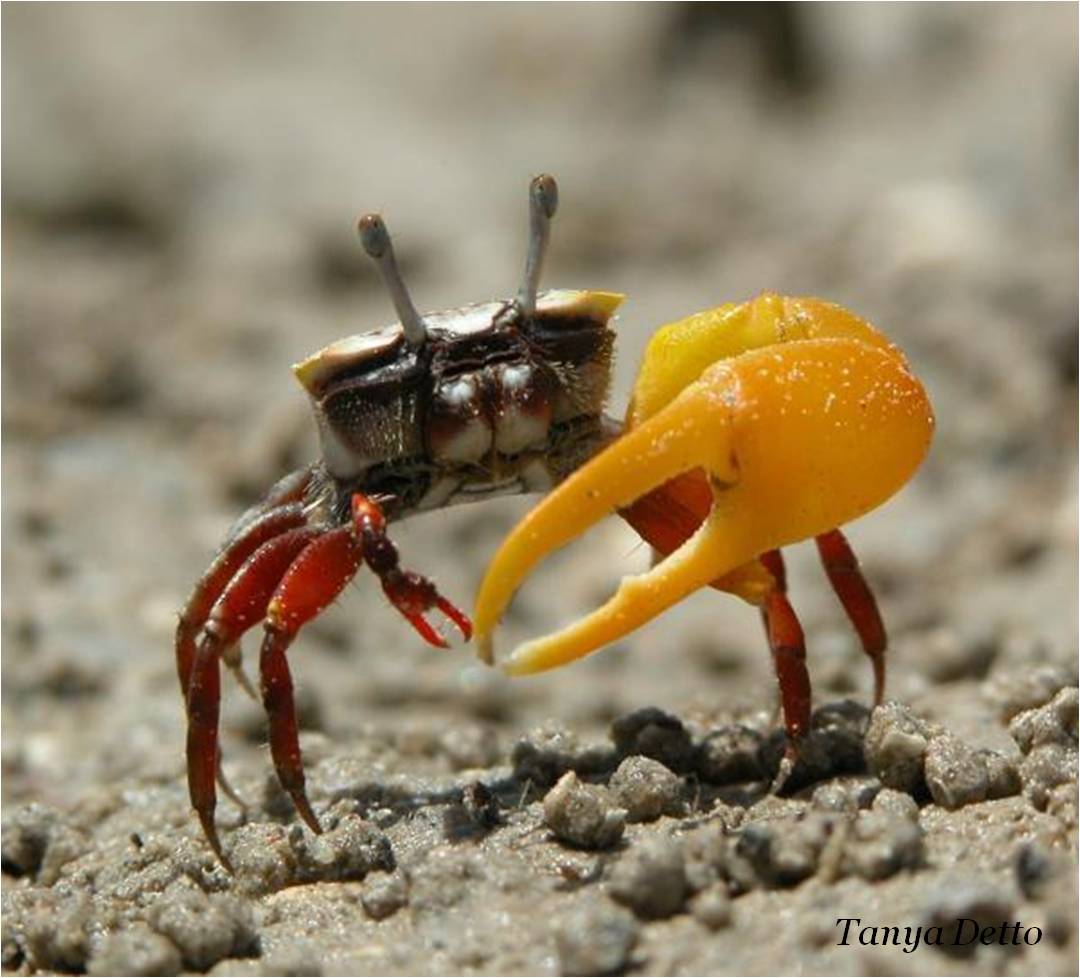
cute, but still sleazy

Thanks to Meghan Garrison for telling me about this incredible crab behavior!

Read more:
Slatyer, R.A., M. D. Jennions, and P. R. Y. Blackwell. 2012. Polyandry occurs because females initially trade sex for protection. Animal Behviour 83: 1203-1206.

Friday, November 23, 2012

The mystery crab is a...

FIDDLER CRAB!

sand fiddler crab, Uca pugilator

Did you guess that? In the last post with my story about a little lost crab, I gave a few clues as to what type of crab he was:

1. When he first woke up, he saw some characters from the nursery rhyme "Hey, diddle, diddle" by Mother Goose: a cat, a fiddle with our fiddler crab, a cow jumping over the moon, a dish running away with a spoon.

2. Tevye is the main character from "Fiddler on the Roof",  and I couldn't pass up an opportunity to reference that musical! Even National Geographic played with the connection, so I know I'm not alone. The title of the musical is referenced when Tevye says, "Traditions, traditions. Without our traditions, our lives would be as shaky as... as... as a fiddler on the roof!" That's why Farmer Tevye in my little story warns the crab to be careful up there.

I LOVE this musical!!!

(Next up was the chicken on the roof. He had no secret meaning. I just thought a conversation with a chicken would be funny.)

3. Having the crab go to the Georgia Aquarium in Atlanta gave me a place to focus my fiddler crab species search, and it also gave me an awesome opportunity to have the Charlie Daniels Band's "Devil went down to Georgia" stuck in my head for a good week! While I'm not generally a fan of his, that song is a classic that can't be ignored. If you've never heard it, it's about the Devil trying to get the soul of a boy named Johnny by challenging him to a fiddle duel. Johnny wins. Boom.

4. Finally, going to the coast led to actual biological clues to the crab's identity: seeing little holes in the sand surrounded by balls (sand from the fiddler crab excavations), feeling cooler after waving, and having one large claw and one small claw all pointed to the fiddler crab!

a flock of fiddler crabs

Georgia salt marshes have three fiddler crab species: Uca pugnax, U. pugilator, and U. minax. I was pretty smitten with the splash of purple on the carapaces of U. pugilator, and I even included a little purple on the fiddler crab stranger that waved to our crab, so that's the final species I chose (in case anyone got really nerdy and wanted to know the scientific name).

pretty in purple

Side note: the two pictures from Americana the Beautiful are from a blog entry beginning with, "A stroll along Cumberland Island...". Pfft. I "strolled" along Cumberland Island for 20-some-odd miles after having spent almost 2 months sailing on a schooner (i.e. not walking a lot), and it. was. awful. We saw wild horses and dolphins, but still. My legs were shaking by the time I got back into my bunk. And I might have cried after the sun set and we were still on the beach and had no idea how far away our ship was.

Other side note: the title of the last post, "Who am I" made me think of Jean Valjean from Les Miserables. Anyone else?

Monday, August 6, 2012

Doing the wave makes you cool

Will and Kate know what I'm talking about:


Fiddler crab males like to wave too, and while their wave is more like, "Hey Girl" rather than "USA! All the way!", that big claw of theirs is keeping them cool.

"It's super hot out here, but that's not going to stop
me from waving at you, baby!" - male playa fiddler crab

Having a large claw is important for males when competing for females, but it's quite the nuisance: it's metabolically taxing to make and maintain the claw (and muscle), it makes movement across the sand difficult, and the worst thing (in my opinion) is that the massive claw gets in the way when eating. You may be thinking, "All that trouble just so he can say hello to the ladies?" Well, while the male is out there in the hot sun, waving up a storm, the large claw helps him stay physically cool. Heat in his body is transferred to his claw and lost through convective heat transfer, kind of like how African elephants stay cool with their large ears.

 "Hooray! We're proud of the Olympic athletes and super cool!"

Read more:
Darnell, M. Z., and P. Munguia. 2011. Thermoregulation as an alternate function of the sexually dimorphic fiddler crab claw. American Naturalist 178: 419 - 428.

Tuesday, September 13, 2011

"Robocrab" or "You still can't trust a fiddler crab"

Researchers wanted to learn the factors affecting mate selection in fiddler crabs, specifically the Australian Uca mjoebergi fiddlers (thanks, Laurinda, for sending me this article!). You see, female fiddler crabs are VERY picky when it comes to choosing a male. Also, it's just plain fun to watch fiddler crab behavior! 

So the researchers mimicked the crabs in two ways:

1. make a robocrab arm to wave to the ladies at different sizes and speeds

2. lie to the ladies, as male fiddler crabs are apt to do, by making them think they are legitimate mates and not just some flailing piece of machinery (read another example of fiddler crab dishonesty here).

Are you a man or a machine?
Actually, you look like a pretty cute male U. mjoebergi!

It's actually pretty cool. Not surprisingly, females preferred "males" with larger claws, but they also liked faster waving speeds. Researchers were then able to learn that males purposefully situate themselves around smaller, slower neighbors in order to make themselves look better! They even go so far as to protect their weaker neighbors, but with an ulterior motive, not "Oh, I'm just a nice guy".

what, you think Ryan Gosling is the only one to say "Hey girl"?

Another study showed males "eavesdropping" on their neighbors to learn where the ladies are! Fiddler crabs. Pfft.

(Watch the robocrab videos here.)

Monday, January 17, 2011

SICB Lessons: You can’t trust a fiddler crab

can you believe this guy?

Fiddler crabs lie! Well, that’s not exactly true. But male two-toned fiddler crabs Uca vomeris can be misleading when it comes to their displays of strength. Males will wave their large chela to show off their guns and attract mates, but some males’ large claws have been broken off and regenerated. A regenerated claw, while being the same length, is often skinnier and weaker, as seen in U. pugilator from South Carolina:

a normal U. pugilator claw on the left compared to a regenerated claw on the right:
the regenerated claw is skinnier and missing the teeth and tubercles
(v = manus length, iii = dactyl length, iv = propodus length)

Candice Bywater of the University of Queensland monitored behavior of male U. vomeris and measured their claw strength and metabolic rates to compare regenerated vs. original claw action and strength. While regenerated claws were, in fact, weaker, that didn’t stop the males from putting their claws in the air like they just don’t care. Males with regenerated claws were basically saying, "Hey ladies, I can protect you from that other dude", even if they can't. Bywater calls this type of deceit ‘unreliable signaling’ and presented her work at the 2011 SICB Symposium.

SQUEEEEEEZE!
Uca vomeris in Candice's lab

She has also seen unreliable signaling in Australian freshwater crayfish Cherax dispar males. Dominance is determined by claw size for both males and females, but while females have to back up their size with strength, male claw strength is not as important for determining social standing. Two males of similar claw size may not have similar claw strength, therefore, when they display their claws before a battle, they may be dishonest about their true strength.

fight! fight! fight!

For discussion’s sake, the congener C. destructor showed male dominance to be dependent on both size and strength while females only needed bigger, not stronger, chelae. Go figure.


I wonder what this one is trying to signal to us

What's that you say?

Bywater, C., M. J. Angilletta, and R. S. Wilson. 2008. Weapon size is a reliable predictor of weapon strength and social dominance in females of the slender crayfish. Functional Ecology 22: 311-316.

McLain, D. K., L.D. McBrayer, A.E. Pratt, and S. Moore. 2010. Performance capacity of fiddler crab males with regenerated versus original claws and success by claw type in territorial contests. Ethology Ecology & Evolution 22: 37–49.