Showing posts with label AK MSS. Show all posts

Thursday, February 6, 2014

Anchorage Crab Extravaganza!

Last week 2 weeks ago (time flies!) I attended the 2014 Alaska Marine Science Symposium, and boy was it crab-tastic! I went to present a couple posters on my work with the Gulf of Alaska Project (my portion is studying baby fish body condition), but you better believe I stopped at all the crab posters I could find!

Here's a run-down of some of the neat crabby things I learned:

Snow crabs are loving detritus up in the arctic! Lauren Divine looked at Chionoecetes opilio stomach contents from crabs collected in the Chukchi and Beaufort Seas. Along with detritus, crabs were eating polychaetes, bivalves, brittle stars (you can see a pile of them from this post), and other crabs including opies!

Lauren showing off her poster and special friend

that's a larger-than-life snow crab ready to show you...

...its stomach contents!

Alaska Department of Fish and Game is mapping Tanner crab (Chionoecetes bairdi) habitat to better understand their distribution off of Kodiak. The fun part of this: underwater pictures of crabs in action!

(download the abstracts here)

Ocean acidification will affect larval Tanner crabs as the ocean's pH drops. Here's Chris Long presenting his work where they exposed brooding females to different levels of pH (the lower the pH, the more "acidified" the water is). The greatest effect was toward larval survival. He also gave a talk on how a similar experiment affected the embryos of Tanner crabs (there's a difference... I can explain further if you'd like) and they weren't doing too well either.

over-achiever: giving a poster presentation AND a talk!

Remember how I said aging crabs was near-impossible? Alexei Pinchuk, Ginny Eckert, and Rodger Harvey are out to prove me wrong!

"Development of Biochemical Measures of Age in the Alaskan Red King Crab:
Towards Quantifying Thermal Effect on Aging"

Last but not least, I learned about ZOMBIE CRABS!!! (No, not these zombie crabs.) Leah Sloan, a UAF grad student, is looking at the distribution of that nasty parasite, the rhizocephalan, and how it may be affected by temperature. The infected king crabs she's studying are referred to as 'zombie crabs' because their bodies have basically been hijacked by the parasite to be a walking, eating, parasite-brooding machine! She's answering her temperature question by exposing larval rhizocephalans (aka parasitic barnacles) to different temperatures and tracking their survival. I'll interview her soon for an "Ask a Grad Student" post so we can all learn more.
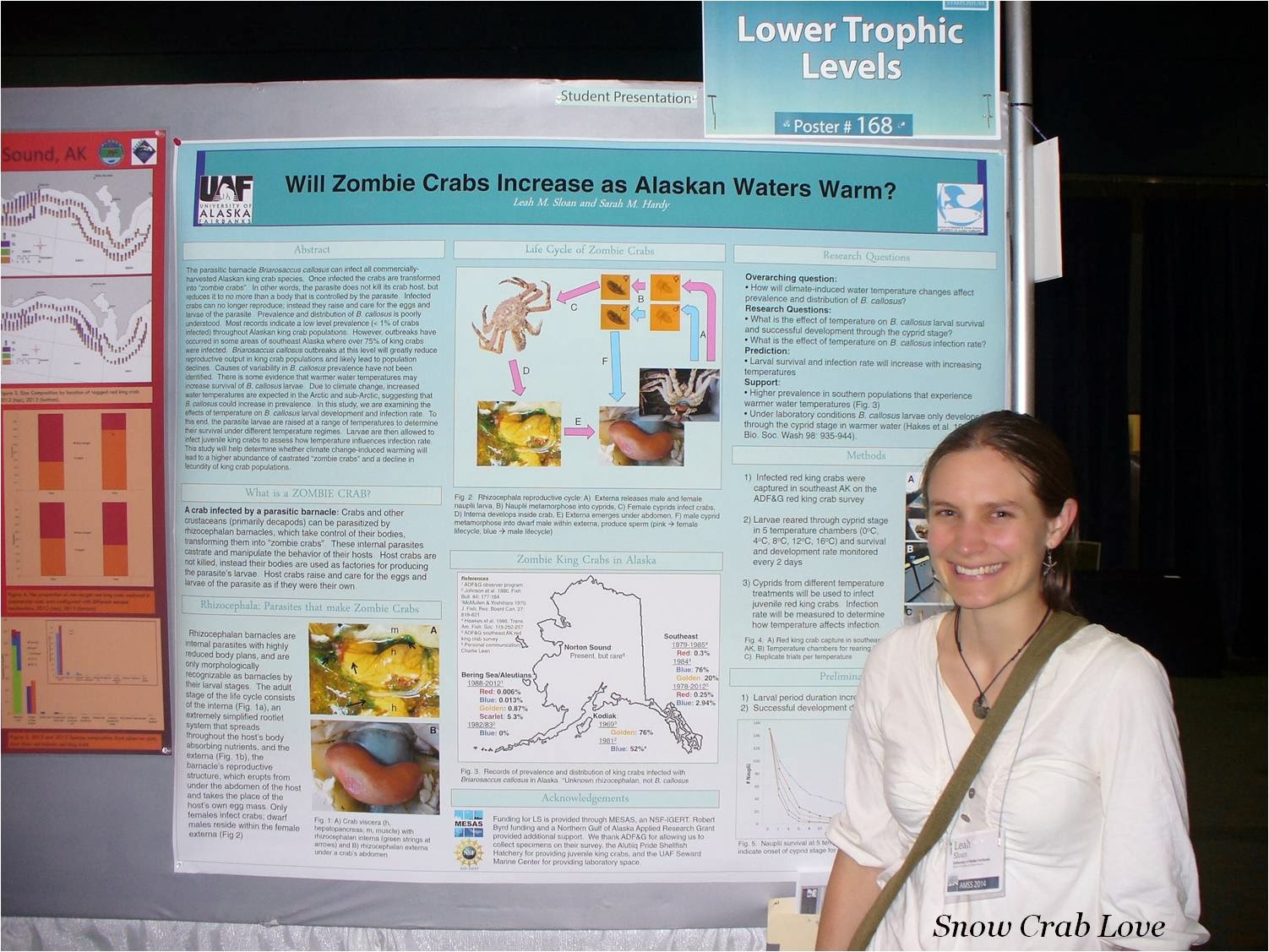
she had me at "Zombie"!

I took so many other crab notes, so we'll see if I can share them all with you over the next... year!?!? By then I'll be ready for another round of Marine Science Symposium fun!

Sunday, May 13, 2012

Can't blame your mom on this!

HAPPY MOTHER'S DAY!

We all have a lot to thank our moms for, but I know there are some out there who like to blame their moms for some things too. Like, "Don't blame me; I have my mother's sense of humor" or "I can't help it; I got my mom's lack of coordination" or "I'm getting my mom's butt!!!"

"I got my mom's pretty polka dots!" - Neopetrolisthes ohshimai
(OK, that's probably not the porcelain crab's mom,
but it definitely got the polka dots from someone)

It's no different for crab moms, but new research is showing that not all facets of baby crabs can be blamed on their moms. At this past year's Alaska Marine Science Symposium, two such studies looked at potential maternal effects on embryo quality, one in snow crab (Chionoecetes opilio) and the other in red king crab (Paralithodes camtschaticus).

"Eee! I'm a larval snow crab!"

Joel Webb looked at embryo size, dry weight, and chemical compostition (% carbon and nitrogen) in emryonic snow crabs to see if they varied depending on the size of their mothers. It's already known that multiparous mothers (those gals that have been around the block a few times) are more fecund than primiparous females (first-time moms). The question here was: will larger mothers make larger, healthier babies? He found that, for all quality measurements, there was little variation due to female size and shell condition. Ultimately, to answer his question: No.

Yay for opie moms!

Kathy Swiney looked at similar quality controls (size, weight, carbon and nitrogen content) from red king crab clutches. She also found that, while mothers may have been different sizes, the quality of larvae they produced was no different! (There were differences in carbon and nitrogen between years, but that's another story.)

(photos by Ben Daly and Celeste Leroux)

So there you have it: you may blame a lot on your parents, but if you're a crab baby, you can't blame your small stature on you mom!

You can read the abstracts from the link here:
Joel Webb et al.: Are all eggs equal? Maternal effects on embryo quality in the snow crab, Chionoecetes opilio. p. 162

Kathy Swiney et al.: Interannual and Seasonal Variability in the Size-Fecundity Relationship for Red King Crab (Paralithodes camtschaticus), with Considerations of Maternal Size effects on Embryo and Larval Quality. p. 64

Tuesday, February 7, 2012

It's all in the DNA

Have you ever found yourself with a water sample and thought, "I wonder if there are larval king crabs in here"? 

  
I see some!
(larval kings photo: Celeste Leroux)

Pam Jensen (et al.) did (from the RACE division of the Alaska Fisheries Science Center). So she developed a quantitative PCR assay to detect baby red king crabs (Paralithodes camtschaticus) and shared her work with us at the Alaska Marine Science Symposium. The "how did she do that" stuff is a little over my head, but the "why did she do that" is pretty neat: little is known about where the larval red king crabs are dispersed throughout the Bering Sea, but there are A LOT of water samples. The assay is used to screen for larval red king crabs so they can know which samples had crabs, and then they can figure out where there samples (and baby crabs) were found. Using the assay, they can detect 1/10,000th of a larva!

can you imagine 1/10,000th of one of these little guys?
(these are actually blue king crabs, fyi)

Yes, that's right: 1/10,000th! Of a larva! Those things are incredibly tiny!! That's like the ol' needle in a haystack problem, but you're Magneto so you can detect it like it's your job.

 
Molly: "I sense larval red kings over there"

Read more:
Pam's AK Marince Science Symposium abstract: Development of a Quantitative PCR Assay for Detection of Planktonic Red King Crab (Paralithodes camtschaticus) Larvae (click on the Abstract link to download the book of abstracts and find hers on page 63)

You can also see a poster she made on the subject here.

Friday, January 27, 2012

How to prepare and cook Dungeness crab

Paralytic shellfish poisoning (PSP) is a health concern with symptoms of numbness or tingling of the face, arms, and legs, dizziness, nausea, and, in severe cases, death. It's pretty prevalent in Southeast Alaska and you can get it from eating clams and mussels that have bioaccumulated neurotoxins produced by the microalgae Alexandrium sp. The neurotoxins don't lose potency just from freezing the meat or cooking it.

incidents of PSP, showing why people stick to the
'R' months when harvesting bivalves

Neurotoxins are also accumulated in crabs, although they're only found in crab viscera ("innards") and not the meat. This is why it's important to know how to properly prepare your Dungies before cooking and eating them. (Read more about PSP in Dungeness crabs Metacarcinus magister here.)

a lovely Dungeness crab complete with barnacle accessory!

The basic steps to properly, quickly, and safely killing and cleaning your Dungeness crabs are to:

1. Crack off the top of their carapace quickly. You can even see a depiction of this step by famed Alaskan artist Rie Muñoz here.

2. Clean out their internal organs - this is what kills them almost instantly because it quickly removes their heart and nerves (remember learning about crustacean nervous systems from this post?), and by removing their hepatopancreas and other innards you are removing your risk of PSP!

3. Crack the dead crab in half, leaving one claw and four legs on each half. Now you're ready to boil 'em for 5 -7 minutes!

perfectly cleaned, halved, and cooked

For a video, you can click on this link. It's a bit crude, but it shows how the guy can get the job done quickly. The crabs' legs twitch a bit after the fact, but that's just like how human bodies will twitch after they're dead sometimes, so even though in the comments section someone is complaining about the crab being alive after being gutted and halved, that's just not true.

ready to crack into!

I've seen videos and articles on boiling the crabs whole, and even heard a rant from Gordon Ramsay (on MasterChef) on the "inhumane" way of killing crabs by quickly splitting them in half rather than boiling them alive, but this is the best way to do it if you don't want to risk getting PSP.

don't worry, Gordon, I'm still a fan

Luckily for us, researchers are working on a PSP monitoring program to detect the two main players in Alaska, Alexandrium fundyense and A. ostenfeldii, by developing a quantitative molecular assay which can tell not only presence or absence, but also level of toxicity (I learned about it at the 2012 Alaska Marine Science Symposium). 

If you're not into killing your own crabs, no worries - canned crab is just fine, especially if it's not Dungie season in your area. Just promise me you won't use fake krab meat for anything other than a California roll. Remember, that stuff is surimi (mostly ground pollock).

OK, OK, even after observing pollock offloads at the 
Alyeska Plant in Dutch Harbor, I'll still eat this stuff!

So, now that you have your crab meat ready, have fun cooking any of these recipes:

Amalga crab cakes
Crab apple salad
Creamy crab and pepper spread

I'm going to post a couple recipes next week in preparation for Super Bowl Sunday, so keep an eye out for that too!

Tuesday, January 24, 2012

Boo!

During this past year's Interagency Crab Meeting, Bob Foy (the Kodiak lab director) briefly covered all the amazing crab projects being undertaken by NMFS at the AFSC in Kodiak. One study that caught my attention over the others was a tag/dive project looking at the incidence of commercially important crab in derelict pots. An equally interesting study caught my eye at the 2012 Alaska Marine Science Symposium: it was a side scan sonar/dive survey of derelict pots in Southeast Alaska. So let's compare ghost fishing between Womens Bay off of Kodiak and around Southeast AK, and its effects on red king crab and Dungeness crab stocks!

a ghost-fishing pot with its prize: a dead blue crab
(Callinectes sapidus) from Chesapeake Bay

You may remember this post about ghost fishing in Chesapeake Bay. Ghost fishing is when gear is lost and not retrieved in the water, but still intact enough to continue catching, and killing, animals. How many crabs are being caught by derelict pots in Alaska? Let's first look at Womens Bay:

The Kodiak project was a bit longer in scale, running from 1990 to 2008. Between that time, scientists dove on 614 lost pots and found tagged red king crabs (Paralithodes camtschaticus) in or around almost 10% of those lost pots! Of the 26 tagged crabs found, 12 were dead, including 4 mature females. Hundreds of untagged crabs were spotted as well.

a derelict pot and its king crab catch

The Southeast Alaska project ran during the summers of 2009 and 2010. First researchers used side scan sonar to identify potential pots, then they dove on the sites to confirm sightings (sometimes it was just a large rock) and retrieve the derelict pots. They found 206 pots at a density of 1 - 22 pots per square kilometer (0.4 - 8.5 square miles), and up to 50% of the pots had one or more Dungeness crabs (Metacarcinus magister) depending on the area surveyed.

watch out, little crab, you're about to be Casper-fished!

So how is this phenomenon of ghost fishing affecting the crabs overall? In southeast it's estimated that 1,812 Dungies are being caught in 1,675 pots yearly, which is less than 2% of the annual commercial harvest. But in Womens Bay, it's estimated that derelict pots kill between 6 and 12% of king crab per year! Ghost fishing is not just an issue around Kodiak and Southeast; an estimated 10,000 commercial crab pots may dot the sea floor across the Gulf of Alaska and Bering Sea. That's why it's so important for commercial and recreational crab fishermen to comply with regulations, whether it calls for 18 inches of biodegradable mesh or unobstructed escape rings on the side of a pot. In the Southeast study, 91% of the retrieved pots were in compliance with an escape mechanism. (Actually, 15% of the Southeast pots were still fishing because they were so old that marine biota had overgrown any possible escape routs!)

a nice lookin' pot with some Dungies off Oregon

Abstract fun:
Ghost Fishing on King Crab in Womens Bay
Peter A. Cummiskey, Eric Munk, and W. Christopher Long

Ghost Fishing in the Southeastern Alaska Commercial Dungeness Crab Fishery (click on the Abstract Book link)
Jacek Maselko, Gretchen Bishop, and Peter Murphy

Wednesday, January 18, 2012

Alaska Marine Science Symposium 2012

I'm having a great time at the Alaska Marine Science Symposium meeting up with friends, presenting my research, and learning A LOT! (And enjoying Anchorage's restaurants!)

king crab cakes eggs benedict from Snow City Cafe

I had a great time at the poster session seeing all the other snow crab posters as well as other crabby works (and, of course, all my fellow SFOS students' posters). I also had fun seeing all the Snow Crab Love mugs scooped up. I hope everyone likes them!

showing off my poster and mug at the symposium

with Sherry - makin' her proud!

Congratulations to Raphaelle Descoteaux, one of the poster session winners! Way to represent crab science! Her project is "Effects of ocean acidification on larval development in Alaskan crabs", and hopefully I can get an "Ask a Grad Student" interview with her later so you can learn more about it.

Chionoecetes bairdi larval stages (from here)

There's still Gulf of Alaska presentations to see tomorrow, but I'll be back with more crab knowledge gained from this meeting next week! See you then!

Friday, January 21, 2011

2011 Alaska Marine Science Symposium

Wow! I just got back from the 2011 Alaska Marine Science Symposium, and even though I was only there for 3 days, I learned A LOT! Here's some of what I caught:

CRABBY STUFF:

In some southeast Alaska sample regions, 100% of primiparous female Tanner crabs (Chionoecetes bairdi) are infected with Hematodinium, the parasitic dinoflagellate causing bitter crab syndrome (BCS) (Sherry Tamone, UAS)

Bering Sea primiparous female snow crabs (C. opilio) had lower sperm reserves compared to the Northwest Atlantic (Laura Slater, ADFG)

Reflexes of snow crab bycatch were impaired, and potential mortality increased, when windchill was < -10° C on commercial fishing boats (Dan Urban, NMFS)

so pumped and ready to talk about snow crabs!!

OTHER FUN TID BITS (taken directly from my notes):

Sea otters are not nutritionally equal to potato chips (James Estes, UCSC)

Not all bloody herring have VHS (viral hemorrhagic septicemia) (Paul Hershberger, USGS)

You can tag walruses with crossbows (Chadwick Jay, USGS)

seriously, crossbows!

I also ran into another Southampton College alum (other than my husband, who had a poster on organochlorine contaminants in Steller sea lion Eumetopias jubatus pups):

action shot: Adam talking with our friends and former NMFS observers

... my freshman roomie Stephanie Grassia, who works sighting bowhead whales and other marine mammals out of Barrow. This is why I love all these conferences!