Showing posts with label swimming crab. Show all posts

Wednesday, December 19, 2012

a sweet victory for bitter crabs

I recently visited family in Illinois and, while flying there, talked with a fellow passenger about bitter crab disease and the prevalence of it in southeast Alaskan Tanner crabs (Chionoecetes bairdi). In one area, the parasitic dinoflagellate affected 95% of the crabs, and that was back in 1987! Lately some southeast Alaskan populations had 100% of their primiparous females infected (Sherry Tamone talked about that at the Alaska Marine Science Symposium in 2011). Bitter crab is a problem in Alaska, but it is also affecting fisheries off Virginia and along the eastern coastal US, as well as in crab hatcheries in China and lobster populations in Scotland! What is causing this, and how is it spreading? What can fishermen do to quell the infection rate? And how can processors assist the fishermen in this effort?

 an infected Tanner crab (top) with milky hemolymph
and a healthy Tanner (bottom) with translucent hemolymph

Lots of questions, I know. Scientists have been feverishly researching Hematodinium sp, the dinoflagellate that is wreaking havoc on commercial crab species. A group of crab scientists at VIMS were able to trace the life history of Hematodinium sp. "[W]e can now really start picking the life cycle apart to learn what the organism does and how it functions," said Jeff Shields.

(Jeff Shields, VIMS)

The researchers noticed a pattern of development time in the dinoflagellate that correlates with cycles of infection in the field and molting of blue crabs (Callinectes sapidus). This knowledge enables them to make suggestions, at least in the realm of aquaculture, on how to avoid the spread of bitter crab by minimizing any effects the parasite could have on crabs during certain periods of both host and parasite life cycles. It seems small, but it's an important victory 15 years in the making in the battle against bitter crab disease!

Friday, September 28, 2012

The Weather Crab

Have you seen this crab yet? My friend Sean sent me this video of a weather-predicting blue crab (Callinectes sapidus) that's apparently giving Punxsutawny Phil a run for his money. (Fun side-note: they filmed Groundhog Day in Woodstock, Illinois, not too far from where I grew up, so I got to go with my 2nd grade class and watch some of the movie magic in action!)

Movie. Magic.

Our weather crab, Baltimore Bill, predicted that this winter will be an early one (as opposed to having a warm fall).

Baltimore Bill makes his 2012 prediction

So, is Bill right? This year we're shifting from La Niña to El Niño. What does that mean? At the equator it means that weather will shift from unusually cool temperatures to unusually warm temperatures. What about for the east coast? An El Niño winter is a wet one, or one having a high amount of precipitation. If it's a "weak" year, that'll mean low temperatures and A LOT of snow. If it's a "strong" El Niño year, it'll be warm with a few winter storms. Hopefully, for these kiddos, it'll be a weak El Niño bringing lots of snow days, and not one as fearsome as Chris Farley!

Friday, September 21, 2012

Did I mention I like to dance?

It's been a fun-filled family week for Snow Crab Love here in Juneau (hence the slow-down on posts) but I'm back today to share this video right on time for the weekend! It's sort of a follow-up video from Christopher Paparo on his photobombing lady crab: a male lady crab (Ovalipes ocellatus) showing off his moves!


Quite the twinkle toes, am I right? He could be the next Psy (minus the horses)!


Friday, September 14, 2012

Camera hog

Who knew lady crabs could be such camera hogs? Here's one photobombing like your drunk friend a pro while Fish Guy Christopher Paparo (a Long Islander with mad photography skillz) was video taping his favorite porgy spot:


I hope this inspires some fun Friday night shenanigans for you all. (And how's my photobombing ability you ask? Pretty good, I'd say. Pretty good.)

Friday, August 17, 2012

A day at the races

Here I was, going through Olympics withdrawal, when I did my usual "crabs" Google search and came across this gem:

CRAB DRAFT PICKS

Apparently assigning your fantasy football draft order is pretty tough (because, you know, it's so real. And important. Life changing even? Truth: I've never had a fantasy football team, but I might this year, so maybe after our draft picks I'll be singing a different tune.). ANYWHO, the Baltimore Orioles were in quite a tizzy about who got to go first, so to solve it they called upon the power of the crab!

"Put me in, coach!"

Darren O’Day, pitcher for the Orioles, decided the best way to go about this was pick up some blue crabs (Callinectes sapidus), assign each a person to represent, and have a good old fashioned crab race! Why crabs? Because, as O'Day put it, "That’s what you do in Maryland. Crabs and football[.]" Nice.

"I am a champion!" - Chris Davis’ crab

Crab racing - that competition I've been craving since the awesome Men's 4x400 quailfier when Manteo Mitchell broke his leg while running AND FINISHED! (The blue crab racers were awarded a little less brilliantly than Olympic athletes though: they were turned into crab dip.)

Friday, May 11, 2012

perfect Crabday for moms

Mother's Day is right around the corner! Have you gotten your mom something yet? Flowers? A card? This week's Crabday crab??

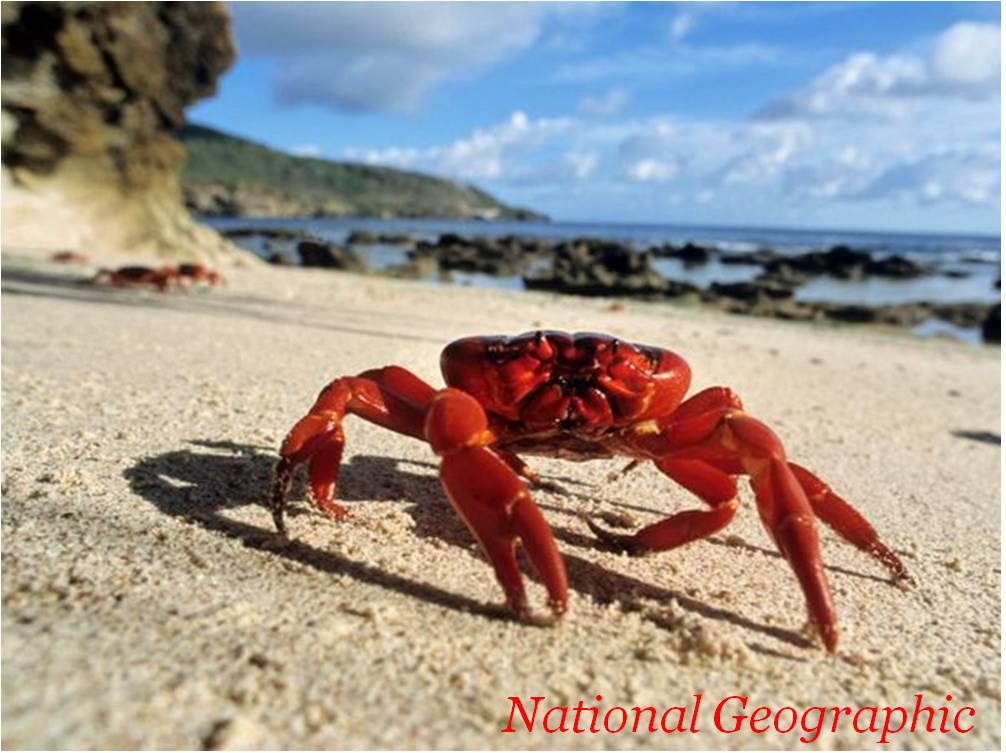
Chocolate Swimming Crab
Thalamita spinimana

"I love you THIIIIIIIS much!" - chocolate swimming crab

If I know moms, then I know what moms love: CHOCOLATE! So I figured what better crab to talk about than a chocolate one? Well, really it's called the red swimming crab, but we all know how common names vs scientific names work, and this guy has a chocolate-colored appearance, so I'm going with it! (You can see the brown hues better at this site.)

a red specimen showing off his beautiful spots

These guys like to hang out in tropical reefs, and because they have those modified 5th walking legs shaped like paddles, they can swim around and catch their prey! They are so good at hunting that they've even been described as "vicious"! And we all know moms can be vicious when blocked from their chocolate gifts.

 nom nom nom
(check out his chocolate spots!)

Well done, crabs. Well done.

Thursday, October 20, 2011

Alaska Day and Oil Spills

Happy (Belated) Alaska Day! It was on October 18th, so I'm a little late (again), but I hope everyone had a great day and a great week celebrating the 49th state! What did you do? I graded salmon and rockfish skeletons for how accurately each bone was identified (I'm TA-ing Ichthyology over at UAS)!

Since this Alaska Day is so close to the 18 month anniversary of the Deepwater Horizon oil spill (which occurred April 20, 2010), and Alaskans know a thing or two about the lasting effects of oil spills, I thought it'd be interesting to check in on how the Gulf of Mexico crustacean populations are doing today. Just because, you know, this happened:

a ghost crab on the shore line (picture from this photographer)

a dead blue crab floating in some oil

a little hermit crab trying to make its way through the muck

So what's happening now? A lot of the oil has been consumed by microbes (go microbes!) but there's still a layer of oil and ashes from the burned oil on swaths of the Gulf of Mexico sediment (via a report from the Gulf of Mexico Research Initiative, funded by BP). This layer could affect any benthic animal, like, say a crab, who may walk around and dig through the oil layer to forage for food. That foraging behavior was also a concern in Prince William Sound after the Exxon Valdez oil spill: researchers were worried about sea otters digging in the sediment for their prey and, in the process, dispersing the settled oil throughout the water column and onto themselves.

a ghost crab amid the oil, glowing under UV light
(to help with clean-up and all... the light, that is... not the crab)

Lingering oil may affect growth, reproduction, and ultimately survival, but Gulf of Mexico fisheries continue as long as the animals are deemed safe for consumption. It may be tricky to estimate spawning biomass for subsequent stocks, since there's little background data available about the spawning habits of crabs and shrimp around the Gulf, and so much is unknown about potential effects of oil on their reproductive physiology, but we'll just have to keep an eye on how those fisheries progress the next few years. There may still be hope: as far as crabs go, those that survived the spill may have one more trick up their sleeves:


For an interesting first-person account of an oil spill back in Alaska you can listen to Dune Lankard of Cordova's reaction to the Exxon Valdez oil spill here. Alaska Day: not just for celebrating, but also for learning!

Friday, September 30, 2011

Classy Lady... Crab

The ladies from my last post were classy, and so are this Crabday's crabs:

The Lady Crab!
Ovalipes ocellatus

the name's 'Lady', 'Miss Jackson' if you're nasty

Lady crabs roam all over the east coast from Georgia up to Canada! I saw them a lot when I was beachcombing on Long Island.

peek-a-... oh wait.

Another name for the lady crab is the calico crab (or the sand crab... so bland). Careful when you think of 'calico crabs' though, because O. ocellatus is not to be confused with another calico crab Hepatus epheliticus. The lady-crab-version of calicos are swimming crabs, like the blue crabs and devil crabs we've seen. (Unlike blue crabs, they're not really considered tasty, so humans leave 'em alone. Other animals eat them though, including lobsters!)

look at her pretty swimmerettes!
(photo from here)

Telling the two calicos apart is pretty easy. For one, the swimmerettes are kind of a give-away (H. epheliticus doesn't have them). But if that doesn't do it, just think: the lady/calico crab O. ocellatus has little dappled spots like an ocelot! Eh? EH?

you see it?

OK. So this crab may be a lady (though, obviously, there are male Lady Crabs... I think they prefer the name 'sand' in that case), but she's a fighter: these crabs are known to be aggressive, and are not afraid to use their sharp chelae in order to defend themselves.

Lady crab: "Poke me and find out what happens."

Stay classy, Lady Crab!

Wednesday, August 31, 2011

The Color Purple

When Jake Marzucco was fishing for blue crab (Callinectes sapidus), he never thought he would land a purple one! But land one he did in Chesapeake Bay. 

this blue crab is clearly having an identity crisis

This purple blue crab isn't as uncommon as you'd think, and may owe its purple hue to a genetic mutation. (BONUS: what sex is the above crab?) Another purple blue crab was caught a few years ago and said to be a Baltimore Ravens fan, but that's just ridiculous. All blue crabs are Chicago Bears fans, regardless of their pigmentation. I know this as fact.

See? This is an actual photograph from National Geographic showing the
blue crab's Bears preference. (Well, maybe the Bears logo is from here.)

Anyway, we've seen other odd-colored crustaceans with an albino blue crab here and a blue lobster and half-and-half lobster here. What you may not know is this blue crab was just trying to fill out the rainbow:

Monday, July 4, 2011

Happy Fourth!

Happy 4th of July!


I hope you are all having a fun and safe time celebrating the red, white, and blue!

Tuesday, May 31, 2011

Ghost Fishing

friendly ghost fishing?

Recently Virginia budgeted $3.5 million for a Marine Debris Removal Program in an effort to clean their waters of lost crab pots. These “ghost” pots, so called because they continue to trap and kill animals without their attending fishermen, were targeted as part of a larger ($15 million) project to restore the blue crab (Callinectes sapidus) population. What resulted was a 70-[water]man-effort pulling 24,859 crab pots from Chesapeake Bay and its tributaries over the past 3 years! In addition, 3,336 peeler and eel pots and 152 nets were removed.

Chesapeake Bay: red dots are buoyed crab pots,
peach dots are unbuoyed crab pots;

All the pots were located using side-scan sonar tracking. Fishermen who had been shut out of the crab dredge fishery, which had been closed in 2008, were offered the pot retrieval work, making this program not only help the benthic population but also the human population of Virginia.

a pile of pots

In both my work on a lobster boat in Long Island Sound and commercial fishing vessels in the Bering Sea, ghost fishing pots were hard to avoid. Bering Sea fishermen regularly find crab pots, lost due to storms or lines being cut from propellers or ice flows. When a pot was found, it was brought on board, the netting was cut so nothing else could be caught, and then it would be dumped at set locations where other fishermen throughout the Bering know to avoid (pretty neat, actually).

Bering Sea crab pot stuck in our net

Ghost fishing can be a huge problem for both healthy and recovering stocks; VIMS scientists supervising the Chesapeake Bay program estimated that each derelict pot can capture about 50 crabs each year it’s lost! Just within the last year of the Marine Debris Removal Program, 9,970 ghost pots were snagged with more than 11,000 animals trapped inside. Imagine how many animals will be saved, for future stocks and future managed harvests, now that the Chesapeake is without more than 28,000 pots!

dead blue crabs in a derelict pot

Thursday, April 28, 2011

Crabs: “Phuket or Bust”?

Millions of crab megolopae are washing up on shore in Phuket, Thailand! Why? I… I just don’t know.

um, I think you're lost, little megalopae

a closer view of the little guys

The crabs, originally reported as krill, are 2-3 mm long with a carapace width of about 1 mm. They were first noticed in the afternoon last Friday (April 22, 2011). The Phuket Marine Biological Center (PMBC) has been sampling the little guys from Kata and Karon beaches, as the crab babies have yet to be identified to species. The director of PMBC, Wannakiat Thubthimsang, noted that they are definitely swimming crabs, evidenced by the modification of the last pair of their legs to paddles (like blue swimming crabs Portunus pelagicus). Note: they may be just that.

ready: identify!

The scientists are looking into several causes, such as hypoxic water conditions, but some are attributing the presence of millions of crab babies to overfishing: normally fish will munch on these little guys, but with less fish comes less predation and greater planktonic crab survival. Others suggest that it may have just been a fluke: moms releasing their clutches at the wrong place and/or time.

A LOT of lost babies

The world may never know.

Monday, April 18, 2011

Celebrating Boston!

Today is that most special of special days for marathoners: BOSTON!

In honor of the oldest annual marathon (this is the 115th Boston Marathon!), I wanted to take a closer look at a Boston crab (no, not the wrestling position):

Blue Crab  
(Callinectes sapidus)!

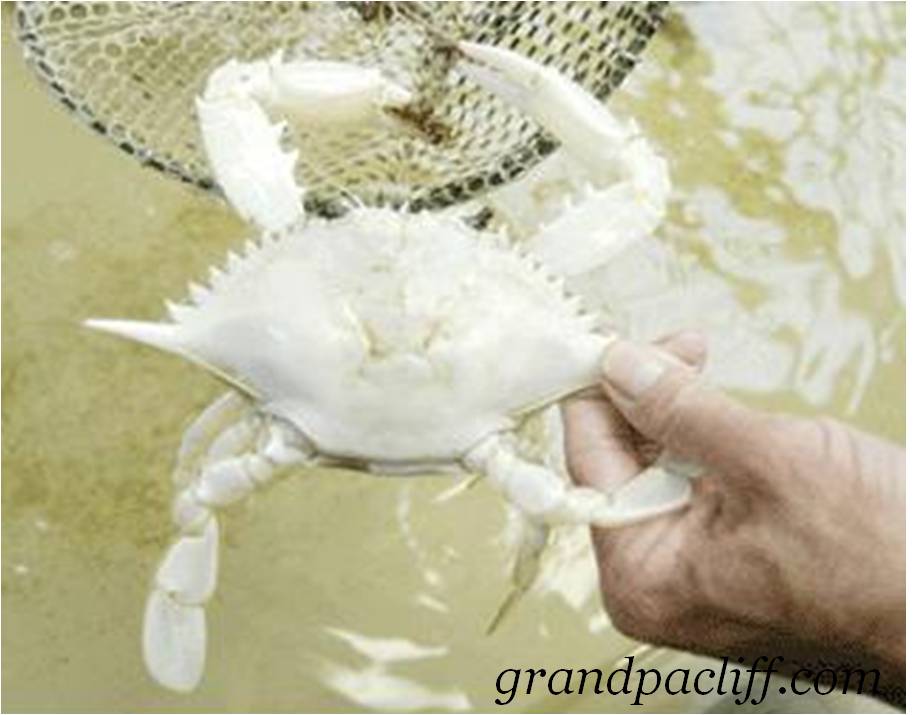
a beautiful Callinectes sapidus

What? An albino blue crab?? You know it!

You can fish for these while visiting Massachusetts. (Or you could try your hand at recreational lobstering, but all I have to say is good luck with that one!) These crabs are true athletes, although they are better known for their swimming abilities than marathon running. See their little paddles on their modified fourth walking legs? Their scientific name even refers to this, meaning "savory beautiful swimmer".

Here's a blue crab eating a clam (I wanted to post a video of one running/swimming, just to keep with the spirit of the day, but the original video was removed from youtube):


Yikes, I hope she waits before running after that meal!

Wednesday, January 12, 2011

What the devil?

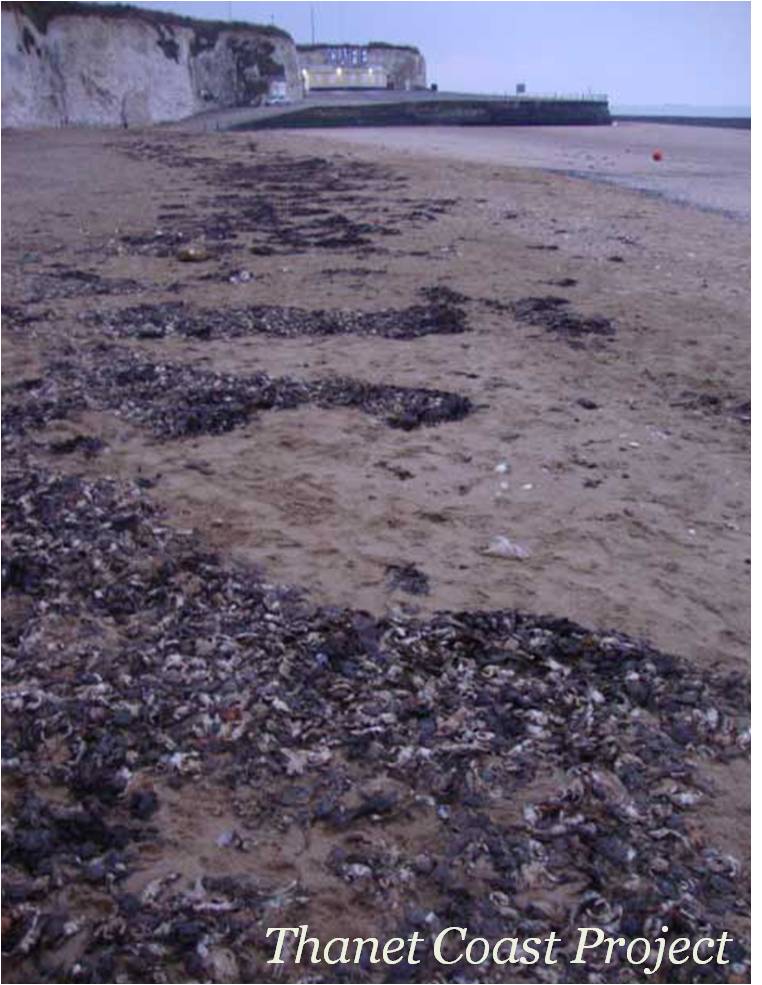
A friend of mine living in London alerted me to this story: thousands of velvet swimming crabs (Necora puber) have washed up on the Thanet shore for the third year in a row! One Thanet Coast local said that the arrival of dead velvet swimming crabs along the shore in winter is not that shocking; it is simply the number of crabs that is alarming for beach combers. Estimates range from 25,000 to 40,000 dead crabs. Also among the mix are sea stars and anemones.

Thanet Coast starred

velvet swimming crab carnage

Nicknamed the devil crabs because of their red eyes, these little guys may have succumbed to Britain’s coldest December in 120 years. The velvet swimming crab is the largest swimming crab in British waters with a carapace width reaching 8 cm (3.15 in). In comparison, blue crabs Callinectes sapidus grow to about 9.06 in. Velvet swimming crabs are blue in color, but appear brownish because of their brown hairs, leading to their velvety texture.

two "devil crabs" in happier times

At first, scientists were testing for possible viruses affecting the crabs. Declines in their French population were linked to possible Hematodinium infections – Hematodinium is a parasitic dinoflagellate responsible for bitter crab disease in Chionoecetes bairdi and C. opilio in Alaska (as well as several other crustaceans). There were massive mortalities of the devil crabs linked to these dinoflagellate infections in Mor-Braz, France.

Mor-Braz (south Brittany, France): sight of more crab deaths

The British scientists concluded that it was more likely the crabs off the Thanet Coast were dying from hypothermia due to sudden drops in temperature. In a quick search I had trouble finding in what optimal temperature range juvenile and adult N. puber thrive, but in some lab experiments they’ve been held at 17 ± 1° C. Lowest lethal temperature noted for embryonic development was measured from 2 to 4° C. Does anyone know the sea surface temps for that coast in December?

coastline of crabs

In any case, I’d just like to extend a “Good Luck” to Necora puber!


Velvet swimming crab literature:

Valdes, L., M. T. Alvarez-Ossorio, and E. Gonzalez-Gurriaran. 1991. Influence of temperature on embryonic and larval development in Necora puber (Brachyura, Portunidae). Journal of the Marine Biological Association of the United Kingdom 71: 787-789.

Wilhelm, G., and E. Mialhe. 1996. Dinoflagellate infection associated with the decline of Necora puber crab populations in France. Diseases of Aquatic Organisms 26: 213-219.