Showing posts with label king crab. Show all posts

Friday, July 18, 2014

a little extra crab with this king

My friend was out on a crab survey this summer and spotted this guy:

Paralithodes camtschaticus

Nothing out of the ordinary, right? EXCEPT FOR THESE:

WHAT?!?!?

We've seen extra appendages before (here and here). They most often are a result of some trauma to that leg that the crab's physiology tries to heal through regeneration (remember, crabs can rebuild entire legs!) that goes awry. When my friend posted these photos, someone asked if they were mobile or able to move independently. While I wasn't there, allow me to speculate: these bonus crab bits are just that. Bonus. The crab can't control their movement (you can see that they don't have actual joints, just the impression) and if the leg gets dropped for whatever reason and is regenerated, it likely won't have those mutations the second time around. BUT it would be cool if they could move, because imagine how much more scary that would make this guy:

"I pinch, twice!" - mutant crab

Katie, please feel free to let me know if I'm wrong! (Fingers crossed!)

Thursday, February 6, 2014

Anchorage Crab Extravaganza!

Last week 2 weeks ago (time flies!) I attended the 2014 Alaska Marine Science Symposium, and boy was it crab-tastic! I went to present a couple posters on my work with the Gulf of Alaska Project (my portion is studying baby fish body condition), but you better believe I stopped at all the crab posters I could find!

Here's a run-down of some of the neat crabby things I learned:

Snow crabs are loving detritus up in the arctic! Lauren Divine looked at Chionoecetes opilio stomach contents from crabs collected in the Chukchi and Beaufort Seas. Along with detritus, crabs were eating polychaetes, bivalves, brittle stars (you can see a pile of them from this post), and other crabs including opies!

Lauren showing off her poster and special friend

that's a larger-than-life snow crab ready to show you...

...its stomach contents!

Alaska Department of Fish and Game is mapping Tanner crab (Chionoecetes bairdi) habitat to better understand their distribution off of Kodiak. The fun part of this: underwater pictures of crabs in action!

(download the abstracts here)

Ocean acidification will affect larval Tanner crabs as the ocean's pH drops. Here's Chris Long presenting his work where they exposed brooding females to different levels of pH (the lower the pH, the more "acidified" the water is). The greatest effect was toward larval survival. He also gave a talk on how a similar experiment affected the embryos of Tanner crabs (there's a difference... I can explain further if you'd like) and they weren't doing too well either.

over-achiever: giving a poster presentation AND a talk!

Remember how I said aging crabs was near-impossible? Alexei Pinchuk, Ginny Eckert, and Rodger Harvey are out to prove me wrong!

"Development of Biochemical Measures of Age in the Alaskan Red King Crab:
Towards Quantifying Thermal Effect on Aging"

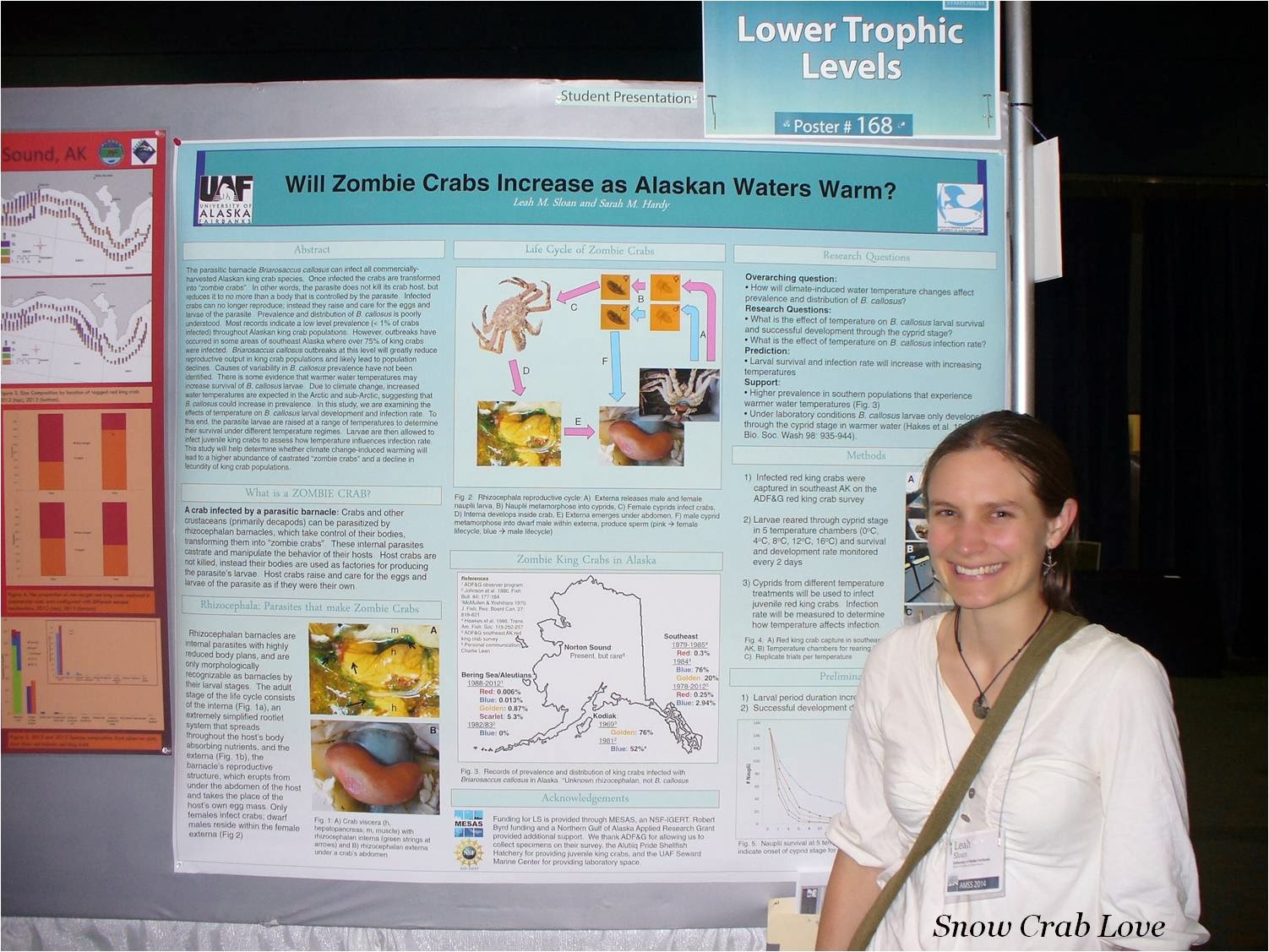
Last but not least, I learned about ZOMBIE CRABS!!! (No, not these zombie crabs.) Leah Sloan, a UAF grad student, is looking at the distribution of that nasty parasite, the rhizocephalan, and how it may be affected by temperature. The infected king crabs she's studying are referred to as 'zombie crabs' because their bodies have basically been hijacked by the parasite to be a walking, eating, parasite-brooding machine! She's answering her temperature question by exposing larval rhizocephalans (aka parasitic barnacles) to different temperatures and tracking their survival. I'll interview her soon for an "Ask a Grad Student" post so we can all learn more.

she had me at "Zombie"!

I took so many other crab notes, so we'll see if I can share them all with you over the next... year!?!? By then I'll be ready for another round of Marine Science Symposium fun!

Tuesday, October 8, 2013

What's goin' on

It's almost snow, Tanner, and red king crab season! The opening is October 15th! The limit for Bristol Bay red king crab is 8.6 million pounds and the reopened Tanner crab fishery is 3.1 million pounds. The snow crab quota almost 54 million pounds (down a but from last year's 66.3 million pounds) - they're kind of a big deal!

Are you ready? More importantly, are the fishermen?

(Turn off the closed captioning by hitting the "CC" icon for easier viewing.)

Mark Begich commented on the importance of the fishing permits: “These permits take hours to process. The paperwork trail is important so we know it’s not illegal crab caught by fish pirates on the other side of the Bering Sea. The paperwork trail helps Americans know the crab we’re eating is safe."

it's a tough job, but someone's got to do it!

Special Note: This is currently happening in Alaska. This post takes no political sides. This post is only to share information regarding the Alaskan crab fisheries. Please, no negative comments!

Tuesday, July 30, 2013

Friday Fun at NOAA

Last Friday (July 26th) was the Ted Stevens Marine Research Institute open house, and man was it fun! The lab hosted tours, an interactive touch tank, NOAA partners in research and management, and had yummy refreshments courtesy of the Ted Stevens Foundation. I was on aquarium duty, so I got to meet people right as they came in and answer any questions they had about the fish, crabs, and other animals in the facility's aquaria. If you didn't have a chance to make it out, don't worry: I took notes!

The TSMRI (that's our little acronym for this lab... scientists and their abbreviations, amirite?) entrance has these lovely metal "walls" that line the sidewalk leading to the front doors. They make me smile with their shiny rockfish and herring, but what really catches my eye is the little metal Dungeness crab.

see it?

oh, why thank you, welcome crab!

What can I say, I love metal dungies! Even nerdy Lord-of-the-Rings-referencing ones. Moving in to the building you are greeted with our largest aquarium (there are three more around the back). It holds several species of rockfish, some sculpins, sablefish, dolly vardin, kelp greenlings, and a lingcod.

lots of things to ooh and aah over

It also currently holds some snazzy red king crabs (Paralithodes camtschaticus) and some cheeky Dungeness crabs (Metacarcinus magister)!

Hi, gorgeous!

SFOS student Jennifer Stoutamore took time to say "Hi"
to her fellow king crabs on her way to the UAF table

this Dungy was photobombed by a greenling

Aside from the aquarium and the great tours through the lab, the touch tank was a huge crowd pleaser! It was stocked with sea stars, sea cucumbers, hermit crabs, lyre crabs, Tanner crabs, urchins... the list goes on and on!

holding a hermit crab - outreach in action

a Tanner crab (Chionoecetes bairdi) showing off
his perfect M-shaped mouth and bright red eyes

Check out KTOO's coverage of the event here to see more photos and hear the open house in action. Thanks for stopping by!

Monday, May 27, 2013

How low can they go?

You didn't think I forgot about answering the questions from our crab chat did you? Nope! The next question to answer is:

Just how deep in the ocean do king crabs and snow crabs live?

To answer this I looked at the crab survey data from 2012. This is only looking at Bering Sea crabs in summer, so it's a little limited, but I figured it was a great place to start. Here's what I learned:

King crabs really stay out of each others' way! Every sampling location that found red king crabs was absent of blue king crabs. Also, on average, blue kings were found deeper in the Bering Sea than red kings; the average blue king crab depth was 87.6 meters (287.5 feet) and the average red king crab depth was 51.7 meters (169.7 feet). This was interesting to me because the bycatch of blue king crabs in red king crab fisheries has closed down red king fisheries in the past (due to low blue king crab abundance), but it would seem that for the summer of 2012 that might not have been a concern.

Heading deeper into the Bering Sea, I found the Chionoecetes crabs! Both Chionoecetes bairdi and Chionoecetes opilio liked an average depth around 91 meters (91.5 m and 91.4 m, respectively), which is close to 300 feet. Unlike the king crabs, these Chionoecetes cousins hung out together quite a bit, which isn't too shocking since they're known to hybridize.

gross

The thing that caught my eye with hybrid Tanner crabs was that their average depth was slightly shallower than the two "pure blooded" crabs (88.1 meters). If I didn't have a real job, I would look into the sex distribution of male and female bairdi and opilio crabs and compare that to the distribution of hybrids to finally answer who's mating with whom. Anyone else want to check it out!?!? Let me know. (Seriously. I'm totally interested.)

average depths (in meters) for the locations where red king crab,
blue king crab, Chionoecetes bairdi, C. opilio, or their hybrids were present

The other thing that caught my eye is that hybrid crab presence was NOT dependent on both "pure" crabs being there (during the survey, that is). Of the 157 sites that had hybrids, 25 sites were missing on of the original species. Plus, there were 70 sites that had both bairdi and opilio crabs but no hybrids. (Fun fact: those sites had a deeper average at 107.4 meters.)

So, that's how low king crabs and snow crabs can go! For perspective, if the Bering Sea's depth was in line with a football field, red kings would make it just past the 50 yard line while blue kings and hybrid Tanners would be in the red zone. But bairdis and opilios would go ALL. THE. WAY!!!

Tuesday, April 23, 2013

King crabs are red,

King crabs are blue,
Poems are hard,
Bacon.

It's time to answer another crab chat question:

What's the difference between red and blue king crabs (aside from color)?

Red king crabs and blue king crabs have 4 pairs of legs (6 walking legs and two claws) unlike snow crabs and Tanner crabs, which have 5 pairs of legs. The neat thing about kings is that they're NOT symmetrical! Think about your average crab (or human, horse, dog, fish, etc): when you visually slice it in half, each side is the same, albeit opposite. But not our friends, the king crabs! They have asymmetrical abdomens which are possibly derived from hermit crab ancestors (remember how hermit crab abdomens curve to the left, to the left?) (Remember how I'm cool because I reference Beyoncé songs in my nerdy crab blog?

A female king crab's abdominal flap is made up of 7 segments,
but they aren't all the same shape or size!

That's what they have in common, but you wanted to know what makes them different. One of the main differences, aside from color, is size. Blue king crab males can grow up to 18 pounds, which is pretty awesome for any crab, but red king crab males can get even bigger: up to 24 pounds with a leg span of 5 feet! Another physical difference is the number of spines they have on their rather spiny carapace. If you focus in on just the mid-dorsal plate of the king crab carapace, you'll notice a grouping of prominant spines. When you count 4 spines, you're looking at a blue king crab; you've got a red king crab when you count 6 spines. Now, this is not always true (there are rebel crabs out there that don't like to live by the rules and will rock 5 spines), but when in doubt, do a quick count! For example, I shared this photo of a king crab my husband came across that had been baking in the sun in Russia:


I foolishly just called it a red king crab (because I, equally foolishly, thought they only had red kings in Russia), but was promptly corrected. On closer investigation, I could see the 4 mid-dorsal spines!

Blue king crab it is!

That geographical mistakes leads me to another difference: while we can find both red and blue king crabs in Alaskan waters, their distributions are pretty different. Red king crabs are pretty well spread out with open commercial or personal use fisheries in southeast Alaska, Bristol Bay, and Norton Sound. Blue king crabs have a patchier distribution and their populations have such low numbers that all of their fisheries are closed.


Of course, considering all of these differences, it's still pretty awesome to see how brilliantly blue a blue king crab is compared to its red cousin!

One crab, Two crab, ↑Red crab, ↓ Blue crab

A good field guide (and the source of the abdomen pictures):
Donaldson, W. E., and S. C. Byersdorfer. 2005. Biological Field Techniques for Lithodid Crabs. University of Alaska Sea Grant. AK-SG-05-03, Fairbanks.

Tuesday, September 4, 2012

Crab Chat

I had another fun opportunity to chat with fans of Deadliest Catch last week. Boy, did we cover A LOT in 2 hours! Aside from funny snow crab mating behaviors, temperature dependent reproductive cycles, and just how many babies a snow crab female can make, here's a break-down of some topics we talked about:

Do we have to worry about mercury in crabs like we do mercury in fish?

We worry about mercury in tuna, swordfish, and even salmon because they're large fish that eat other fish and bioaccumulate methylmercury. In the case of tuna and swordfish, their long lives only help to increase this accumulation. Since crabs aren't really eating much fish (they prefer clams, mussels, and worms), we don't need to worry about mercury building up in their little bodies. The US limit for mercury is 1.0 parts per million, but crabs rarely are measured over 0.4 ppm with average king crab levels at 0.09 ppm and average Tanners (potentially including both Chionoecetes bairdi and C. opilio) at 0.15 ppm (see Table 3 here). American lobsters (Homarus americanus) seem to be the only crustacean with the ability to accumulate a higher level of mercury above the US limit, but their average is still maintained around 0.31 ppm. Overall, the answer is "No", we don't have to worry too much about mercury in crabs.

Why aren't blue king crabs fished as much as red king crabs?

It's not that blue king crab are hard to get to or just in the northernmost Bering Sea and Russia, making them difficult to fish due to sea ice coverage; blue kings have a wide distribution like red king crabs. The reason they're not fished is because they're so rare and few in numbers. You can see the density of blues from the National Marine Fisheris Service summer 2011 survey in the draft report here (go to page 53).

blue's range in yellow: you can see them in Southeast Alaska,
by the Pribs and St. Matt's, and near Norton Sound

What's Sig Hansen's crab dip recipe?

Oh man, we were talking A LOT about food! I love cooking and trying different recipes, whether they use crab or otherwise. Someone mentioned that Captain Sig has a crab dip recipe that he likes to make, and I for the life of me can't find it in the interwebs. The closest I got were these two clues:

A. "I like to just make a crab dip, just a regular spread. I bake it with cheese and bread crumbs on top. We like to watch a movie and have some crab dip." - Sig Hansen, from an interview by Hannah Sentenac

B. He apparently told a Swedish journalist (at CatchCon?) that he likes 'a hot crab dip with artichoke and a layer of cheese melted on top' - from a CatchCon recap by April MacIntyre

OK, I like the sound of the second one: gotta love bonus artichokes. I found a couple recipes, one super simple and one that reminded me of a halibut recipe I learned when I lived in Unalaska, so I'm going with the second one (found here, but modified a little):

Hot Crab and Artichoke Dip

Ingredients
1 (14 ounce) can artichoke hearts
1 cup lump crabmeat
1 cup grated parmesan cheese
1 cup sour cream
1 cup mayonnaise
1 clove garlic, crushed
1/4 teaspoon cayenne pepper, or to taste
bread crumbs

Directions
1. Preheat the oven to 350 degrees F.
2. Drain the artichokes, then chop them.
3. Mix with the other ingredients, transfer to an ovenproof dish.
4. Sprinkle with bread crumbs and bake for 15-20 minutes, until golden and bubbly.

If you know the real recipe let me know, but I'm super excited to try this one out!

Are you a Star Trek fan?

One funny thing to come out of Thursday's chat was the realization that most of us were also Star Trek fans! Is there some connection between crab fishing and deep space exploration??

"My tea (Earl Grey, hot) is so much better in this
Snow Crab Love mug!" - Capt. Picard

Thank you again, F/V Seabrooke fans and Deadliest Catch fans! I had a great chat with you and look forward to any future opportunities to talk shop crab with you!

Sunday, May 13, 2012

Can't blame your mom on this!

HAPPY MOTHER'S DAY!

We all have a lot to thank our moms for, but I know there are some out there who like to blame their moms for some things too. Like, "Don't blame me; I have my mother's sense of humor" or "I can't help it; I got my mom's lack of coordination" or "I'm getting my mom's butt!!!"

"I got my mom's pretty polka dots!" - Neopetrolisthes ohshimai
(OK, that's probably not the porcelain crab's mom,
but it definitely got the polka dots from someone)

It's no different for crab moms, but new research is showing that not all facets of baby crabs can be blamed on their moms. At this past year's Alaska Marine Science Symposium, two such studies looked at potential maternal effects on embryo quality, one in snow crab (Chionoecetes opilio) and the other in red king crab (Paralithodes camtschaticus).

"Eee! I'm a larval snow crab!"

Joel Webb looked at embryo size, dry weight, and chemical compostition (% carbon and nitrogen) in emryonic snow crabs to see if they varied depending on the size of their mothers. It's already known that multiparous mothers (those gals that have been around the block a few times) are more fecund than primiparous females (first-time moms). The question here was: will larger mothers make larger, healthier babies? He found that, for all quality measurements, there was little variation due to female size and shell condition. Ultimately, to answer his question: No.

Yay for opie moms!

Kathy Swiney looked at similar quality controls (size, weight, carbon and nitrogen content) from red king crab clutches. She also found that, while mothers may have been different sizes, the quality of larvae they produced was no different! (There were differences in carbon and nitrogen between years, but that's another story.)

(photos by Ben Daly and Celeste Leroux)

So there you have it: you may blame a lot on your parents, but if you're a crab baby, you can't blame your small stature on you mom!

You can read the abstracts from the link here:
Joel Webb et al.: Are all eggs equal? Maternal effects on embryo quality in the snow crab, Chionoecetes opilio. p. 162

Kathy Swiney et al.: Interannual and Seasonal Variability in the Size-Fecundity Relationship for Red King Crab (Paralithodes camtschaticus), with Considerations of Maternal Size effects on Embryo and Larval Quality. p. 64

Tuesday, April 10, 2012

Waiter, there's a crab in my bivalve!

Last Crabday's shellback crab got me thinking (and hungry): how would a crab-stuffed clam taste? I'm just guessing, but I'd say AMAZING! And while I'm not about to head out and go digging for clams around here (call me Miss Cautious, but paralytic shellfish poisoning is pretty prevalent up here and kind of freaks me out), this recipe from Food Network caught my eye:

Stuffed Razor Clams with Alaskan King Crab Rice Filling

Ingredients
  • 2 tablespoons oil
  • 1 tablespoon finely chopped fresh garlic
  • 1 tablespoon finely chopped fresh ginger
  • 6 razor clams (make sure it's a real razor clam, and not a robot!)

a razor clam and its roboclam counterpart

  • 1/2 cup scallions, white and green parts, sliced 1/4-inch thick
  • 2 tablespoons chopped fresh cilantro
  • Salt and freshly ground black pepper
  • 1 cup short grained sushi rice, washed, cooked and cooled, as for sushi
  • 1 cup coarsely chopped Alaskan king crab meat
  • 1 1/2 quarts water mixed with a pinch of sea salt and 1 sheet of nori (the original recipe calls for actual sea water mixed with a cup of bull kelp... so go crazy if you can rock that ingredient!)

Directions
Shuck, clean, and chop the razor clams. Reserve the shells and about 1 cup of the clam meat.

(image found here, with another tasty lookin' recipe)

Wash, cook, and cool the sushi rice just like you would for sushi. You'll want about 2 cups cooked rice for the stuffing.

Heat the oil in a wok over high heat. Add the garlic and ginger and stir-fry for about 2 minutes until soft. Add the chopped razor clam meat, scallions, and cilantro. Season with salt and pepper, to taste, and mix lightly. Fold the mixture into the rice with the chopped crab meat.

Divide the filling among 6 razor clam shells (I'm imagining that you'll actually have a total of 12 things since you can fill each half separately). Pour water/nori mixture into a wok fitted with a steamer. Bring the water to a boil and place the stuffed clams in the steamer. Cover the steamer and cook until heated through, about 10 minutes.

how I imagine this dish might look
(baby crab picture by Jon Felis)

Let me know how it turns out if you try this recipe, or any other crab+bivalve combo!

Tuesday, February 7, 2012

It's all in the DNA

Have you ever found yourself with a water sample and thought, "I wonder if there are larval king crabs in here"? 

  
I see some!
(larval kings photo: Celeste Leroux)

Pam Jensen (et al.) did (from the RACE division of the Alaska Fisheries Science Center). So she developed a quantitative PCR assay to detect baby red king crabs (Paralithodes camtschaticus) and shared her work with us at the Alaska Marine Science Symposium. The "how did she do that" stuff is a little over my head, but the "why did she do that" is pretty neat: little is known about where the larval red king crabs are dispersed throughout the Bering Sea, but there are A LOT of water samples. The assay is used to screen for larval red king crabs so they can know which samples had crabs, and then they can figure out where there samples (and baby crabs) were found. Using the assay, they can detect 1/10,000th of a larva!

can you imagine 1/10,000th of one of these little guys?
(these are actually blue king crabs, fyi)

Yes, that's right: 1/10,000th! Of a larva! Those things are incredibly tiny!! That's like the ol' needle in a haystack problem, but you're Magneto so you can detect it like it's your job.

 
Molly: "I sense larval red kings over there"

Read more:
Pam's AK Marince Science Symposium abstract: Development of a Quantitative PCR Assay for Detection of Planktonic Red King Crab (Paralithodes camtschaticus) Larvae (click on the Abstract link to download the book of abstracts and find hers on page 63)

You can also see a poster she made on the subject here.

Tuesday, January 24, 2012

Boo!

During this past year's Interagency Crab Meeting, Bob Foy (the Kodiak lab director) briefly covered all the amazing crab projects being undertaken by NMFS at the AFSC in Kodiak. One study that caught my attention over the others was a tag/dive project looking at the incidence of commercially important crab in derelict pots. An equally interesting study caught my eye at the 2012 Alaska Marine Science Symposium: it was a side scan sonar/dive survey of derelict pots in Southeast Alaska. So let's compare ghost fishing between Womens Bay off of Kodiak and around Southeast AK, and its effects on red king crab and Dungeness crab stocks!

a ghost-fishing pot with its prize: a dead blue crab
(Callinectes sapidus) from Chesapeake Bay

You may remember this post about ghost fishing in Chesapeake Bay. Ghost fishing is when gear is lost and not retrieved in the water, but still intact enough to continue catching, and killing, animals. How many crabs are being caught by derelict pots in Alaska? Let's first look at Womens Bay:

The Kodiak project was a bit longer in scale, running from 1990 to 2008. Between that time, scientists dove on 614 lost pots and found tagged red king crabs (Paralithodes camtschaticus) in or around almost 10% of those lost pots! Of the 26 tagged crabs found, 12 were dead, including 4 mature females. Hundreds of untagged crabs were spotted as well.

a derelict pot and its king crab catch

The Southeast Alaska project ran during the summers of 2009 and 2010. First researchers used side scan sonar to identify potential pots, then they dove on the sites to confirm sightings (sometimes it was just a large rock) and retrieve the derelict pots. They found 206 pots at a density of 1 - 22 pots per square kilometer (0.4 - 8.5 square miles), and up to 50% of the pots had one or more Dungeness crabs (Metacarcinus magister) depending on the area surveyed.

watch out, little crab, you're about to be Casper-fished!

So how is this phenomenon of ghost fishing affecting the crabs overall? In southeast it's estimated that 1,812 Dungies are being caught in 1,675 pots yearly, which is less than 2% of the annual commercial harvest. But in Womens Bay, it's estimated that derelict pots kill between 6 and 12% of king crab per year! Ghost fishing is not just an issue around Kodiak and Southeast; an estimated 10,000 commercial crab pots may dot the sea floor across the Gulf of Alaska and Bering Sea. That's why it's so important for commercial and recreational crab fishermen to comply with regulations, whether it calls for 18 inches of biodegradable mesh or unobstructed escape rings on the side of a pot. In the Southeast study, 91% of the retrieved pots were in compliance with an escape mechanism. (Actually, 15% of the Southeast pots were still fishing because they were so old that marine biota had overgrown any possible escape routs!)

a nice lookin' pot with some Dungies off Oregon

Abstract fun:
Ghost Fishing on King Crab in Womens Bay
Peter A. Cummiskey, Eric Munk, and W. Christopher Long

Ghost Fishing in the Southeastern Alaska Commercial Dungeness Crab Fishery (click on the Abstract Book link)
Jacek Maselko, Gretchen Bishop, and Peter Murphy

Friday, November 4, 2011

BKC!

What's BKC, you ask? Why, it's today's Crabday friend:

Blue King Crab
Paralithodes platypus

The blue king crab (BKC) is called P. platypus because it is the one crab that has webbed dactyls and a duck bill:


Ha, no. No, that's not true. You got me!

BKC range throughout the Bering Sea and down through southeast Alaska. In Juneau, they like to hang out by bronze statues of Alaskan fish and kelp.

nice spines!

Whoa, no! That's not true either! That "crab" is really our artsy BKC geneticist Jen Stoutamore, donning her AMAZING Halloween costume. She loves blues as much as I love opies, if you can believe it!

not a P. platypus but a creative H. sapiens

OK, so seriously, BKC are an important crab in Alaska. They've had several fisheries opened and closed throughout their range. Most notably, the Pribilof Island fishery was closed in 1999, which affects other fisheries that may scoop up blues as bycatch. Because of their population declines, there's been quite a bit of research on 'em popping up: remember these SFOS students' presentations from here?

true blue from Saint Matthew

One population of BKC is all the way up in the Bering Strait, chillin' around Little Diomede Island and King Island (off the Seward Peninsula). That's where Heidi Herter et al. and friends recently looked at size and fecundity of male and female P. platypus.

Alaska with Little Diomede and King Island under the yellow star
and the Pribilof Islands under the dark blue star

They found that these more northerly crabs were smaller than their Pribilof counterparts (which we've seen with snow crabs here), and as such, the females produced less eggs and subsequently released fewer larvae. Interestingly, the decrease in numbers from eggs to larvae (not all embryos make it to the larval stage) was similar between Pribilof BKC and Bering Strait BKC (32% and 30%, respectively).

Oh, BKC, you never fail to amaze me!
(Remember this guy and his eelpout friend from this post?)

Read more:
Herter, H., B. Daly, J. S. Swingle, and C. Lean. 2011. Morphometrics, fecundity, and hatch timing of blue king crabs (Paralithodes platypus) from the Bering Strait, Alaska, USA. Journal of Crustacean Biology 31: 304-312.