Showing posts with label Alaska. Show all posts

Monday, January 26, 2015

Crabs rock!

Check out this awesome Alaskan rock formation:

Choris Peninsula, Kotzebue Sound "Crab Claw"
66 16.020 N, 161 54.520 W

It's from the Alaska ShoreZone Coastal Mapping and Imagery program, which has tasked itself with documenting geographic and biological resources along the 6,640 miles of Alaskan coastline! (That's more miles than the rest of the coastal states combined!) From the ShoreZone description of this shot: "One of the few rock outcrops in Kotzebue Sound, near the south end of the Choris Peninsula. The bedrock is resistant to erosion and stands as near vertical rock cliffs." Now that's a large claw if ever I saw one!

(If you watch this video, you can see the helicopter footage of the Crab Claw at 42:40!)

Monday, October 20, 2014

National Seafood Month

Many of you know I LOVE October. I continually sing, "It's the most wonderful tiiiiime of the yeeeeear!" and I'm not talkin' about Christmas, y'all! Among all the reasons I love October (fall colors, Halloween, crab season openers), I just learned it's also National Seafood Month! Yes, not only should you be celebrating everything pumpkin, but also everything locally harvested from Alaskan waters! And to learn more about local seafood, you can read this Seafood 101 pamphlet. The link will bring you to the layout and you can zoom in to read the different articles. Who knows, it may even inspire your next Halloween costume:


"Bering Sea or bust!"

Happy National Seafood Month!

Saturday, October 12, 2013

Gulf Life

I finished last month doing something that I love: being at sea playing with fish! I was on the Oscar Dyson for work with the Gulf of Alaska Project (my little part of that big project is looking at the bioenergetics of baby fish like walleye pollock and Pacific cod).

I love research!!!

Don't worry, while I was there I also looked for my little crustacean friends! First, along for the trip with me was a fellow crab lover:

Dr. Jodi Pirtle researched red king crab for her PhD!

Jodi was doing really awesome work with mapping the seafloor. Another researcher shared this special little find with me:

MEEEP!

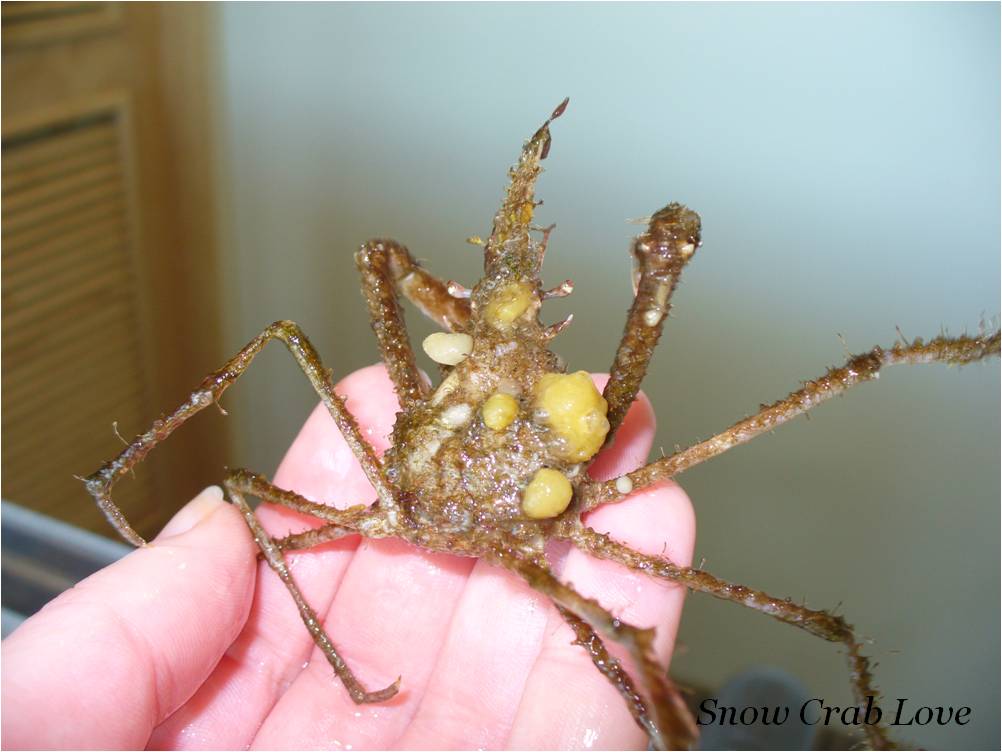
I'm not sure what kind of crab it is. We were trawling off of Kodiak, so I wouldn't be surprised if it was a little king crab, but I honestly don't know. Any guesses?

I didn't mind touching that little angel, but this next thing took some mental pep talks to actually handle:

yes, I touched that
(the board is in centimeters, so this gal was 43 mm long!)
(see this post for why I don't like isopods)

ugh, I hate to admit it, but she's actually kind of cute

Off the boat, I enjoyed Kodiak's crabbing culture. This was a beautiful view to start my day and a beautiful view to end this post. Enjoy!

crab pot sunrise

Tuesday, October 8, 2013

What's goin' on

It's almost snow, Tanner, and red king crab season! The opening is October 15th! The limit for Bristol Bay red king crab is 8.6 million pounds and the reopened Tanner crab fishery is 3.1 million pounds. The snow crab quota almost 54 million pounds (down a but from last year's 66.3 million pounds) - they're kind of a big deal!

Are you ready? More importantly, are the fishermen?

(Turn off the closed captioning by hitting the "CC" icon for easier viewing.)

Mark Begich commented on the importance of the fishing permits: “These permits take hours to process. The paperwork trail is important so we know it’s not illegal crab caught by fish pirates on the other side of the Bering Sea. The paperwork trail helps Americans know the crab we’re eating is safe."

it's a tough job, but someone's got to do it!

Special Note: This is currently happening in Alaska. This post takes no political sides. This post is only to share information regarding the Alaskan crab fisheries. Please, no negative comments!

Friday, August 9, 2013

Krill Kill

One of the awesome things about my job is getting to interact with scientists who are working all over Alaska. Barrow is hosting some scientists right now, and they've been kind enough to share some photos taken in July.

nothing says summer like sea ice on the beach!

The researchers witnessed a neat feeding frenzy near Plover Point involving that most ubitquitous of crustaceans: krill!

 check out those chromatophores!

You may remember seeing krill in this post from Antarctica and in this post from the Gulf of Alaska. They are EVERYWHERE! And just about every marine animal seems to benefit from them in one way or another.

krill-filled water

What made this frenzy special was these krill were washing up dead on shore, so the birds were scooping 'em up right by the beach.

"nom nom nom" - Sabine's gull

Why were they washing up dead? Were they poisoned? Was the water hypoxic? No! Let's not sensationalize this, OK people? Since the ice had retreated from this area and the wind was just right, fresh water may have been pushed out from Elson Lagoon around Plover Point and shocked the little marine critters. The birds just happened to be in the right place at the right time to take advantage of it!

Plover Point is right on the edge where Elson Lagoon and the Beaufort Sea meet

"I'll take my krill on the rocks, please."

The scientists just happened to be there too for some beach seine surveys. Hooray for great timing!

a beach seine topped by krill as they are washed ashore

Tuesday, July 30, 2013

Friday Fun at NOAA

Last Friday (July 26th) was the Ted Stevens Marine Research Institute open house, and man was it fun! The lab hosted tours, an interactive touch tank, NOAA partners in research and management, and had yummy refreshments courtesy of the Ted Stevens Foundation. I was on aquarium duty, so I got to meet people right as they came in and answer any questions they had about the fish, crabs, and other animals in the facility's aquaria. If you didn't have a chance to make it out, don't worry: I took notes!

The TSMRI (that's our little acronym for this lab... scientists and their abbreviations, amirite?) entrance has these lovely metal "walls" that line the sidewalk leading to the front doors. They make me smile with their shiny rockfish and herring, but what really catches my eye is the little metal Dungeness crab.

see it?

oh, why thank you, welcome crab!

What can I say, I love metal dungies! Even nerdy Lord-of-the-Rings-referencing ones. Moving in to the building you are greeted with our largest aquarium (there are three more around the back). It holds several species of rockfish, some sculpins, sablefish, dolly vardin, kelp greenlings, and a lingcod.

lots of things to ooh and aah over

It also currently holds some snazzy red king crabs (Paralithodes camtschaticus) and some cheeky Dungeness crabs (Metacarcinus magister)!

Hi, gorgeous!

SFOS student Jennifer Stoutamore took time to say "Hi"
to her fellow king crabs on her way to the UAF table

this Dungy was photobombed by a greenling

Aside from the aquarium and the great tours through the lab, the touch tank was a huge crowd pleaser! It was stocked with sea stars, sea cucumbers, hermit crabs, lyre crabs, Tanner crabs, urchins... the list goes on and on!

holding a hermit crab - outreach in action

a Tanner crab (Chionoecetes bairdi) showing off
his perfect M-shaped mouth and bright red eyes

Check out KTOO's coverage of the event here to see more photos and hear the open house in action. Thanks for stopping by!

Thursday, July 25, 2013

Tour the NOAA lab in Juneau!

Saturday July 27th is Ted Stevens Day in Alaska. Say what you will about Senator Stevens (his life certainly wasn't boring), but the United States has protected and managed fisheries because of the Fishery Conservation and Management Act, passed with no small effort from Sen. Stevens (R-AK) and Sen. Warren Magnuson (D-WA). You probably know it as the Magnuson-Stevens Act. The highlights:
 
Promote safety of human life at sea
(I was certainly thankful for this as a fisheries observer!)

Prevent overfishing while reaching an optimum yield

Manage fisheries based on the BEST scientific information available

Take into account the importance of fishery resources on fishing communities
and minimize any negative impacts to those communities
(obviously a big deal up here!)

Limit bycatch mortality
(this affects a lot of groundfish fisheries that may scoop up
our beloved crabs as well as their intended catch)

I paraphrased these from a pamphlet at my work. Where is that, you may be asking? Why, at the Ted Stevens Marine Research Institute. Thanks for asking. We're hosting an open house and giving tours of the NOAA facility tomorrow to celebrate Ted Stevens Day, and you're invited! Swing by July 26th anytime between 2:30 and 7:00 pm to take a tour, handle some sea stars at our touch tank, and nosh on snacks complimentary of the Ted Stevens Foundation. I'll be there working (SCIENCE!) and hanging out by the aquarium to answer any questions you may have, crabby or otherwise!

Ted Stevens *hearts* king crabs

Tuesday, June 4, 2013

Kodiak Crab Festival 2013

I have yet to make it to the Crab Festival in Kodiak (next year? fingers crossed!) but this year my dear friend and fellow crab enthusiast, Miranda Westphal, was on the scene with her family to catch some crabby fun!

poster design by Adina Preston

While the Crab Festival celebrates crabs, it is also a celebration of Kodiak itself and life on an island. Miranda shared some festival moments dedicated to the people who make Kodiak home:

horses horses horses horses!
(any Sleepless in Seattle fans out there?)

Kodiak dancers

beat boys taking it up a notch

the marimba band (with back-up maraca players)

 
who's that there but our very own Laura Stichert,
snow crab biologist extraordinaire!!

But don't worry, crab lovers. There were also crabs:

so many jokes, so little time

I'll have to make sure I get there some day! Did you go? What was your favorite part? Leg? Tail? (Har-dee-har-har!) Thanks, Miranda!

(logo by Sean Lawler)

Monday, May 27, 2013

How low can they go?

You didn't think I forgot about answering the questions from our crab chat did you? Nope! The next question to answer is:

Just how deep in the ocean do king crabs and snow crabs live?

To answer this I looked at the crab survey data from 2012. This is only looking at Bering Sea crabs in summer, so it's a little limited, but I figured it was a great place to start. Here's what I learned:

King crabs really stay out of each others' way! Every sampling location that found red king crabs was absent of blue king crabs. Also, on average, blue kings were found deeper in the Bering Sea than red kings; the average blue king crab depth was 87.6 meters (287.5 feet) and the average red king crab depth was 51.7 meters (169.7 feet). This was interesting to me because the bycatch of blue king crabs in red king crab fisheries has closed down red king fisheries in the past (due to low blue king crab abundance), but it would seem that for the summer of 2012 that might not have been a concern.

Heading deeper into the Bering Sea, I found the Chionoecetes crabs! Both Chionoecetes bairdi and Chionoecetes opilio liked an average depth around 91 meters (91.5 m and 91.4 m, respectively), which is close to 300 feet. Unlike the king crabs, these Chionoecetes cousins hung out together quite a bit, which isn't too shocking since they're known to hybridize.

gross

The thing that caught my eye with hybrid Tanner crabs was that their average depth was slightly shallower than the two "pure blooded" crabs (88.1 meters). If I didn't have a real job, I would look into the sex distribution of male and female bairdi and opilio crabs and compare that to the distribution of hybrids to finally answer who's mating with whom. Anyone else want to check it out!?!? Let me know. (Seriously. I'm totally interested.)

average depths (in meters) for the locations where red king crab,
blue king crab, Chionoecetes bairdi, C. opilio, or their hybrids were present

The other thing that caught my eye is that hybrid crab presence was NOT dependent on both "pure" crabs being there (during the survey, that is). Of the 157 sites that had hybrids, 25 sites were missing on of the original species. Plus, there were 70 sites that had both bairdi and opilio crabs but no hybrids. (Fun fact: those sites had a deeper average at 107.4 meters.)

So, that's how low king crabs and snow crabs can go! For perspective, if the Bering Sea's depth was in line with a football field, red kings would make it just past the 50 yard line while blue kings and hybrid Tanners would be in the red zone. But bairdis and opilios would go ALL. THE. WAY!!!

Wednesday, May 8, 2013

Sea Week is Crabtastic!

We've been busy busy busy over here at Snow Crab Love! An HPLC adventure, a quick trip to Illinois, and Sea Week at NOAA have dominated our schedule! Sea Week is actually 3 weeks of marine animal fun hosted by NOAA. Elementary school children come out to the Ted Stevens Marine Research Institute and learn about fish, whales, marine mammals, birds, and invertebrates. They have a scavenger hunt for animals in our 4 aquaria, walk through a whale's mouth and feed it a "herring" (stick a paper herring onto the stomach of the whale display), learn about global currents on a giant map that they can walk on, and learn how to safely handle some small friends that they can find in the rocky intertidal. If you aren't a Juneau elementary student and missed Sea Week, here's your chance to see some invertebrate friends:

this orange little guy caught my eye and stole my heart
(same as last year!)

a hermit crab perched on some very old barnacle shells

we have a lot of Dungeness crabs, but this fellow was particularly friendly

a decorator crab showing off its beautiful sponge accessories

be still my heart:
we have a real live heart crab in an aquarium! I've finally seen one!!

the educators were able to show kids how sea stars use their tube feet
to manipulate their prey as this guy opened up a blue mussel

here's an urchin chowing down on a little sea star!

The students really seem to enjoy seeing all the fish, playing on the map, and touching the sea cucumbers, scallops, and crabs,and they get to learn about why it's important to keep our oceans clean! Does your community have any fun ocean-themed outreach programs for the kiddos?

Friday, April 5, 2013

Let's talk about crabs, baby!

Last week I had the fun opportunity to chat with Deadliest Catch fans about anything and all things crab! (This is the third time I've been able to chat using the Wheel House forum, so check out my past summaries here and here.) It's always fun and covers a lot of crab topics, so it's hard for me to answer all of the questions fully at once. So, for those of you who didn't get to participate in the chat and for those of you who did but want to know more, these are the top questions I will try to answer over the next few posts:

Who can fish Alaskan waters?

What was this season's C. opilio catch compared to last season's catch?

What was the largest snow crab ever caught?

Just how deep in the ocean do king crabs and snow crabs live? And how far can they travel within a year?

What's the difference between red and blue king crabs (aside from color)?

What is the red king crab distribution, and why are they considered an invasive species in Norway?

Is crab meat tested for contaminants before going to market?

Let's get the big picture: how do El Niño and La Niña affect the Bering Sea and Gulf of Alaska?

Last but not least, the most often talked about crab query: do crabs really fart?!? I promise to get to the bottom of this conundrum once and for all!

Captain Phil teaching us a thing or two

Phew! That's a lot of information, so let's get started!

Who can fish Alaskan waters?

Only vessels owned by United States citizens can fish in Alaskan waters. This doesn't mean that if you're not a citizen you can't fish here. Anyone who has been to Kodiak or Dutch Harbor knows that the fishing industry is a melting pot of cultures! Kimchi on hotdogs? Yes please! As long as the vessel is US owned and operated, it's good to go. (Oh snap, I threw in something kinda controversial! Anyone want to discuss vessels that are clearly NOT operated by US citizens? Anyone?)


What's considered 'Alaskan' as far as the water goes? The United Nations set up an Exclusive Ecomonic Zone (EEZ) which spans 200 nautical miles from a country's shoreline. This zone belongs to that country. Alaska has a pretty big EEZ since it has over 44,000 miles of coast (boom, biggest state for the win!):

Alaskan EEZ in the darker blue

You might notice a funny little half circle near Russia of unclaimed ocean. That's commonly referred to as the donut hole and is closed for fishing no matter where you're from. There are other areas where the distance between the two countries doesn't allow for both to have a 200 mile limit, so they, for the most part, go halvesies. Otherwise, they go to war! Just joking. Kind of.

There you have it! One question down, eight more to go!

Monday, January 14, 2013

On your marks, get set, Tanner crab fish!

A Tanner crab (Chionoecetes bairdi) fishery is opening tomorrow off of Kodiak. Where, you might ask? Right here:

beautiful Kiliuda Bay

But wait, what's all that racket going on in Kiliuda Bay, home of the upcoming Tanner crab fishery?

Oh, this old thing?

That's right. Sitting in Kiliuda Bay is the Kulluk, Shell's oil rig that had run aground off Kodiak January 1st. The Kulluk is using Kiliuda Bay as safe harbor, but as such, any boats that will be participating in tomorrow's fishery will need to get special permission from the Coast Guard to do the same if the fishermen want to sleep in the bay. As for the fishery itself, the Kulluk should be out of the way as it is anchored in a nursery area for juvenile Tanner crabs and is therefore closed to the fishery.

Kiliuda Bay is enlarged showing the grey area closed to fishing

As long as the Kulluk stays "intact and upright" it shouldn't pose a threat to the crabs. And we can totally trust that nothing like that would happen, right? I mean, it was built in 1982 (and is older than me) but survived a season in the Arctic and didn't spill any oil during the grounding, so...

(waves crashing over the Kulluk when it was first grounded)

Sorry, all that craziness aside, the Tanner crab fishery is opening and you can place orders for pick up in Kodiak, Homer, or Anchorage! The Bering Sea Tanner fishery is closed for 2013 so this Kodiak fishery is a great opportunity for Alaskans (or at least those not privy to Southeast Tanners) to get some fresh C. bairdi meat and support local fishermen.

 a good Kodiak catch

Are you involved in the Tanner crab fishery or from Kodiak? Let me know how the fishery goes and what, if anything, you had to change to accommodate the Kulluk!