Showing posts with label Crabday. Show all posts

Friday, April 19, 2013

PBBBT!

This week has been... terrible. So here's something to cheer you up:

Raspberry Crab
Nucia speciosa


I mean, can you believe how cute this little guy is? I thought it would be the perfect Crabday crab to ooh and ahh over.

"Meep!" - raspberry crab

The raspberry crab, also known as the red leucosiid crab, can be found off of Hawaii, Guam, (assumingly elsewhere in the South Pacific), Indonesia, Mauritius, and the Red Sea! They live intertidally on coral reefs and blow kisses on each others' carapaces. OK, OK, I can't say for sure if they give each other raspberries, BUT I can't say for sure that they don't. You can decide what to believe.

"pbbbbbbt!" - raspberry crab

Raspberry crabs average a width of 3/4 inch, so you really could just fill a bowl with them and put whipped cream on top! Not that you'd want to do that. Save that for real raspberries, weirdos.

Thursday, February 14, 2013

Happy Valentine's Crabday!

I hope you are all having a lovely day! To celebrate Valentine's Crabday, I thought it would be perfect to introduce you all to the incredibly lovely

Heart Crab
Phyllolithodes papillosus

I *heart* this crab!
 
Imagine my surprise and joy when I found out this beauty is an Alaska native! Heart crabs, or flatspine triangle crabs (yawn), spread the love from Dutch Harbor, Alaska all the way to southern California. They're lithodids, meaning they're related to the king crabs we know and love. The red hearts are actually large bumps, or 'papillae', hence their species name papillosus. The neat thing is that, while the adults are beautiful in their own Valentine-themed way, the juveniles have white, purple, and orange markings too!

"Yar, check out me orange beard!" - juvie heart crab

If you haven't already, don't forget to make someone (or some pet) a special card for today:
 
Lobster Love (a bit risque)

Share the Crab Love!

Wednesday, October 31, 2012

Happy Halloween! Hermit Crab!

Happy Halloween!

And Happy Halloween Crabday!
And Happy Halloween Hermit Crab Crabday!!!

Halloween Hermit Crab
Ciliopagurus strigatus

"Trick or Me! (Because I'm obviously a treat.)"

OK, I'll calm down. You see, Halloween is my favorite holiday by far. I love the costumes, the decorations, the spooky movies, the pumpkin-and-chocolate everything. So you can imagine how thrilling it was for me to find a Halloween crab! And a beautiful crab to boot!

"Even my tush is cute!"

We've already had a Crabday for hermit crabs in general, and a Crabday for the coconut crab (a shell-less hermit crab), but what makes the Halloween hermit crab special (aside from its name) are their orange and black legs. Those bold legs also differentiate the Halloween hermit crab from the other 3 species of hermits within the "Ciliopagurus strigatus complex".

claw coloration in the complex:
(A) Ciliopagurus strigatus, (B) C. tricolor,
(C) C. vakovako, and (D) galzini

What is a "Ciliopagurus strigatus complex?" It is a grouping of 4 species within the genus Ciliopagurus that are all very similar with the exception of their coloration. Normally, they might even be considered different variations of the same species, but they do, in fact, have enough genetic variation from one another to justify the different species names. In the aquarium world, they're still all commonly called Halloween hermit crabs though. Overall, the take away message that I got from this is, "Wow! The Halloween hermit crab has some purdy cousins!"

"Don't I know it!" - Halloween hermit crab

I hope everyone has a safe and happy Halloween (and a relatively dry one for our East Coast readers)!

Complex reading:
Poupin, J., and M. C. Malay. 2009. Identification of a Ciliopagurus strigatus (Herbst, 1804) species-complex, with description of a new species from French Polynesia (Crustacea, Decapoda, Anomura, Diogenidae). Zoosystema 31: 209 - 232.

Tuesday, October 23, 2012

Happy Mole Day!

Happy Mole Day! October 23rd is celebrated as "Mole Day" because of Avagadro's number:

6.02 x 10²³

That number is how many molecules are in one mole of any substance, anywhere! For this special day (which is also my birthday), we're having a special Crabday:

Mole Crab
superfamily Hippoidea
here's lookin' at you, mole crab

I've got some celebrating to do, but I'd like to share 6.02 things about these crabs with you:

1. There are actually a few different species of mole crab, but they all live in the surf zone and filter food from the water as waves wash over them. That's like you sitting at the beach and waiting for a wave to bring you a cheeseburger!

"Here dinoflagellate, dinoflagellate, dinoflagellate!"

2. Because of where mole crabs live, they have to constantly shift their bodies in the sand (as it moves with each wave) and make hasty escapes within the sand when predators pass by. So they dig (hence their name), but they actually do it backwards.

mechanics of a mole crab: on the right is the "recovery stroke"
and the left shows movement (the M arrow) as it shuffles its thoracic legs

3. Mole crabs are also called sand crabs or even sand fleas, but don't mistake them with those nasty little amphipods. It's just gross and insulting.

you don't want to hurt this guy's feelings, now do you?

4. They are edible, and some people deep fry them shell and all (well, minus their telson). I'm not sure how I feel about popcorn mole crabs, but I won't say I'll never try it.

5. Aside from people, mole crabs also have to dodge sea birds and ghost crabs! And we all know how fast ghost crabs can be!
 
"AAHHHHH!" - mole crab
(a long-billed curlew with its quick snack)

6. You can go fishing with them! Apparently pompanos love the little guys: just hook 'em on to some line and go surf casting. Some say the orange eggs of female mole crabs are what attract the fish, but I'd say leave the ladies alone! (You can always tie a fly to mimic a female mole crab with a full clutch if you really want that orange burst.)

a momma mole crab with some wee babies
(I wonder if they hatched on October 23rd!?!?)

Happy Mole Day!

Friday, September 7, 2012

Halimeda!

I wake up almost everyday and sing, "Hal - imeda!" Is it because I love calcareous green algae?

I first learned about this while diving in Fiji.
(It's a tough life, I know.)

Partly, yes. It's my way of saying good morning to my beloved goldfish, Halimeda, named after the aforementioned algae. I got her back in 2010 when I was TA-ing Biology 310. Goldfish tails are perfectly translucent enough to study blood movement through their veins under different conditions. Every student got to take their fish home if they wished, but luckily for me there was one extra! Not only is she a dear member of our family, she's also the inspiration for this Crabday's crab:

Halimeda Crab
Huenia heraldica

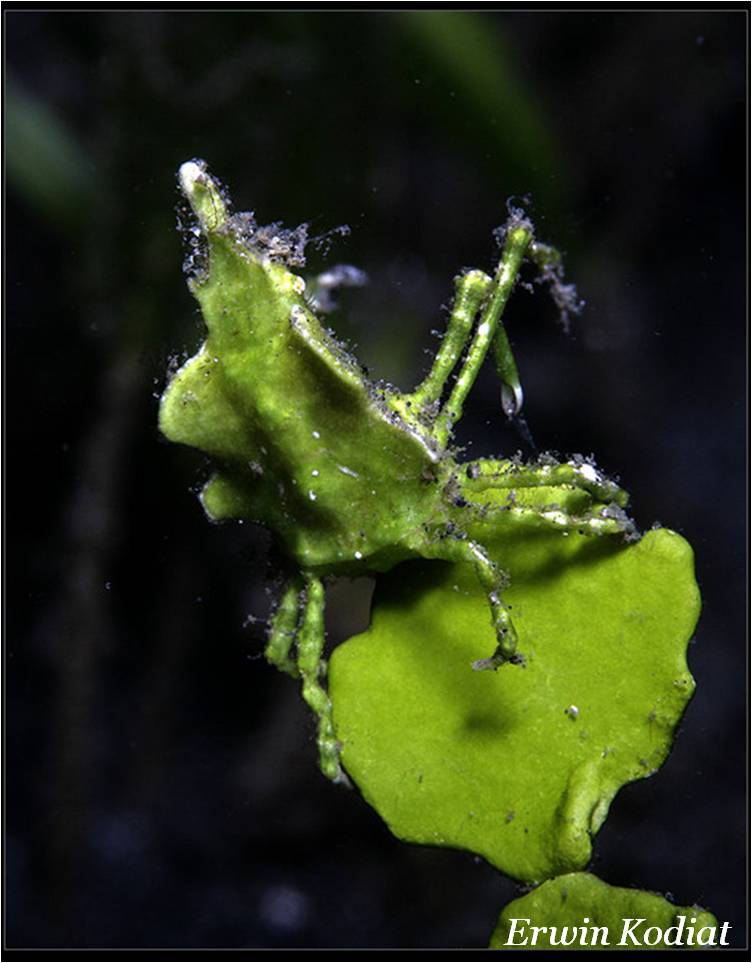
Eee! It's so tiny and so green!

These little crabs are kind of like the decorator crabs we've seen before (here) in that they like to decorate their bodies with bits of the algal halimeda. And, I mean, why wouldn't they, when they look so good!

"I'm going for a 'Dumbo' type look." - halimeda crab

These arrowhead crabs live around the Indo-Pacific, but from the looks of things, probably stay in areas with little-to-no currents:


See how he moves in the water? It's like having a big ol' umbrella attached to your face! Which might look cool... if you're a crab...

Friday, July 20, 2012

7-11

As you saw here, we just got back from the lower 48 and enjoyed our fair share of great food, both slow prepared and fast! One of the places we stopped when we stayed over in Seattle was the 7-11! Really, it was just for water, but it was hard to turn down these bad boys:

TAQUITOS! how can something so bad be so good?

If there's one thing 7-11 reminds me of (other than go-go taquitos and hot dogs with molten "cheese"), it's this Crabday's crab:

Seven-Eleven Crab
Carpilius maculatus

just chillin' on some coral in Bali (lucky!)

The 7-11 crab gets its name from the 7 spots on the top of its carapace and 4 additional spots on the abdomen. Hawaiian legend says that the spots came from the sea god after handling the crab.

"I pinch... even gods!" - 7-11 crab

This crab is used for food (just like 7-11!) but may also be poisonous (just like 7-11?), but the toxicity is most likely from the crabs munching on bivalves that bioaccumulated toxic algae or the like and not from the crabs themselves (similar to our Dungeness crabs in southeast Alaska). This penchant for potential poisoning may actually help out the crab: it is listed as endangered in Singapore. These crabs need a lot less harvesting and a lot more reproducing!

"Hey, I'm working on it!"

Good luck, seven-eleven crab! But stop reminding me of go-go taquitos! The last time I ate them was the summer of 2006 (buffalo chicken flavor on Long Island), and I want to keep it that way!

Friday, May 11, 2012

perfect Crabday for moms

Mother's Day is right around the corner! Have you gotten your mom something yet? Flowers? A card? This week's Crabday crab??

Chocolate Swimming Crab
Thalamita spinimana

"I love you THIIIIIIIS much!" - chocolate swimming crab

If I know moms, then I know what moms love: CHOCOLATE! So I figured what better crab to talk about than a chocolate one? Well, really it's called the red swimming crab, but we all know how common names vs scientific names work, and this guy has a chocolate-colored appearance, so I'm going with it! (You can see the brown hues better at this site.)

a red specimen showing off his beautiful spots

These guys like to hang out in tropical reefs, and because they have those modified 5th walking legs shaped like paddles, they can swim around and catch their prey! They are so good at hunting that they've even been described as "vicious"! And we all know moms can be vicious when blocked from their chocolate gifts.

 nom nom nom
(check out his chocolate spots!)

Well done, crabs. Well done.

Friday, April 27, 2012

I'd call this crab Wartimer

No need for the Freeze Away®, folks. You're going to love this Crabday's wart-riddled crab:

Warty Crab
Eriphia verrucosa


This crab was brought to my attention by one of the Snow Crab Love followers on facebook. Despite its name, the warty crab is quite pretty. It's also known as the yellow shore crab but gets the warty reputation from the tubercles found on its claws.

see the awesome tubercles?

This rocky intertidal crab (living on the coastlines up to 15 meters in depth) can be found in the Black Sea, the Mediterranean Sea, and the Atlantic Ocean. However, the warty crab has decreased in the Black Sea, being listed as endangered in the Ukrainian Red Data Book. This is not only bad for our little crab friend, but also for the rest of the Black Sea community. Warty crabs are the only native animal strong enough to crack the shells of invasive snails, Rapana venosa, who have made their entrance into the Black Sea due to warmer water conditions. (Remember learning about the ongoing battle between crabs and snails here?)

"Bring it!"
(you can see more amazing pictures of these snails here
and the crab photo was from here)

Aside from invasive snails, the warty crab likes to eat polychaetes, bivalves, and even hermit crabs! While not eating, they use rocks and anemones to hide and protect themselves from becoming eaten.

WHOA! 

OK, I guess that's enough! I hope you enjoyed learning about this beautiful bumpy crab!

Read more:
Ozcan, T., T. Katagan, and A. Kocatas. 2005. Brachyuran crabs from Iskenderun Bay (Southeastern Turkey). Crustaceana 78: 237-243.

Rossi, A. C., and V. Parisi. 1973. Experimental studies of predation by the crab Eriphia verrucosa on both snail and hermit crab occupants of conspecific gastropod shells. Bolletino di Zoologia 40: 117-135.

Friday, April 13, 2012

Roses are red, this new crab is blue!

It's a new Crabday and a new crab! Christmas Island is known for it's crabby inhabitants and has been studied for quite awhile now because of the yearly red crab migration. So it's surprising that a new species has only just now been described, but better late than never!

Blue Crab
Discoplax celeste

What a beaut!

Much like the newly discovered crabs we learned about last week, researchers were well aware of these beautiful blue crabs, but simply thought they were a blue version of D. hirtipes (found in Fiji and are so elegantly described as "dark violet and the chela bright cinnabar red"). The trick was that D. celeste change color as they grow: small juvenile crabs are black and light tan, and don't become that brilliant blue until they reach 46 - 52 mm carapace width.

a color progression from small juvie (A) to adult (H)

Upon closer inspection of the carapace, male abdomin, and gonopods, the researchers discovered the blue version were in fact a completely different species from the dark purple/black one originally described, so they decided to name the new one after its sky blue color.

it makes me want to watch for animal-shaped clouds...

Our new D. celeste wasn't the only crab on Christmas Island thought to be D. hirtipes. This other sneaky crab  D. aff. hirtipes has the dark purple/black carapace known to D. hirtipes proper, but yellow chela (hence the "aff." in the name, which simply signifies the similarity to the original species while noting that, as a new species, it has yet to be defined)!

a lovely blue D. celeste next to a
flashy D. aff. hirtipes on Christmas Island

Those two will make a great color-coordinated pair next Leap Year Day! (Here's hoping they survive the next 4 years!)

Check out the paper:
Ng, P. K. L., and P. J. F. Davie. 2012. The blue crab of Christmas Island, Discoplax celeste, new species (Crustacea: Decapoda: Brachyura: Gecarcinidae). The Raffles Bulletin of Zoology 60: 89-100.

Friday, March 30, 2012

Hey, where's that shell going?

Have you ever been beach combing, spot a lovely clam shell, and go to pick it up only to have it wander away from you? Well, you may have seen this Crabday's crab:

Shellback Crab
Hypoconcha arcuata, H. parasitica, and H. spinosissima

this H. arcuata is a sneaky little surprise!

Did anyone else know these existed!?!? I didn't until I stumbled across a picture of them on The O'Keefe Family Website (no, I don't know the family; they just have really awesome crab eye candy!). The crabs pictured there are from North Carolina but all three species listed above are found all along the Atlantic coast of the US. Don't worry, west coasters, there's also a California shellback crab H. californiensis!

another H. arcuata showing how cozy a bivalve can be

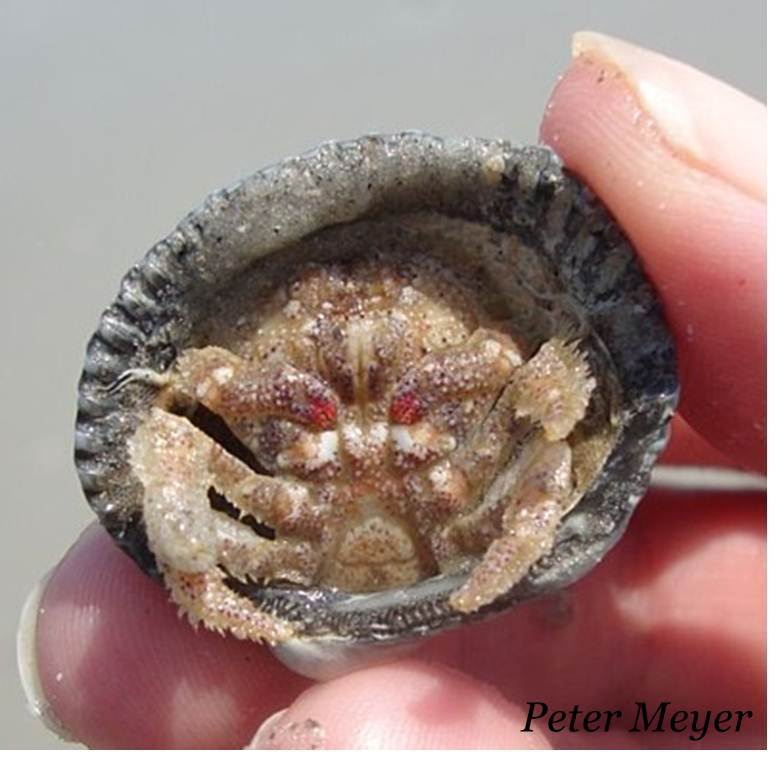
While these guys rely on other animals' shells for protection, they are very different from hermit crabs. Shellback crabs are true crabs (infraorder Brachyuran) while hermit crabs are not considered 'true' crabs (infraorder Anomura). Also, while hermit crabs will protect their soft abdomens with 360° of a snail shell, shellback crabs only protect the top half of their "membranous" (aka soft) bodies by using old bivalve shells like clams or scallops.

this little juvie H. spinosissima is so small
it only needs a shell fragment for protection

What's really neat about these guys is they have modified 4th and 5th walking legs (kind of like how swimming crabs have leg modifications) that enable the shellback crabs to hook and almost suction themselves into the shell halves!

little known fact:
shellback crabs are incredible at yoga


I strongly advise you all to stretch before trying to impersonate the shellback crab! Safety first, am I right?

Friday, March 16, 2012

A slow (and steady) Crabday

It's Crabday! Crabday! Gotta get down on Crabday!

(So terrible but still so wonderful!)

This week's Crabday crab was inspired by the sargassum crab due to its unusual choice of real estate: a sea turtle's behind. While researching googling "sea turtle with crabs" I came across the aptly named

Turtle Crab
Cryptolithodes sitchensis

I can't get over that adorably flat rostrum!

These amazing-looking crabs are also called umbrella crabs due to their wide, smooth carapaces. Their claws and walking legs are all hidden with only their eyes poking out.

wrong umbrella crab...

there you go: see how it has the ability to protect all of its legs?

tah-dah! all of it's happy little legs tucked away like a turtle!

Turtle crabs range from southern California all the way up to southeast Alaska (hence another name, the Sitka crab). They're an intertidal species so you can probably spot them while beachcombing rocky intertidal zones (though I haven't had the pleasure of seeing one myself).

(now you can visualize what it must feel like to come across a turtle crab!
Thanks, YouTube!)

Turtle crabs are, unshockingly, quite slow (hey-oh), feeding on coralline algae (which doesn't move at all...) but their predators include otters, octopus, and sea birds. They are also constantly annoyed by sea hares (also seen here) egging them on for races. That... that last part's not true.

"Besides, I could totally beat any sea hare,
any day!" - turtle crab

You go, turtle crab. You go!

Friday, March 2, 2012

Why is this turtle so unhappy?

loggerhead sea turtle: "AHHHH!"

Could it be because:

(A) it is being accosted by a man in a speedo?

(B) it just realized it had been swimming east this whole time instead of west and was now off the coast of Spain, not Mexico? or

(C) it has an uncomfortable crab companion near its bum?

If you guessed (A) or (B), you obviously missed that this blog is about crabs. If you guessed (C), you're correct and have picked this Crabday's featured crab!

Sargassum Crab
Planes minutus

a sweet little sargassum crab

(not to be confused with the sargassum swimming crab, Portunis sayi)

"Hey! I'm swimmin' here!" - P. sayi

The sargassum crab, also known as the Columbus crab or gulfweed crab, is found on flotsam in the ocean. The most notable "flotsam" of all is the Sargasso Sea, and wouldn't you know it, the sargassum crab thrives there, floating among the Sargassum mats.

a minute P. minutus sayi mama! (found here)
(Thanks, Joe, for the species correction!)

When not living in masses of floating debris, P. minutus finds a home on loggerhead sea turtles, eating other epibionts like barnacles and parasitic amphipods! Unfortunately, the crabs seems to pick a not-so-cozy-for-the-turtles spot to call home:

peek a boo!

That's right, not one, but two sargassum crabs!
You can see the claw of the 2nd crab next to the 1st.

That's one tight squeeze! If I were these guys, I think I'd be looking out for the nearest Sargassum patch! (As for the sea turtle, I guess these crabs are found on a lot of them, so this turtle probably really was just upset about the speedo.)