Showing posts with label parasite. Show all posts

Friday, February 14, 2014

It's Valentine's Day.

When trying to come up with a card this year I was inspired by these hilarious, not-so-romantic cards:

(from Sad Shop)


 (from Lost Marbles)

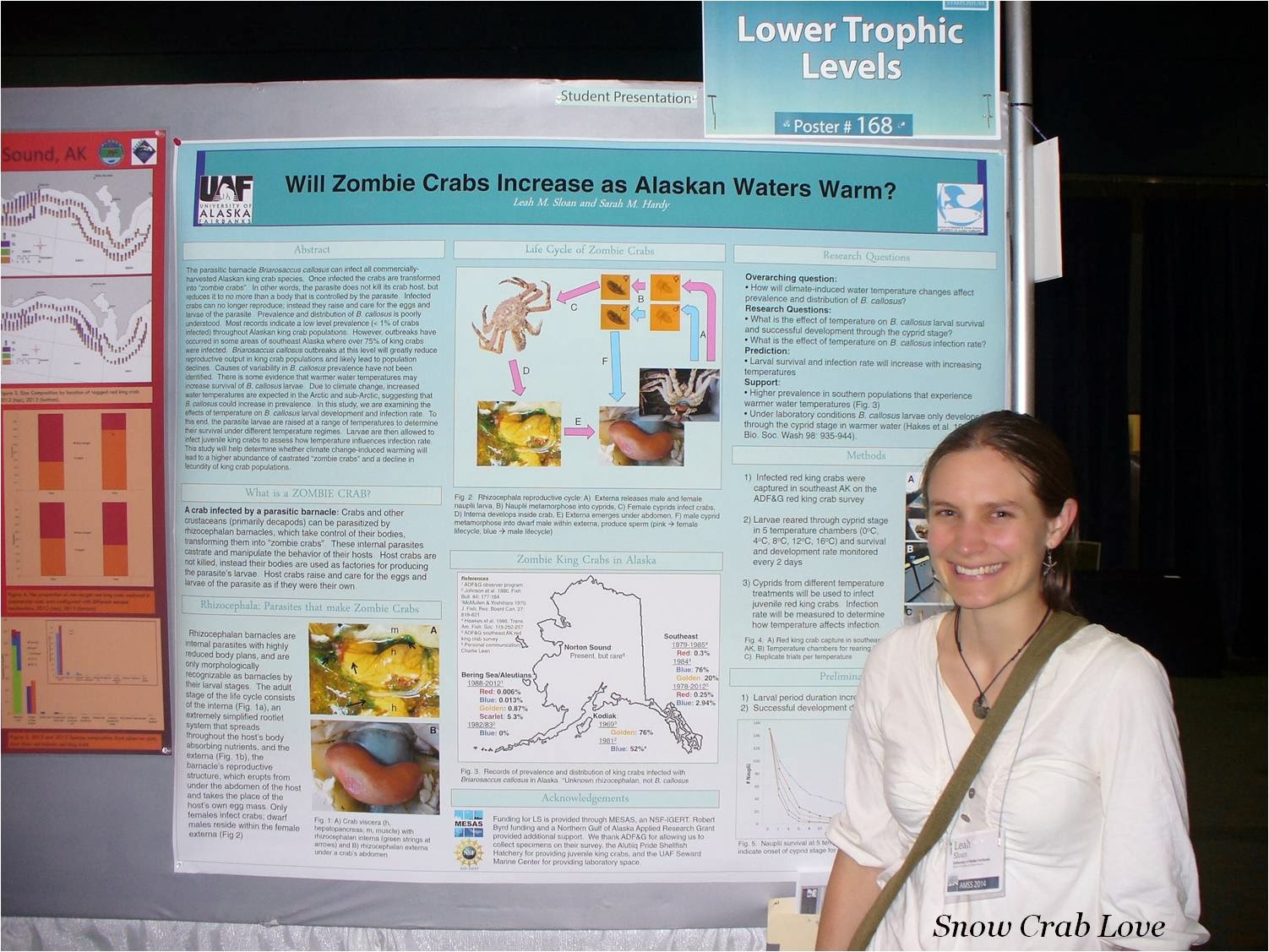
I was also inspired by my renewed interest in rhizocephalans after seeing UAF student Leah Sloan's zombie-themed poster at the Alaska Marine Science Symposium. So I came up with this beauty that you can share with your loved ones or your not-so-much-in-love-but-you-don't-hate-them-either ones!


To make this heart-warming card:
1. Download the PDF
2. Print out the card and fold on the dotted line
3. Give to someone!

they will be thrilled.

Check out these other cards too:

Love Like a Mantis Shrimp
Lobster Love
I *crab heart* you

Happy Valentine's Day!

Thursday, February 6, 2014

Anchorage Crab Extravaganza!

Last week 2 weeks ago (time flies!) I attended the 2014 Alaska Marine Science Symposium, and boy was it crab-tastic! I went to present a couple posters on my work with the Gulf of Alaska Project (my portion is studying baby fish body condition), but you better believe I stopped at all the crab posters I could find!

Here's a run-down of some of the neat crabby things I learned:

Snow crabs are loving detritus up in the arctic! Lauren Divine looked at Chionoecetes opilio stomach contents from crabs collected in the Chukchi and Beaufort Seas. Along with detritus, crabs were eating polychaetes, bivalves, brittle stars (you can see a pile of them from this post), and other crabs including opies!

Lauren showing off her poster and special friend

that's a larger-than-life snow crab ready to show you...

...its stomach contents!

Alaska Department of Fish and Game is mapping Tanner crab (Chionoecetes bairdi) habitat to better understand their distribution off of Kodiak. The fun part of this: underwater pictures of crabs in action!

(download the abstracts here)

Ocean acidification will affect larval Tanner crabs as the ocean's pH drops. Here's Chris Long presenting his work where they exposed brooding females to different levels of pH (the lower the pH, the more "acidified" the water is). The greatest effect was toward larval survival. He also gave a talk on how a similar experiment affected the embryos of Tanner crabs (there's a difference... I can explain further if you'd like) and they weren't doing too well either.

over-achiever: giving a poster presentation AND a talk!

Remember how I said aging crabs was near-impossible? Alexei Pinchuk, Ginny Eckert, and Rodger Harvey are out to prove me wrong!

"Development of Biochemical Measures of Age in the Alaskan Red King Crab:
Towards Quantifying Thermal Effect on Aging"

Last but not least, I learned about ZOMBIE CRABS!!! (No, not these zombie crabs.) Leah Sloan, a UAF grad student, is looking at the distribution of that nasty parasite, the rhizocephalan, and how it may be affected by temperature. The infected king crabs she's studying are referred to as 'zombie crabs' because their bodies have basically been hijacked by the parasite to be a walking, eating, parasite-brooding machine! She's answering her temperature question by exposing larval rhizocephalans (aka parasitic barnacles) to different temperatures and tracking their survival. I'll interview her soon for an "Ask a Grad Student" post so we can all learn more.

she had me at "Zombie"!

I took so many other crab notes, so we'll see if I can share them all with you over the next... year!?!? By then I'll be ready for another round of Marine Science Symposium fun!

Saturday, January 11, 2014

Gettin' crabby in Oregon (part 1)

It's time for another adventure! Let's

I mentioned in the last post that I was headed to Oregon for a wedding. It was beautiful and touching and just plain fun! The next day we took advantage of our proximity to the coast and headed out for a walk near the Yaquina Bay State Recreation Site. I wasn't expecting to see much other than waves, sand, and sun, but my friend Alice spotted this little fellow:

a sandy-colored smooth bay shrimp

We thought it was dead since it was just lying in the wash zone of the beach. Either my husband or Alice went to pick it up (I don't remember who) and it flipped away from us! We all gave a jump and a scream, then picked it up and put it back in the ocean! It was a good start to a fun beach walk!

This little shrimp isn't just your average cocktail ingredient. Oh no, he's got quite the story. Smooth bay shrimp (Lissograngon stylirostris) host a nasty little parasite named Argeia pugettensis, a bopyrid isopod. The isopod will attach itself to a shrimp's gills and use the shrimp's carapace as an extra layer of shelter. The first one to attach to the shrimp develops into a female.

"Last one to the shrimp is a rotten egg male!" - parasitic isopod

Any subsequent parasite to enter that shrimp's gills will become male and fertilize the female parasite's eggs. Once the little larvae hatch, they head out in search of an intermediate host (namely a calanoid copepod) to ruin someone else's day develop further until it can start the whole process over again by swimming up into a shrimp's gills.

"Gross Steve, you've got something on your back!" - Larry the shrimp
"AH! Larry, you've got something on YOUR back!" - Steve the shrimp
 "AHHH!" - Larry and Steve
"AHHHHHH!" - all the shrimp EVERYWHERE!

Luckily for the shrimp we found, it wasn't infected with anything.

Yet.
(Dun-dun-dun!)

Stay tuned to see more of our beach discoveries!

Thursday, February 28, 2013

Say "AAAAAAAH!!!"

You may not know this about me, but isopods freak me out (unlike these guys, apparently). What are isopods? They're crustaceans that haunt my dreams are found in marine, freshwater, and terrestrial environments. The only known isopod I will happily play with is the roly-poly. Other than that, I will turn into a little girl, scream, and run away (unless I'm on a boat, in which case I'll stay on board because those suckers are EVERYWHERE in the ocean). Why am I so creeped out by them?

Exhibit A:

he's not joking. he will.

Exhibit B:

God help this sweet kitten

And finally, Exhibit C:

isopod got your tongue?

Yes, folks. That's an isopod living in the mouth of a fish! This isn't the first time we've met a parasitic isopod. Remember the hyperparasite that lives on rhizocephalans that are themselves parasitizing crabs? They're awesome in the 'karma' sense, but that's about it.

Back to the tongue-eating isopod, my sister sent me an informative video about Cymothoa exigua:


That almost makes them seem endearing, but don't let the little cartoons fool you! They will eat your soul!!!

Thursday, January 31, 2013

Double Ouch!

It's science fair season, and if you're lucky like me, you're up to your eyeballs in mentoring and facilitating fun experimental designs. This past weekend I was able to help my student run some behavioral experiments with hermit crabs (more on that later), and while we were removing the crabs from their shells (by gently holding the shell steady at the surface of a small tank: the hairy hermit crab, Pagarus hirsutiusculus, will wiggle its way out of the shell and drop to the bottom of the tank) we noticed this:

 
The hermit crab is about to enter its shell, but see that red blob?

Do you know what it is?

.
.
.
.
.
.
.
.

(I'll give you a moment to think)

.
.
.
.
.
.
.
.

It's a rhizocephalan! WOOO! And GROSS!!! This poor little hermit crab is being parasitized by a reproductive-organ-hijacking barnacle. Remember learning here that rhizocephalans will sterilize their host and use the host's energy to raise and protect their own little parasite larvae. I was used to seeing these parasites on king crabs, but it is pretty common for hermit crabs to have rhizocephalans on them, at least in Auke Bay, where our science fair animals had been collected. In fact, back in 1996, researchers went out and collected 169 hairy hermit crabs from Auke Bay and found the parasites on about 13% of them! But don't worry, because they also found this:

The blobs marked "A" and "B" are rhizocephalans (Peltogaster paguri),
but the "C" blob is a HYPERPARASITE on the "B" rhizocephalan! 

YEAH! Take that, parasite! You've got a parasite of your own! (Nature: it's an awesome, scary place.) The rhizocephalan's hyperparasite is Liriopsis pygmaea, an isopod that will sterilize its host. It's a nice case of karma, am I right?

Wednesday, December 19, 2012

a sweet victory for bitter crabs

I recently visited family in Illinois and, while flying there, talked with a fellow passenger about bitter crab disease and the prevalence of it in southeast Alaskan Tanner crabs (Chionoecetes bairdi). In one area, the parasitic dinoflagellate affected 95% of the crabs, and that was back in 1987! Lately some southeast Alaskan populations had 100% of their primiparous females infected (Sherry Tamone talked about that at the Alaska Marine Science Symposium in 2011). Bitter crab is a problem in Alaska, but it is also affecting fisheries off Virginia and along the eastern coastal US, as well as in crab hatcheries in China and lobster populations in Scotland! What is causing this, and how is it spreading? What can fishermen do to quell the infection rate? And how can processors assist the fishermen in this effort?

 an infected Tanner crab (top) with milky hemolymph
and a healthy Tanner (bottom) with translucent hemolymph

Lots of questions, I know. Scientists have been feverishly researching Hematodinium sp, the dinoflagellate that is wreaking havoc on commercial crab species. A group of crab scientists at VIMS were able to trace the life history of Hematodinium sp. "[W]e can now really start picking the life cycle apart to learn what the organism does and how it functions," said Jeff Shields.

(Jeff Shields, VIMS)

The researchers noticed a pattern of development time in the dinoflagellate that correlates with cycles of infection in the field and molting of blue crabs (Callinectes sapidus). This knowledge enables them to make suggestions, at least in the realm of aquaculture, on how to avoid the spread of bitter crab by minimizing any effects the parasite could have on crabs during certain periods of both host and parasite life cycles. It seems small, but it's an important victory 15 years in the making in the battle against bitter crab disease!

Wednesday, May 2, 2012

Waiter, there's a crab in my bivalve: part 2

No, this is not another recipe for baked clams or crab-filled treats. This is much better!

Where the shellback crab lives in old bivalve shells for protection, there are other crabs that live in LIVE clams, mussels, oysters, etc!! That crab is the

Pea Crab

the polka dot pea crab (Pinnaxodes floridensis)

I was pretty excited when I learned about this guy (thanks Bryan!).  There are a few species with the common name pea crab, but, as far as my little research review went, they all have one thing in common: they hunker down in those comfy hinged molluscs!

"Of the small crabs that live in a foreign host"
(from Rondeletius (1554) courtesy of Haines et al. (1994))

Female pea crabs seem to prefer this lifestyle compared to the free-swimming male crabs, but mating pairs have been found in mussels! Because of this sexual difference in preference, the relationship between male pea crabs and their hosts is considered amensalism, which means one species has a negative effect on another, but with no effect to itself. The male pea crab may harm its mussel host, but it gets no real benefit from the mussel.

true story

Female pea crabs are simply parasites. Parasitism means one species benefits at the expense of the other species. Scientists saw negative effects to mussel growth when female pea crabs were present, so while the female pea crabs had a safe place to live, their mussel hosts were stressed and unable to attain similar lengths compared to unparasitized mussels.

"Hey! I'm livin' here!" - female pea crab

Bonus fun fact: pea crabs also parasitize sea cucumbers too! So if you're feeling like you want two snacks in one, keep an eye out for these little crabs on your next mussel/cucumber foraging expedition!

Pea crab papers:
Haines, C. M. C., M. Edmunds, and A. R. Pewsey. 1994. The pea crab, Pinnotheres pisum (Linnaeus, 1767), and its association with the common  mussel, Mytilus edulis (Linneaus, 1758), in the Solent (UK). Journal of Shellfish Research 13: 5-10.

Tablado, A., and G. J. Lopez. 1995. Host-parasite relationships between the mussel, Mytilus edulis L., and the pea crab, Tumidotheres maculatus (Say), in the southwestern Atlantic. Journal of Shellfish Research 14: 417-423.

Friday, February 17, 2012

Fire in the hole!

It's Crabday again! Hooray! This week I asked Courtney Lyons (from the sea lion attack story) which crab I should look into and she said the

Black-clawed Crab
Lophopanopeus bellus

a beautiful L. bellus from Peiser Island, AK

Courtney actually knew the scientific name and everything! And we all know how important (and impressive) that is. Black-clawed crabs range from the Aleutian Islands up here in Alaska all the way down to California. When researching them, I came across an amazing article about "the explosion of the spermatozoa" of this species! Can you picture it?

(original picture from here)

OK, so it really looks like this:

the top panel (A) shows normal spermatozoa
the bottom panel (B) shows exploding spermatozoa in
calcium chloride (the first one) and distilled water (the last two)

The "explosions" occur in different solutions that cause the spermatozoa to push out, or evert, the primary or secondary vesicles (labelled in panel A as v and v'). So they weren't really exploding on their own, just eviscerating themselves in when they were in solutions with lower osmotic pressures than seawater. And how did the scientist get all the spermatozoa for this experiment? Black-clawed crabs are pretty neat in that they only have one large spermatophore (unlike snow crabs who have many little spermatophores), so all the guy had to do was, "rupture the deferent ducts and the male gametes oozed out in tremendous numbers". Gotta love science from the 1920's!

"do I?"

Possible explosions and 1920's scientists are not the only things these guys have to deal with. Black-clawed crabs are parasitized by those nasty barnacles, rhizocephalans, that hijack the reproductive organs of crabs. Apparently up to 25% of the black-clawed crabs in Sitka are assaulted by them!

Yikes! It makes exploding spermatozoa sound pleasant!
(the rhizocephalan is
Loxothylacus panopaei)

Do you have a crab you'd like to learn about/celebrate in Crabday fashion? Let me know!

Explosive paper:
Fasten, N. 1921. The explosion of the spermatozoa of the crab Lophopanopeus bellus (Stimpson) Rathbun. Biological Bulletin 41: 288-300.

Tuesday, May 24, 2011

So bitter!

What makes a crab bitter? Is it the lack of contact with its parents after hatching? Is it the constant diet of polychaete worms (I mean, really, who would enjoy that?)? Oh no, it’s something much worse:

Hematodinium sp.
aka the parasitic dinoflagellate that causes bitter crab disease (BCD).

Hematodinium perezi in blue crab (Callinectes sapidus) hemolymph

This nasty phytoplankton infects crabs, destroying the hemocytes (blood cells) in the host's hemolymph which leads to respiratory and organ failure, and finally death. You can tell if you have a bitter crab by their cooked appearance: Chionoecetes bairdi look bright red and C. opilio look milky whitish yellow. The name “bitter crab” (referred to as both disease and syndrome) comes from the bitter flavor of the infected crab’s meat (Taylor and Khan, 1995). The mechanism behind the spread of BCD is unknown, but may happen during molting, cannibalism, or even just physical contact with other diseased hosts.

comparing C. bairdi:
top was infected with BCD (note the milky-colored hemolymph)
while the bottom was healthy

Recently, Mullowney et al. (2011) investigated possible factors of what may be regulating BCD transmission in Newfoundland and Labrador opies. What they found is that BCD may be density-regulated for snow crabs, meaning that the number of crabs in a given area correlated with the prevalence of BCD in that population. In this study’s case, the density-dependence was influenced by small to medium new-shell (recently molted) crabs. Does the newly molted status mean infection happens during molting? They didn’t say. We’ll have to stay tuned on that one.

comparing C. opilio:
the top crab was healthy while
the bottom was infected with BCD (note the opaque color)

Mullowney et al. (2011) did note that the idea of measuring prevalence of BCD in a population is a tricky thing. It is possible to underestimate prevalence due to inefficient fishing techniques and the ability to only diagnose chronic cases of infection. Overestimation of prevalence can occur through those infected crabs seeking out pots (and the accompanying bait) more so than healthy crabs due to the extra nutritional demands the infection is putting on their little crab bodies.

an eyestalk-ablated C. bairdi from the Tamone lab
potentially infected with BCD (from this article)

BCD is on the rise (remember the velvet swimming crab deaths in France, mentioned here?), and the infection’s resulting mortality is affecting commercial stocks’ reproductive potentiontial. Siddeek et al. (2010) observed BCD and the way it may alter harvest strategies for C. bairdi in Alaska (Sherry Tamone presented on the proportion of BCD in Tanners from southeast Alaska here). Hopefully biologists can learn more about how this disease is transmitted and how it’s affecting populations to better manage our crab stocks!

Read more:
Mullowney, D. R., E. G. Dawe, J. F. Morado, and R. J. Cawthorn. 2011. Sources of variability in prevalence and distribution of bitter crab disease in snow crab (Chionoecetes opilio) along the northeast coast of Newfoundland. ICES Journal of Marine Science 68: 463-471.

also:
Siddeek, M. S. M., J. Zheng, J. F. Morado, G. H. Kruse, and W. R. Bechtol. 2010. Effect of bitter crab disease on rebuilding in Alaska Tanner crab stocks. ICES Journal of Marine Science 67: 2027-2032.

Taylor, D. M., and R. A. Khan. 1995. Observations on the occurence of Hematodinium sp. (Dinoflagellata: Syndinidae), the causative agent of bitter crab disease in Newfoundland snow crab (Chionoecetes opilio). Journal of Invertebrate Pathology 65: 283-288.

Monday, March 7, 2011

Crab parasites

A while back my friends and I were talking about crab parasites. We got to this topic when clarifying that the crabs I study are Chionoecetes opilio and not Pthirus pubis, the type of “crabs” that parasitize mammals.

that's not something I would advertise

We wondered what type of parasites crustaceans may come across. One is the barnacle Briarosaccus callosus, which is found in king crabs.


These nasty little rhizocephalans hijack the hosts’ reproductive process by sterilizing them, using their energy to make thousands of cyprid larvae (how scientists know these blobs are in fact barnacles), and coercing them to protect the parasitic pirates.

a scarlet king crab Lithodes couesi
host with the most!
(the red blob is the parasite)

Paralomis hirtella with its own pink-ish rhizocephalan
reported here

They almost make "crabs" sound not that bad…

Read more:
Isaeva, V. V., S. M. Dolganov, and A. I. Shukalyuk. 2005. Rhizocephalan barnacles—Parasites of commercially important crabs and other decapods. Russian Journal of Marine Biology 31: 215-220.
DOI: 10.1007/s11179-005-0075-9