Showing posts with label hermit crab. Show all posts

Tuesday, January 6, 2015

New year, new crab!

Well, kind of. Recently a woman in Honolulu noticed this guy walking down the street:

oh hey there!

Normally seeing a crab in Hawaii wouldn't be weird. But this guy is a coconut crab (remember learning about them here) and they are invasive in Hawaii. It might have just showed up for vacation, but what's more likely is that someone had bought the crab in hopes of making a tasty dinner - can you blame it for trying to run away!?!?

Just as a note, in the video (on the Huffington Post link) they keep saying how dangerous the crabs are because of their strong claws. Coconut crabs can break through coconuts and were rumored to crack skulls of sleepy castaways, but I'm not sure how dangerous they truly are. So here's the lesson: rumors will follow you, coconut crab. You may have escaped being dinner (it will now live at the Honolulu Zoo), but you can't escape the sins of your father! (Regardless, getting pinched by a small mud crab can hurt so I'd avoid these claws!)

Friday, February 28, 2014

Are you strong enough to be my shell?

Is anyone else singing Sheryl Crow right now? Just me?

It's Science Fair time up here in Juneau!!! That means data has been collected, numbers have been crunched, and posters are being put together for the big presentation this weekend! This will be my third year judging and I'm so excited to see all the projects the high school students have come up with this year!

Last year I was also a mentor (mentioned here) but sadly my student didn't end up presenting her results. It was sad in two ways: (1) she was pretty pumped about the project, but had double-booked the weekend because she was also super involved in a lot of school activities (go get 'em!), so it was too bad she didn't get to present her work. (2) This experiment involved live animals, so had I known she wouldn't complete the program, I wouldn't have mentored this type of project. I take working with animals very seriously and take it to heart if/when any of the animals in my care die.

this seems silly, but remember my snow crab quilt
with a crab to honor each of my study animals?

That being said, I still want to present the fun little project I had the opportunity to participate in since it hasn't been shared yet! Hermit crabs depend on gastropod shells to protect their soft, delicate abdomens. Because of this need for protection, shell strength is an important variable for them when choosing which shell to inhabit. Given the choice in normal situations, it's been observed that hermit crabs will choose intact shells over damaged ones, since the damaged ones would be easier to break into by their predators. We wondered how their shell choice might differ in differing situations: will they make the same choice under stress? How about if they think there are a bunch of potential shells around - will they be as choosy initially? Will they still worry about shell strength???

To test this question, we took hairy hermit crabs, Pagarus hirsutiusculus, that were being housed at the University of Alaska Southeast wet lab and offered them two shells: one intact, one with a tiny hole. When giving the crabs an opportunity to make this choice, we took advantage of their use of chemical cues and exposed them to different "smelling" water. We exposed some of the hermit crabs to water that smelled like a known predator, the Dungeness crab, to act as the stress treatment. We exposed others to water that smelled like dead snails to mimic a gastropod predation event, or a time when several snails are being eaten and therefore leaving their shells up for grabs. We finally had a control treatment where the hermit crabs made their choice in the same water that had been pumping through their holding tanks.

hello!

In order to encourage shell selection, we had to gently remove the hermits from their original shells (crazy easy to do without any harm to the crabs!). We saved their original shell so that they could move back into it when the trial was finished. We also measured their original shell's weight so that we could offer them test shells of similar size/weight (we didn't want to give a big crab a small shell!).

science! collecting naked crab weights!

We measured the time it took for them to approach a shell, the time it took for them to enter a shell, and their shell selection. We took note if they changed which shell they chose too, just in case any of them had buyer's remorse.

choices choices: the two shells offered are from the same species of snail,
but one is damaged goods and one seems shiny and new
(the small white thing in the leftmost part of the tank is a bit of gravel)

What did we find? For all treatments, the hermit crabs chose the intact shells over the damaged shells. This wasn't too shocking, but it was still interesting to see that, even under stress (Dungeness-scent) or at leisure (dead snail-scent), they still made the same basic decision.

more hermit crabs chose intact shells than damaged shells
and rarely changed their minds, although one crab switched from
an intact shell to damaged one in the predator treatment...

The time it took for the crabs to approach a shell and enter it were very similar. It seemed like some of the crabs would just wander around the tank for the most part and sense the shells by touch rather than sight. Once they touched a shell, they would hurry their little tushes into it! The time it took for them to find the shells was roughly the same across all treatments (ie "there was no significant difference in average time for first approach or shell entry across treatments (ANOVA, p > 0.05)").

get in there!!! (see his little rhizocephalan?)

The main thing: IT WAS FUN! Yes, it was several hours in the lab and, yes, I'm still sad that it wasn't presented at the fair, but it was fun being a mentor and doing this crabby side-project!

Friday, June 14, 2013

Micro Awesomeness

Hey y'all! I've been working all week pulling stomach contents out of baby Pacific cod (Gadus macrocephalus) and walleye pollock (Theragra chalcogramma). I know, I know. They're not crabs. They're not even crustaceans. BUT they eat crustaceans!

Boom! Euphausiid in the house!

It's not surprising to find one hundreds of these bad boys in a fish stomach. Euphausiids, or krill, are pretty ubiquitous and are the go-to prey item for a lot of animals, even the crabeater seal. The excitement in the lab this morning came from this guy:

"oof"

He's obviously different from the krill we'd been seeing all week. What sparked fellow Southampton College and University of Alaska Fairbanks alum (holla!) Casey Debenham's curiosity was that large claw.

that's a legit chela

Right off the bat we could tell this was a crab!! But what kind of crab? On further inspection, with the help of Emily Fergusson, stomach content pro, we saw that the left claw was quite a bit smaller than the right. This was the tipping point!


Do you know what it is? I'll wait while you guess.

.

.

.

.

.

.

.

.

.

.

.

.

.

.

.

It's a hermit crab!

can you see it?

It's a Pagurid in the megalopae stage! Pretty cool right? I guess he hadn't settled yet to find a protective shell and was just chilling up in the water column. Had he not been eaten, he might have grown to look like this:

although he'd probably be rockin' a gastropod shell

Oh well. Circle of life, amirite?

Wednesday, May 8, 2013

Sea Week is Crabtastic!

We've been busy busy busy over here at Snow Crab Love! An HPLC adventure, a quick trip to Illinois, and Sea Week at NOAA have dominated our schedule! Sea Week is actually 3 weeks of marine animal fun hosted by NOAA. Elementary school children come out to the Ted Stevens Marine Research Institute and learn about fish, whales, marine mammals, birds, and invertebrates. They have a scavenger hunt for animals in our 4 aquaria, walk through a whale's mouth and feed it a "herring" (stick a paper herring onto the stomach of the whale display), learn about global currents on a giant map that they can walk on, and learn how to safely handle some small friends that they can find in the rocky intertidal. If you aren't a Juneau elementary student and missed Sea Week, here's your chance to see some invertebrate friends:

this orange little guy caught my eye and stole my heart
(same as last year!)

a hermit crab perched on some very old barnacle shells

we have a lot of Dungeness crabs, but this fellow was particularly friendly

a decorator crab showing off its beautiful sponge accessories

be still my heart:
we have a real live heart crab in an aquarium! I've finally seen one!!

the educators were able to show kids how sea stars use their tube feet
to manipulate their prey as this guy opened up a blue mussel

here's an urchin chowing down on a little sea star!

The students really seem to enjoy seeing all the fish, playing on the map, and touching the sea cucumbers, scallops, and crabs,and they get to learn about why it's important to keep our oceans clean! Does your community have any fun ocean-themed outreach programs for the kiddos?

Friday, March 29, 2013

hermit crabs do the twist

After this post about when hermit crabs become, well, hermits and hide their soft abdomens in shells, Sherry asked:

Do hermit crab abdomens always spiral in the same direction?

I'm not gonna lie: I was stumped. The logical person in me thought: not all snail shells spiral in the same direction, so not all hermit crab abdomens spiral in the same direction, right? Shells can spiral to the right (dextral) or to the left (sinistral), and, just to really ruin your day blow your mind, some gastropods will display BOTH spiral directions within the same species!

Sinistral (on the left) and dextral (on the right) shells from
Amphidromus perversus snails (aka super cute land snails)

Then I thought, that may be so, but that doesn't mean that hermit crabs will necessarily inhabit every type of shell ever produced by nature, RIGHT? What I found is that, while hermit crabs prefer dextral gastropod shells, they can and will inhabit sinistral shells. But this seems to be a last-option-for-housing kind of situation, as the occurrence of crabs in the left-spiraling shells is so rare.

to the left, to the left!
everything about me in a shell to the left!

So are the hermit crabs that dwell in sinistral shells curling to the left? NO! Larval hermit crabs have symmetrical abdomens, but as they grow and develop, the abdomen begins to curl. It TURNS out (ha!) that the abdomen curls in a spiral towards the right for hermit crabs! (I'm afraid to say that this is true for all hermit crabs, but so far my quick literature review hasn't told me otherwise.) 

this hermit crab is doing its Tilda Swinton impersonation

I hope that cleared it up for you, Sherry! (Because the shell is clear...) Hey-oh!

Want some light reading?
Chapple, W. D. 1977. Central and peripheral origins of asymmetry in the abdominal motor system of the hermit crab. Annals of the New York Academy of Sciences 299: 43 - 58.

Kosuge, T., and M. Imafuku. 1997. Records of hermit crabs that live in sinistral shells. Crustaceana 70: 380 - 384.

Friday, March 8, 2013

teeny tiny shells

This weekend is the Southeast Alaska Regional Science Fair! The student I mentored did a project looking at shell selection behavior of hermit crabs under different chemical cues (more on that later). This project got me thinking: when exactly do hermit crabs begin using gastropod shells? Is is right when they settle out of the water column onto the benthos or do they have to reach a certain size before they can hoist a shell around?

First let's learn a little about hermit crab development. When they hatch, they are free swimming zoea. They go through a number of zoeal instars, meaning they'll molt and grow, but will still have basically the same form and function.

little larval Anapagurus laevis

After a certain number of instars, the zoea will molt into a megalopae stage. Megalopae will swim around until they find a suitable substrate to settle. Once they settle, they can then molt and grow into a juvenile hermit crab, when they'll finally look like mini-versions of the hermit crabs we know and love!

almost there, little buddy!

So when does the protective gastropod shell come into play? You may have guessed it already: during the megalopae stage! As they settle, the little guys are looking not only for good habitat structure and food availability, but also for shells or shell fragments. If no shells are available to protect their minuscule bodies, hermit crab megalopae can delay morphing into the juvenile stage. But they don't want to dilly-dally, since shell-less hermit crabs at either stage suffer higher mortality rates than those with shells.

Now, what do I mean by "little"? Check out this guy:


the large claw on this Pagurus bernhardus is about 1 mm long

For comparison, pick up a nickel. A nickel is almost 2 mm thick, so this hermit crab megalopa is probably around the same size as your nickel is thick! That's how tiny hermit crabs are when they start looking for shells, or more likely at these sizes, shell fragments to protect their soft abdomens!

Where's the science? 
Roberts, M. H. Jr. 1971. Larval development of Pagurus longicarpus Say reared in the laboratory. IV. Aspects of the Ecology of the megalopa. Biological Bulletin 141: 162 - 166.

Oba, T., and S. Goshima. 2004. Temporal and spatial settlement patterns of sympatric hermit crabs and the influence of shell resource availability. Marine Biology 144: 871 - 879.

Harms, J. 1992. Larval development and delayed metamorphosis in the hermit crab Clibanarius erythropus (Latreille) (Crustacea, Diogenidae). Journal of Experimental Marine Biology and Ecology 156: 151 - 160.

Thursday, January 31, 2013

Double Ouch!

It's science fair season, and if you're lucky like me, you're up to your eyeballs in mentoring and facilitating fun experimental designs. This past weekend I was able to help my student run some behavioral experiments with hermit crabs (more on that later), and while we were removing the crabs from their shells (by gently holding the shell steady at the surface of a small tank: the hairy hermit crab, Pagarus hirsutiusculus, will wiggle its way out of the shell and drop to the bottom of the tank) we noticed this:

 
The hermit crab is about to enter its shell, but see that red blob?

Do you know what it is?

.
.
.
.
.
.
.
.

(I'll give you a moment to think)

.
.
.
.
.
.
.
.

It's a rhizocephalan! WOOO! And GROSS!!! This poor little hermit crab is being parasitized by a reproductive-organ-hijacking barnacle. Remember learning here that rhizocephalans will sterilize their host and use the host's energy to raise and protect their own little parasite larvae. I was used to seeing these parasites on king crabs, but it is pretty common for hermit crabs to have rhizocephalans on them, at least in Auke Bay, where our science fair animals had been collected. In fact, back in 1996, researchers went out and collected 169 hairy hermit crabs from Auke Bay and found the parasites on about 13% of them! But don't worry, because they also found this:

The blobs marked "A" and "B" are rhizocephalans (Peltogaster paguri),
but the "C" blob is a HYPERPARASITE on the "B" rhizocephalan! 

YEAH! Take that, parasite! You've got a parasite of your own! (Nature: it's an awesome, scary place.) The rhizocephalan's hyperparasite is Liriopsis pygmaea, an isopod that will sterilize its host. It's a nice case of karma, am I right?

Monday, January 7, 2013

Happy New Year!

How has everyone's first week in 2013 been? Did you bring in the New Year with a bang or with quiet reflection on the past year? I have a feeling I know what this guy did:

someone went a little overboard with the silly string

To be fair, the hermit crab here, Pagurus prideauxi, wasn't the party animal here. Those pink strings were secreted from the cloak anemone (Adamsia carciniopados). While they seem fun and festive, the strings are actually poisonous tentacles to protect both the hermit crab and its symbiotic friend!

the anemone protecting its hermit crab pal while he courts a little lady

I always love seeing symbiotic relationships with hermit crabs and anemones. It seems like such a wonderful way for an anemone to get around! The cloak anemone really has it figured out though: while hermit crabs normally have to find larger shells to fit into, and thus have to ditch their old small shells despite any friends they might have picked up, the cloak anemone becomes a sort of protective shell itself for the hermit crab. It does this by creating a chitinous layer called a carcinoecium which helps extend the original shell's coverage!

a sad crabless anemone found on a Scottish beach - note the structure of
the carcinoecium that used to protect a hermit crab's face

Because the cloak anemone adds to the hermit crab's home, the hermit crab never has to worry about finding a bigger shell. That means these crab-anemone pairs are set for life! They're like the Pooh Bear and Piglet of the marine world!

"Silly ol' crab!" - cloak anemone

Wednesday, October 31, 2012

Happy Halloween! Hermit Crab!

Happy Halloween!

And Happy Halloween Crabday!
And Happy Halloween Hermit Crab Crabday!!!

Halloween Hermit Crab
Ciliopagurus strigatus

"Trick or Me! (Because I'm obviously a treat.)"

OK, I'll calm down. You see, Halloween is my favorite holiday by far. I love the costumes, the decorations, the spooky movies, the pumpkin-and-chocolate everything. So you can imagine how thrilling it was for me to find a Halloween crab! And a beautiful crab to boot!

"Even my tush is cute!"

We've already had a Crabday for hermit crabs in general, and a Crabday for the coconut crab (a shell-less hermit crab), but what makes the Halloween hermit crab special (aside from its name) are their orange and black legs. Those bold legs also differentiate the Halloween hermit crab from the other 3 species of hermits within the "Ciliopagurus strigatus complex".

claw coloration in the complex:
(A) Ciliopagurus strigatus, (B) C. tricolor,
(C) C. vakovako, and (D) galzini

What is a "Ciliopagurus strigatus complex?" It is a grouping of 4 species within the genus Ciliopagurus that are all very similar with the exception of their coloration. Normally, they might even be considered different variations of the same species, but they do, in fact, have enough genetic variation from one another to justify the different species names. In the aquarium world, they're still all commonly called Halloween hermit crabs though. Overall, the take away message that I got from this is, "Wow! The Halloween hermit crab has some purdy cousins!"

"Don't I know it!" - Halloween hermit crab

I hope everyone has a safe and happy Halloween (and a relatively dry one for our East Coast readers)!

Complex reading:
Poupin, J., and M. C. Malay. 2009. Identification of a Ciliopagurus strigatus (Herbst, 1804) species-complex, with description of a new species from French Polynesia (Crustacea, Decapoda, Anomura, Diogenidae). Zoosystema 31: 209 - 232.

Tuesday, September 11, 2012

Crabs on the move

The hermit crabs are invading!

OK, well maybe they're just migrating. This video of Caribbean hermit crabs, or soldier crabs, (Coenobita clypeatus) was taken at Nanny Point on St. John Island (U.S. Virgin Islands). Not too much is written about this amazing migration, but these gals are all headed towards the beach to release their babies. We've seen this before with the red crab migration on Christmas Island, although I find this movement pretty impressive when considering the added weight of the hermit crabs' protective shells. They can move between 170 to 300 meters per day!

phew!

Have you witnessed this migration in person? If not, a trip to St. John Island next August doesn't sound too bad. Just make sure to take plenty of pictures and send them my way!

Tuesday, May 15, 2012

NOAA's Sea Week

The last 3 weeks were "Sea Week" at NOAA's Ted Stevens Marine Research Institute. Hundreds of kids got to come through the labs and learn about some of the sea creatures that call Alaska home. I got to visit too (since I work there) and took some pictures to share with you!

 the touch tanks had many different animals:
snails, sea cucumbers, hermit crabs, and blue mussels to name a few

 two orange hermit crabs (Elassochirus gilli)
hanging with a sea cucumber (Parastichopus californicus)

I was smitten with this orange guy!

 "Oh dear, I've rolled over!"

 a beautiful blue friend

 a darker fellow (Elassochirus tenuimanus)

Hermit crab molt! You can see, because of their soft abdomen,
that the hard parts they have to molt are only on the 
front portion of their bodies! So cool! 

 there were also some sweet lyre crabs

and scallops! Can you see its many little eyes?

The scallops were a lot of fun because they are really quite active when they sense predators, like this large pycnopodia sea star:


I hope you enjoyed the virtual tour of TSMRI's touch tanks!

Sunday, April 8, 2012

A message from the Easter Crab:

HAPPY EASTER!


I hope you're having a great day, whether it's getting outside for an Easter egg hunt or getting outside for an adventure, or maybe staying inside with family and friends! These Calcinus hermit crabs, found around Easter Island, would also like to wish you a happy day (I'm not sure if these particular crabs are from Easter Island, but their genus is found there).

wouldn't you love a colorful Easter (Island) basket like this?

Why have an Easter Crab? It is kind of a family tradition to celebrate Easter with different animals: I grew up in northern Illinois waiting for Gladys the Easter Cow to come bring bull's eyes and cowtail candies. My dad even had a song for our Easter bovine:


(I feel like this video explains a lot about my own sense of humor!)

Friday, August 12, 2011

Hermit Crabday!


My friend Gretchen (harbor seal chick!) sent me this cartoon and I thought it was so funny and perfect as an opener to show just how cute hermit crabs can be. So here you go, crab lovers, it's hermit Crabday!!

There are SO MANY hermit crab species out there, it's kind of hard to know where to start. But you've already met one beautiful hermit crab from our first Crabday: the coconut crab! Remember, coconut crabs (Birgus latro) give up the extra protection around their abdomen after adolescence. Then they just rock out with their... soft abdomen out. Yes.

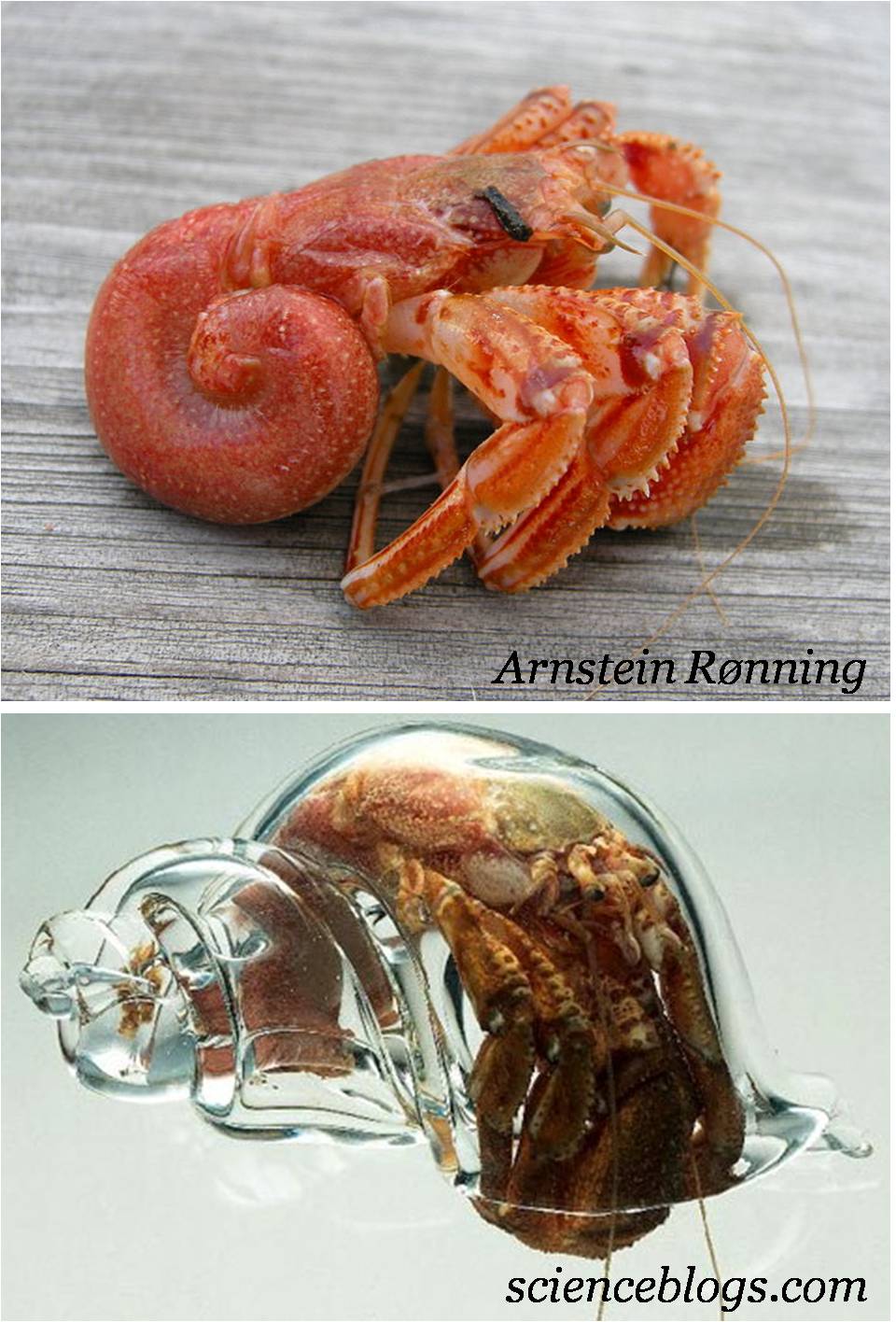
You see, most hermit crabs you know and love need shells because of this feature:

The hermit crab's soft abdomen spirals perfectly to fit inside a
snail shell, as you can see with this guy in the glass shell.
Guess he won't be throwing rocks any time soon, you know what I mean?

If you're like me, you're probably wondering how they mate with all that shell in the way. Male and female hermit crab anatomy is pretty similar to snow crabs, but for males to successfully copulate with female hermit crabs, all they have to do is give a little knock-knock (who's there?) and rock the shell, literally, to convince the female to come out of her protective home. Then BAM!

So, with all that out of the way, here are the cuties I promised:

here's a little Alaskan guy I found in my rocky intertidal backyard - Pagurus sp.
(read about hermit crabs in Alaskan seabird diets here)

"EEEE, I'm a tiny hermit crab!"

I love how comically large the shell is for this beautiful blue hermit crab

hermit crab: "Need a lift?"
anemone: "I got your back, bro."

TGIC, am I right?