Showing posts with label hybrids. Show all posts

Monday, May 27, 2013

How low can they go?

You didn't think I forgot about answering the questions from our crab chat did you? Nope! The next question to answer is:

Just how deep in the ocean do king crabs and snow crabs live?

To answer this I looked at the crab survey data from 2012. This is only looking at Bering Sea crabs in summer, so it's a little limited, but I figured it was a great place to start. Here's what I learned:

King crabs really stay out of each others' way! Every sampling location that found red king crabs was absent of blue king crabs. Also, on average, blue kings were found deeper in the Bering Sea than red kings; the average blue king crab depth was 87.6 meters (287.5 feet) and the average red king crab depth was 51.7 meters (169.7 feet). This was interesting to me because the bycatch of blue king crabs in red king crab fisheries has closed down red king fisheries in the past (due to low blue king crab abundance), but it would seem that for the summer of 2012 that might not have been a concern.

Heading deeper into the Bering Sea, I found the Chionoecetes crabs! Both Chionoecetes bairdi and Chionoecetes opilio liked an average depth around 91 meters (91.5 m and 91.4 m, respectively), which is close to 300 feet. Unlike the king crabs, these Chionoecetes cousins hung out together quite a bit, which isn't too shocking since they're known to hybridize.

gross

The thing that caught my eye with hybrid Tanner crabs was that their average depth was slightly shallower than the two "pure blooded" crabs (88.1 meters). If I didn't have a real job, I would look into the sex distribution of male and female bairdi and opilio crabs and compare that to the distribution of hybrids to finally answer who's mating with whom. Anyone else want to check it out!?!? Let me know. (Seriously. I'm totally interested.)

average depths (in meters) for the locations where red king crab,
blue king crab, Chionoecetes bairdi, C. opilio, or their hybrids were present

The other thing that caught my eye is that hybrid crab presence was NOT dependent on both "pure" crabs being there (during the survey, that is). Of the 157 sites that had hybrids, 25 sites were missing on of the original species. Plus, there were 70 sites that had both bairdi and opilio crabs but no hybrids. (Fun fact: those sites had a deeper average at 107.4 meters.)

So, that's how low king crabs and snow crabs can go! For perspective, if the Bering Sea's depth was in line with a football field, red kings would make it just past the 50 yard line while blue kings and hybrid Tanners would be in the red zone. But bairdis and opilios would go ALL. THE. WAY!!!

Friday, February 3, 2012

O is for opilio

I was recently asked how to distinguish between snow crabs (Chionoecetes opilio) and Tanner crabs (Chionoecetes bairdi). The person knew the difference in eye color thanks to this post: snow crabs have beautiful green eyes while Tanners have blood red eyes. Another way to tell the difference is to read their lips epistome margins. Opies have flat epistomal plates while bairdis have M-shaped plates:

snow crab on top, Tanner crab on bottom

I like to picture the snow crabs making an "O" sound when I look at their faces as if they were saying "OOOOO-pilio"!

Um, so let's say "meatballs" represent the red eyes? Yes.
(Sorry, I couldn't think of a good "M" word.)

There are a couple other differences: generally adult Tanners seem to be larger than adult snow crabs (at least in my experience) and their bodies are shaped a bit differently. Snow crabs have rounder bodies (their carapace length-to-width ratio is about 1) while Tanners are packing wide loads (their length:width is less than 0.945).

carapace shape and epistome margin from left to right:
pure Tanner crabs, three variations on hybrids, and then pure snow crabs

That may seem like a small difference, but if you're on a boat measuring hundreds upon hundreds of crabs, you start to know who is who before you even check their eye color and epistomal plates. You can also get a feel for something awry, like if you have a wide guy but with green eyes. Then you check his epistome margin and it looks like this:

not quite flat, but not quite M-shaped...

That's right, you've got a hybrid! So now you know, and knowing is half the battle.

Tuesday, January 3, 2012

Hybrid crabs

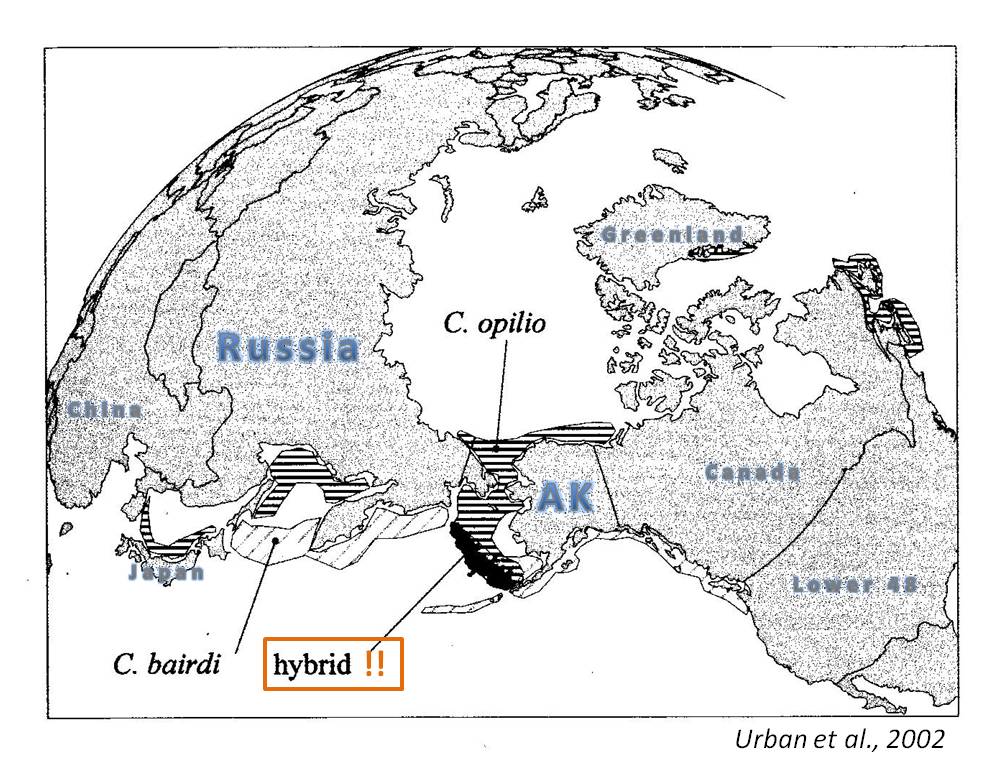
You may remember me mentioning snow crabs (Chionoecetes opilio) and their congener Tanner crabs (C. bairdi) are makin' babies in the eastern Bering Sea, resulting in hybrid crabs!

hybrid: "I'm a monster!!"

Well, it's getting worse. Or more prevalent? Or just more closely looked for and then accurately identified. Something like that. Anyway, when I was at the Interagency Crab Meeting this year, Dan Urban from NMFS Kodiak updated us on the Chionoecetes hybrid situation:

Chionoecetes hybrids (#/square nautical mile) encountered
during the 2011 NMFS summer trawl survey (draft report here)

And just as I had suspected, Dan said the participants are bairdi males and opie females. Which leads me to this horrifying conclusion: the Tanners are trying to take down the snow crabs! Think about it: it's just like the English vs. the Scots:

"If we can't get them out, we'll breed them out."

It's hard to stomach, I know. And that makes our opie men kinda like these guys:

totally historically accurate.

Maybe some of you out there are romantics and are thinking, "No wait. Maybe the opies and bairdis are actually in love, even though it's forbidden!" Yeah, OK. Like maybe the opie females are from the Capulets and the bairdi males are from the Montagues and it's all very enchanting?

"My only love sprung from my only hate!" - Juliet opie female


That would be sweet, except the crabs in the eastern Bering Sea don't have a major failure in communication that leads to their untimely demise (aka heartbroken suicide). They reproduce! They make hybrid babies! And those hybrids reproduce too, albeit at lower rates (the females tend to have less clutch-fullness). So no. I'm sticking with the Braveheart analogy.

Saturday, December 18, 2010

Ask A Grad Student: Greg Albrecht

Don't let the fish throw you off; Greg is a true crab lover all the way! While not studying snow crab genetics, he's playing dress-up with decorator crabs. He's a model for the rest of us!

Age: 27

Degree: MS Marine Biology

Current City: Fairbanks

1. Describe your project, in 4 sentences or less.

My project focuses on defining the genetic population structure of snow crab within the Bering, Chukchi and Beaufort Seas. I'm using 7 microsatellite markers and have 613 samples collected from 13 locations. The hypothesis I'm testing is that due to their long distance larval dispersal abilities the entire stock will have low genetic differentiation. This is an important question for management of the current fishery and figuring out what's going on in the arctic.

a lovely C. opilio

2. Have you come across any opilio-bairdi hybrids, and if so, have you included them in your genetic analysis? In your opinion, are they truly 2 separate species (C. opilio and C. bairdi) , or simply subspecies of one another? Let’s fuel the debate!

To my knowledge, none of the crabs sampled were hybrids; however, that's hard to tell since identifying them can be difficult especially if they aren't first generation. Genetic techniques can be used to distinguish the two, or at least what portion of each species they are; however, we didn't conduct any of those tests or collect any Tanners, which would have been necessary.

So yeah... a species: they are typically defined by two animals that can interbreed and produce fertile offspring; however, that means that opies and bairdis would be the same. There are other examples of this like the cutthroat and rainbow trout that make a cutbow hybrid. So, to the best of my knowledge (which is just basically Wikipedia and asking the grad student in the office next to me) often times genetics and the ecological niche that they fill are used to define the species. Opilio and Tanner crab have different habitat limitations (mostly based on temperature) and although they overlap, I don't think a Tanner would stand a chance in the Arctic. So with that and the significant differences we see in their DNA (at least at this point... given that hybrids don't rule the Oceans... yet) we can say they are still different species.

Now as to "subspecies" well that's kind of a fuzzy line in my opinion. I think that technically subspecies can interbreed, but don't very regularly due to behavioral differences and ecological barriers (i.e. dogs and wolves). In my opinion, Tanners are still morphologically differentiated in a number of ways (size being one big one) and at this point are still defined by different habitats (thermal tolerances).

3. You have also been studying decorator crabs and their decoration choices. What led you to this work and what’s the weirdest thing you’ve seen a decorator crab choose?


I have long thought decorator crabs to be cool, but diving in Kachemak Bay this past summer gave me an opportunity to start a small study on their behavior. I have found flagging tape, viable fish eggs and of course lots of algae on crabs; however, the funniest finding was a crab sampled from a location containing a mix of algae and trash (95% and 5% cover, respectively) who had placed a piece of an old windshield wiper on his carapace.

decorator crabs showing off their flair

4. You eventually want to teach high school: why? (What sparked this interest?)

So that I'll have summers off to play with decorator crabs and go fishing... oh yeah, and I guess to "inspire" the next generation.


 oh snap!

I'm inspired!

5. What is your favorite piece of crab paraphernalia?

My crab pot

crab on!

Thanks, Greg! And I have some great crab dip recipes, just in case you don't know what to do with all that king crab. Just saying. 

Wednesday, September 22, 2010

Meet the Bairdis

Chionoecetes opilio (top) and C. bairdi (bottom) from the eastern Bering Sea

Bairdis (Chionoecetes bairdi), or Tanners,  are cousins of snow crabs and support fisheries both in southeast Alaska and the eastern Bering Sea (EBS) (yes, they’re called Tanners, even though ‘Tanner’ can also refer to other Chionoecetes crabs).


But bairdis like to intermingle and produce hybrids with their opi cousins!

hybrids found in the EBS - blacked out b/c it's too awful to see

Which leads me to the question: WHY?

They have buck teeth. Their eyes are red. Even my male opies won’t touch their females in the lab:

HUGE female bairdi next to a sweet little female opi

you can see the fear in her eyes

They must have amazing personalities.

Oh, who am I kidding, I love bairdis almost as much as I love opies!