Wednesday, May 8, 2013

Sea Week is Crabtastic!

We've been busy busy busy over here at Snow Crab Love! An HPLC adventure, a quick trip to Illinois, and Sea Week at NOAA have dominated our schedule! Sea Week is actually 3 weeks of marine animal fun hosted by NOAA. Elementary school children come out to the Ted Stevens Marine Research Institute and learn about fish, whales, marine mammals, birds, and invertebrates. They have a scavenger hunt for animals in our 4 aquaria, walk through a whale's mouth and feed it a "herring" (stick a paper herring onto the stomach of the whale display), learn about global currents on a giant map that they can walk on, and learn how to safely handle some small friends that they can find in the rocky intertidal. If you aren't a Juneau elementary student and missed Sea Week, here's your chance to see some invertebrate friends:

this orange little guy caught my eye and stole my heart
(same as last year!)

a hermit crab perched on some very old barnacle shells

we have a lot of Dungeness crabs, but this fellow was particularly friendly

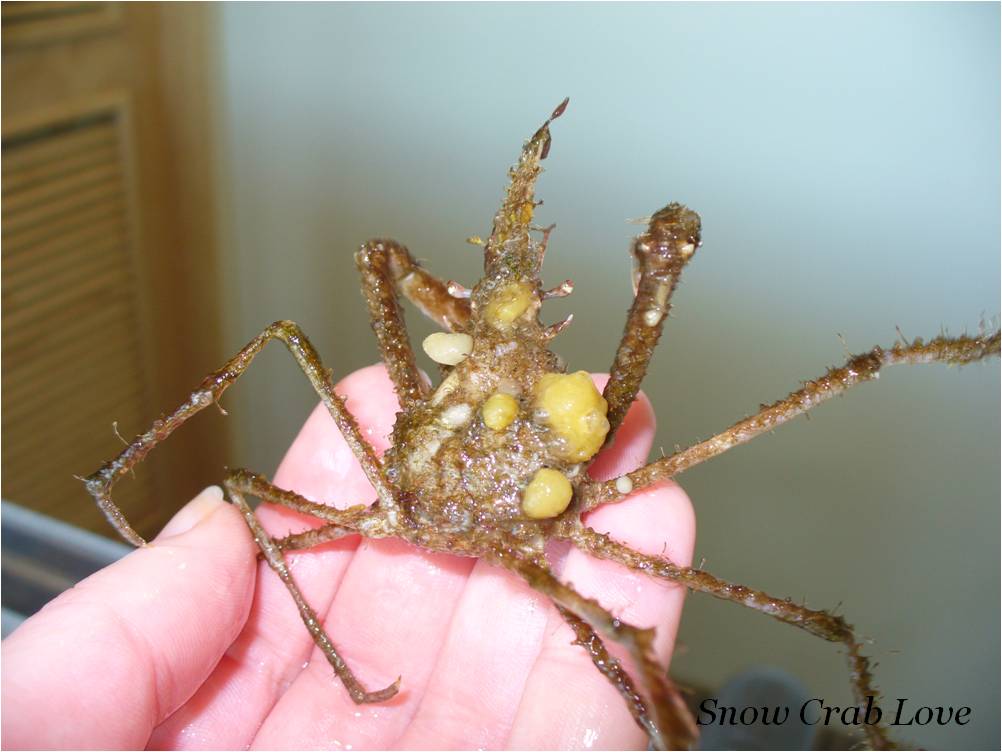
a decorator crab showing off its beautiful sponge accessories

be still my heart:
we have a real live heart crab in an aquarium! I've finally seen one!!

the educators were able to show kids how sea stars use their tube feet
to manipulate their prey as this guy opened up a blue mussel

here's an urchin chowing down on a little sea star!

The students really seem to enjoy seeing all the fish, playing on the map, and touching the sea cucumbers, scallops, and crabs,and they get to learn about why it's important to keep our oceans clean! Does your community have any fun ocean-themed outreach programs for the kiddos?

Tuesday, April 23, 2013

King crabs are red,

King crabs are blue,
Poems are hard,
Bacon.

It's time to answer another crab chat question:

What's the difference between red and blue king crabs (aside from color)?

Red king crabs and blue king crabs have 4 pairs of legs (6 walking legs and two claws) unlike snow crabs and Tanner crabs, which have 5 pairs of legs. The neat thing about kings is that they're NOT symmetrical! Think about your average crab (or human, horse, dog, fish, etc): when you visually slice it in half, each side is the same, albeit opposite. But not our friends, the king crabs! They have asymmetrical abdomens which are possibly derived from hermit crab ancestors (remember how hermit crab abdomens curve to the left, to the left?) (Remember how I'm cool because I reference Beyoncé songs in my nerdy crab blog?

A female king crab's abdominal flap is made up of 7 segments,
but they aren't all the same shape or size!

That's what they have in common, but you wanted to know what makes them different. One of the main differences, aside from color, is size. Blue king crab males can grow up to 18 pounds, which is pretty awesome for any crab, but red king crab males can get even bigger: up to 24 pounds with a leg span of 5 feet! Another physical difference is the number of spines they have on their rather spiny carapace. If you focus in on just the mid-dorsal plate of the king crab carapace, you'll notice a grouping of prominant spines. When you count 4 spines, you're looking at a blue king crab; you've got a red king crab when you count 6 spines. Now, this is not always true (there are rebel crabs out there that don't like to live by the rules and will rock 5 spines), but when in doubt, do a quick count! For example, I shared this photo of a king crab my husband came across that had been baking in the sun in Russia:


I foolishly just called it a red king crab (because I, equally foolishly, thought they only had red kings in Russia), but was promptly corrected. On closer investigation, I could see the 4 mid-dorsal spines!

Blue king crab it is!

That geographical mistakes leads me to another difference: while we can find both red and blue king crabs in Alaskan waters, their distributions are pretty different. Red king crabs are pretty well spread out with open commercial or personal use fisheries in southeast Alaska, Bristol Bay, and Norton Sound. Blue king crabs have a patchier distribution and their populations have such low numbers that all of their fisheries are closed.


Of course, considering all of these differences, it's still pretty awesome to see how brilliantly blue a blue king crab is compared to its red cousin!

One crab, Two crab, ↑Red crab, ↓ Blue crab

A good field guide (and the source of the abdomen pictures):
Donaldson, W. E., and S. C. Byersdorfer. 2005. Biological Field Techniques for Lithodid Crabs. University of Alaska Sea Grant. AK-SG-05-03, Fairbanks.

Friday, April 19, 2013

PBBBT!

This week has been... terrible. So here's something to cheer you up:

Raspberry Crab
Nucia speciosa


I mean, can you believe how cute this little guy is? I thought it would be the perfect Crabday crab to ooh and ahh over.

"Meep!" - raspberry crab

The raspberry crab, also known as the red leucosiid crab, can be found off of Hawaii, Guam, (assumingly elsewhere in the South Pacific), Indonesia, Mauritius, and the Red Sea! They live intertidally on coral reefs and blow kisses on each others' carapaces. OK, OK, I can't say for sure if they give each other raspberries, BUT I can't say for sure that they don't. You can decide what to believe.

"pbbbbbbt!" - raspberry crab

Raspberry crabs average a width of 3/4 inch, so you really could just fill a bowl with them and put whipped cream on top! Not that you'd want to do that. Save that for real raspberries, weirdos.

Friday, April 12, 2013

Big Ol' Crab!

Time to answer another chat question! Remember that I had the chance to talk with crab lovers through an online forum? They asked a lot of questions that I didn't get to fully answer, so I'm trying to tackle them now, one by one. This week's question is

What was the largest snow crab ever caught?

Well, the internet is telling me that the largest snow crab (Chionoecetes opilio) known in modern history was caught off of Newfoundland and weighed in at a stunning 26 lbs! How big is that really? Think about the crabs you see at Red Lobster: those guys are around 3 - 4 inches wide (just their carapace, not including their legs) and probably aren't seen bigger than 6 inches wide. They'll weigh in around 0.5 - 2.0 pounds. So, when thinking of a 26 pounder, how big would that guy have been??

 this big? (at the Yeongdeok Snow Crab Festival)

Using the carapace widths and wet weights from my eastern Bering Sea snow crabs, I did a little fast and not-too-legit math:

R!

A 26 pound snow crab could have a carapace width almost 1 foot wide! Imagine a Subway sandwich, but that's just the body of the crab; it will also have 5 legs that are each well over a foot! I wish that someone had taken a picture of this behemoth, but until I find one (or any of you guys send me one), this will have to do:

 can you imagine!?!
(yes, I overlayed an opie on top of my red king crab photo,
but the proportions are about right)

Friday, April 5, 2013

Let's talk about crabs, baby!

Last week I had the fun opportunity to chat with Deadliest Catch fans about anything and all things crab! (This is the third time I've been able to chat using the Wheel House forum, so check out my past summaries here and here.) It's always fun and covers a lot of crab topics, so it's hard for me to answer all of the questions fully at once. So, for those of you who didn't get to participate in the chat and for those of you who did but want to know more, these are the top questions I will try to answer over the next few posts:

Who can fish Alaskan waters?

What was this season's C. opilio catch compared to last season's catch?

What was the largest snow crab ever caught?

Just how deep in the ocean do king crabs and snow crabs live? And how far can they travel within a year?

What's the difference between red and blue king crabs (aside from color)?

What is the red king crab distribution, and why are they considered an invasive species in Norway?

Is crab meat tested for contaminants before going to market?

Let's get the big picture: how do El Niño and La Niña affect the Bering Sea and Gulf of Alaska?

Last but not least, the most often talked about crab query: do crabs really fart?!? I promise to get to the bottom of this conundrum once and for all!

Captain Phil teaching us a thing or two

Phew! That's a lot of information, so let's get started!

Who can fish Alaskan waters?

Only vessels owned by United States citizens can fish in Alaskan waters. This doesn't mean that if you're not a citizen you can't fish here. Anyone who has been to Kodiak or Dutch Harbor knows that the fishing industry is a melting pot of cultures! Kimchi on hotdogs? Yes please! As long as the vessel is US owned and operated, it's good to go. (Oh snap, I threw in something kinda controversial! Anyone want to discuss vessels that are clearly NOT operated by US citizens? Anyone?)


What's considered 'Alaskan' as far as the water goes? The United Nations set up an Exclusive Ecomonic Zone (EEZ) which spans 200 nautical miles from a country's shoreline. This zone belongs to that country. Alaska has a pretty big EEZ since it has over 44,000 miles of coast (boom, biggest state for the win!):

Alaskan EEZ in the darker blue

You might notice a funny little half circle near Russia of unclaimed ocean. That's commonly referred to as the donut hole and is closed for fishing no matter where you're from. There are other areas where the distance between the two countries doesn't allow for both to have a 200 mile limit, so they, for the most part, go halvesies. Otherwise, they go to war! Just joking. Kind of.

There you have it! One question down, eight more to go!

Friday, March 29, 2013

hermit crabs do the twist

After this post about when hermit crabs become, well, hermits and hide their soft abdomens in shells, Sherry asked:

Do hermit crab abdomens always spiral in the same direction?

I'm not gonna lie: I was stumped. The logical person in me thought: not all snail shells spiral in the same direction, so not all hermit crab abdomens spiral in the same direction, right? Shells can spiral to the right (dextral) or to the left (sinistral), and, just to really ruin your day blow your mind, some gastropods will display BOTH spiral directions within the same species!

Sinistral (on the left) and dextral (on the right) shells from
Amphidromus perversus snails (aka super cute land snails)

Then I thought, that may be so, but that doesn't mean that hermit crabs will necessarily inhabit every type of shell ever produced by nature, RIGHT? What I found is that, while hermit crabs prefer dextral gastropod shells, they can and will inhabit sinistral shells. But this seems to be a last-option-for-housing kind of situation, as the occurrence of crabs in the left-spiraling shells is so rare.

to the left, to the left!
everything about me in a shell to the left!

So are the hermit crabs that dwell in sinistral shells curling to the left? NO! Larval hermit crabs have symmetrical abdomens, but as they grow and develop, the abdomen begins to curl. It TURNS out (ha!) that the abdomen curls in a spiral towards the right for hermit crabs! (I'm afraid to say that this is true for all hermit crabs, but so far my quick literature review hasn't told me otherwise.) 

this hermit crab is doing its Tilda Swinton impersonation

I hope that cleared it up for you, Sherry! (Because the shell is clear...) Hey-oh!

Want some light reading?
Chapple, W. D. 1977. Central and peripheral origins of asymmetry in the abdominal motor system of the hermit crab. Annals of the New York Academy of Sciences 299: 43 - 58.

Kosuge, T., and M. Imafuku. 1997. Records of hermit crabs that live in sinistral shells. Crustaceana 70: 380 - 384.

Tuesday, March 26, 2013

Someone get the cocktail sauce!

We've got A LOT of prawns to eat!

prawn-filled beach in Coronel, Chile

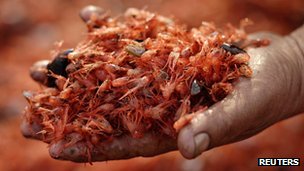
Just kidding. A tide of death has swept Chilean beaches, covering them with thousands of dead prawns and hundreds of dead crabs. Local fishermen are quick to point their fingers at the power plants nearby, which use seawater as a coolant, but an actual cause is not yet known. Researchers are looking into water temperatures and oxygen levels: there may have been an area of hypoxia that was too large for the critters to escape (hypoxia = low oxygen = hard to breath!).

poor little crustaceans

This isn't the first time we've seen a wave of dead crabs wash ashore. Remember the megalopae in Phuket? They may have washed ashore due to hypoxic conditions. And the devil crabs on the Thanet Coast, UK? They may have suffered from a sudden drop in water temperature (although scientists also initially considered bitter crab disease as the culprit). Hopefully Chilean researchers will get to the bottom of their prawn/crab die-off for, if nothing else, the peace of mind of the fishermen. Do you have any theories?