Thursday, February 28, 2013

Say "AAAAAAAH!!!"

You may not know this about me, but isopods freak me out (unlike these guys, apparently). What are isopods? They're crustaceans that haunt my dreams are found in marine, freshwater, and terrestrial environments. The only known isopod I will happily play with is the roly-poly. Other than that, I will turn into a little girl, scream, and run away (unless I'm on a boat, in which case I'll stay on board because those suckers are EVERYWHERE in the ocean). Why am I so creeped out by them?

Exhibit A:

he's not joking. he will.

Exhibit B:

God help this sweet kitten

And finally, Exhibit C:

isopod got your tongue?

Yes, folks. That's an isopod living in the mouth of a fish! This isn't the first time we've met a parasitic isopod. Remember the hyperparasite that lives on rhizocephalans that are themselves parasitizing crabs? They're awesome in the 'karma' sense, but that's about it.

Back to the tongue-eating isopod, my sister sent me an informative video about Cymothoa exigua:


That almost makes them seem endearing, but don't let the little cartoons fool you! They will eat your soul!!!

Friday, February 22, 2013

Trading WHAT for protection?

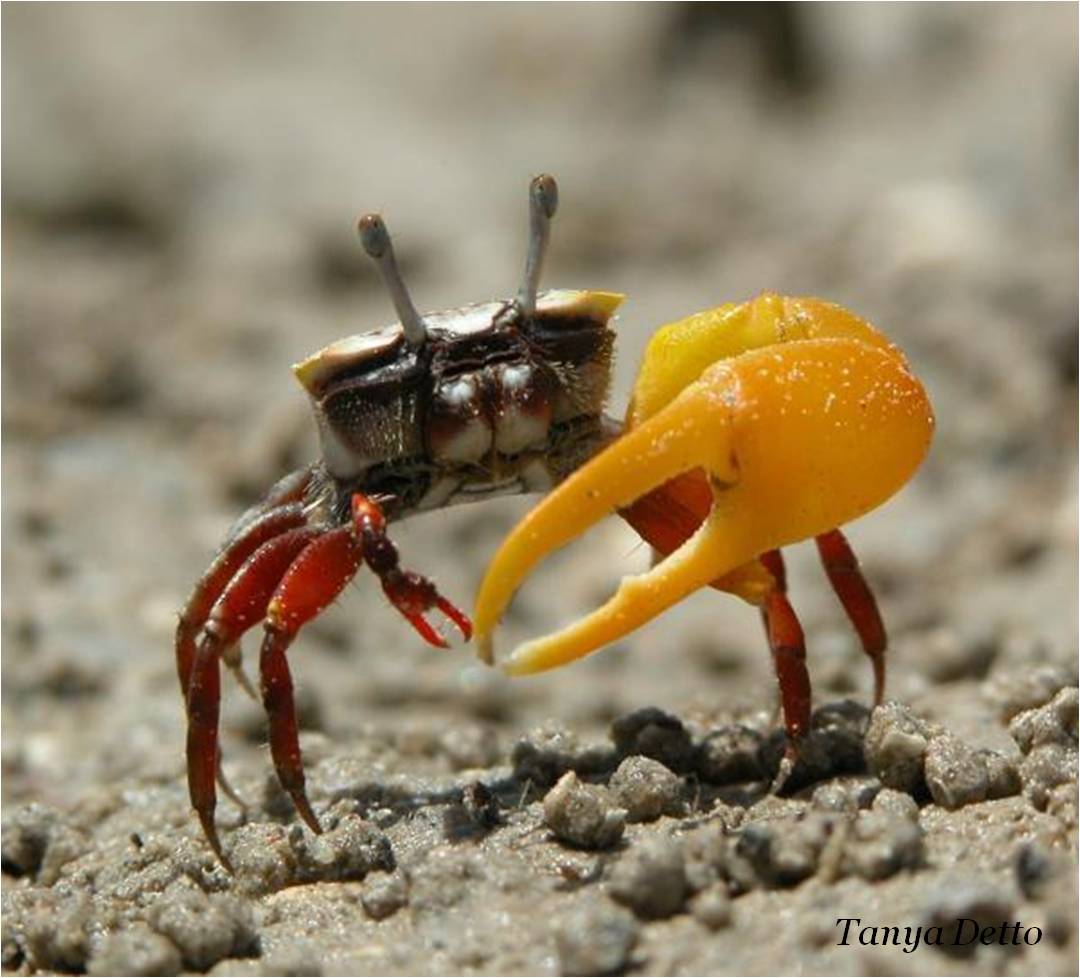
Oh, fiddler crabs, you're at it again.

"Who, me?"

You may already know that I have a deep-seeded distrust of fiddler crabs (despite this story I made up about one), but this next bit of science takes the cake. Few animals in the animal kingdom are monogamous. Hey, they all can't be like the mantis shrimp, right? But female fiddler crabs take this idea of polygamy to a whole new level! Female Uca mjoebergi will mate outside of their burrows on the sand flat for all the world to see. This rather public display with a male fiddler crab will secure that male's devotion in protecting her burrow. She trades sex for protection!

However, this broad's not finished with getting her, er, crab on. She'll next mate with a male inside her burrow, which is protected by her first mate. So the first male gets to mate, but it's the last male that will likely fertilize the majority of her eggs!

"There's nothing going on behind MY back, right? Right?"

The Slatyer et al. (2012) paper observed that the neighboring males were significantly more inclined to help after mating, so really the males are just as sleazy as the females.

cute, but still sleazy

Thanks to Meghan Garrison for telling me about this incredible crab behavior!

Read more:
Slatyer, R.A., M. D. Jennions, and P. R. Y. Blackwell. 2012. Polyandry occurs because females initially trade sex for protection. Animal Behviour 83: 1203-1206.

Thursday, February 14, 2013

Happy Valentine's Crabday!

I hope you are all having a lovely day! To celebrate Valentine's Crabday, I thought it would be perfect to introduce you all to the incredibly lovely

Heart Crab
Phyllolithodes papillosus

I *heart* this crab!
 
Imagine my surprise and joy when I found out this beauty is an Alaska native! Heart crabs, or flatspine triangle crabs (yawn), spread the love from Dutch Harbor, Alaska all the way to southern California. They're lithodids, meaning they're related to the king crabs we know and love. The red hearts are actually large bumps, or 'papillae', hence their species name papillosus. The neat thing is that, while the adults are beautiful in their own Valentine-themed way, the juveniles have white, purple, and orange markings too!

"Yar, check out me orange beard!" - juvie heart crab

If you haven't already, don't forget to make someone (or some pet) a special card for today:
 
Lobster Love (a bit risque)

Share the Crab Love!

Friday, February 8, 2013

I *crab heart* you!

Valentine's Day is coming up, which means it's time for another crustacean-themed card for your sweetie! I was thinking about crab hearts a while back (when discussing pain in crustaceans) and realized they're just as beautiful as the fake hearts we see everywhere around this time of year!

 The blue really catches the eyes, but check out that fun shape!
(drawing from here)

Inspired by the ol' crab circulatory system, I decided to keep this year's Valentine's Day card simple and sweet:


To make your own, simply download the pdf here, print it out, fold in half, then write something sweet or snappy inside! Your loved ones will love it!

You may be asking yourself: what are those little holes in the crab heart drawing? Those are the ostia (singular = ostium) through which hemolymph, or crab blood, is pumped. When the heart is in its relaxed state, the pores open and pull hemolymph in. The hemolymph gets oxygen, then the heart pumps it back out to all the crab innards and extremities to deliver that oh-so-important O2. You see, crabs have an open circulatory system, as opposed to people: blood just goes everywhere and isn't limited to blood vessels like mammals (which is why it was so easy for me to take hemolymph samples, but you wouldn't want to count on me drawing your blood). In my mind, a card with a crab heart representing an open circulatory system is WAY better than one of those "Keep an open heart" necklaces Jane Seymour's been peddling! And you can quote me on that!

Saturday, February 2, 2013

Crab Bowl

Are you ready for some football!?!?!?!

This year's Super Bowl features two teams from very crab-centric cities: the Dungeness crab loving San Francisco and the blue crab loving Baltimore!

Metacarcinus magister vs. Callinectes sapidus!

Both crabs are pretty awesome in their own ways, but in a Crab Bowl, who do you think would win? The defensively strong Dungies or the quick swimming blues? Weigh in at the poll on the sidebar!

Update:
Well, everyone who voiced their opinions were on Team Dungie, but Crab Bowl did not reflect Super Bowl. I guess the Ravens were lucky they weren't a team of swimming crabs. Good job, boys. Good job.

P.S. Remember that blue crabs are really Bears fans anyways? Go Bears!

Thursday, January 31, 2013

Double Ouch!

It's science fair season, and if you're lucky like me, you're up to your eyeballs in mentoring and facilitating fun experimental designs. This past weekend I was able to help my student run some behavioral experiments with hermit crabs (more on that later), and while we were removing the crabs from their shells (by gently holding the shell steady at the surface of a small tank: the hairy hermit crab, Pagarus hirsutiusculus, will wiggle its way out of the shell and drop to the bottom of the tank) we noticed this:

 
The hermit crab is about to enter its shell, but see that red blob?

Do you know what it is?

.
.
.
.
.
.
.
.

(I'll give you a moment to think)

.
.
.
.
.
.
.
.

It's a rhizocephalan! WOOO! And GROSS!!! This poor little hermit crab is being parasitized by a reproductive-organ-hijacking barnacle. Remember learning here that rhizocephalans will sterilize their host and use the host's energy to raise and protect their own little parasite larvae. I was used to seeing these parasites on king crabs, but it is pretty common for hermit crabs to have rhizocephalans on them, at least in Auke Bay, where our science fair animals had been collected. In fact, back in 1996, researchers went out and collected 169 hairy hermit crabs from Auke Bay and found the parasites on about 13% of them! But don't worry, because they also found this:

The blobs marked "A" and "B" are rhizocephalans (Peltogaster paguri),
but the "C" blob is a HYPERPARASITE on the "B" rhizocephalan! 

YEAH! Take that, parasite! You've got a parasite of your own! (Nature: it's an awesome, scary place.) The rhizocephalan's hyperparasite is Liriopsis pygmaea, an isopod that will sterilize its host. It's a nice case of karma, am I right?

Thursday, January 24, 2013

Cod are just like people:


They love to eat snow crabs!

You may remember meeting Laurinda Marcello through an interview last year as a student, but she's since graduated and published her results! Her paper looked at how snow crab recruitment is affected by water temperature and cold area extent, spawning stock biomass (how many crabs are out there makin' babies), and the biomass of crab predators (cod!). As a bonus, she compared these relationships between the Bering Sea and the Canadian North Atlantic.

What did she find out? Let's start with the predators! We know that cod like to eat snow crabs. I've had a cod puke little baby snow crabs on me (it had been through a lot, the poor cod, so I wasn't mad or anything). And check out this piece of knowledge:

snow crabs (in the orange square) make up a relatively large percentage
of both frequency of occurence (%FO, on the top half of the figure)
and stomach content weight (%W, on the bottom half) compared to
red king crabs and Tanner crabs in Pacific cod stomachs (from this paper)

Interestingly enough, Laurinda's study only saw an inverse relationship between predator abundance and snow crab recruitment in one study area! The rest of the areas had no real pattern. This could suggest that, while cod eat snow crab, there may not be enough predation on their part to be considered a top-down effect on snow crab recruitment. (That's a big statement up in here!) However, she warned us not to be too hasty with this conclusion as predator biomass may not mean direct predation pressure on the crabs.

Moving on, spawning stock biomass in both the Bering Sea and one portion of the North Atlantic study area was inversely related to recruitment. What? More baby-makers mean less babies? Crazy town sea, right? Laurinda posited that since snow crab reproduction relies on not only males and females to be present, but for them to be within each other's vicinity, simply looking at the number of adults may not accurately represent the number of mating adults. There's also the case of cannibalism in snow crabs: more adults mean more cannibalistic mouths to feed!

"Get into my belly!" - large snow crab

The big result was that the main factor associated with snow crab recruitment was the ocean climate. From her paper, "[t]his strongly supports our hypothesis... that cold conditions during early life history stages promote subsequent snow crab recruitment."

the colder the temperature (to a point), the more recruits to the fishery!

Cool! (Get it? wink.) Congratulations on the paper, Laurinda!

Read the full paper:
Marcello, L. A., F. J. Mueter, E. G. Dawe, and M. Moriyasu. 2012. Effects of temperature and gadid predation on snow crab recruitment: comparisons between the Bering Sea and Atlantic Canada. Marine Ecology Progress Series 469: 249 - 261. doi: 10.3354/meps09766