Friday, March 22, 2013

Out of Town!

Hey there! I've been a bit busy with work, but don't worry, I didn't forget about Snow Crab Love! I was out of town for a bit to attend a meeting in Seattle (for a Gulf of Alaska project which is also funded by North Pacific Research Board! Hollah!), so while I was there I made sure to eat lots of crustaceans!

you know you want to throw a fish around!

What was my most invertebrate-filled meal? That would have to be the bowl of Dungeness crab (Metacarcinus magister) and oyster (I don't know which species) chowder with half of an Oregon bay shrimp (Pandalus jordani) sandwich! I went with some friends to Pike Place Chowder in Post Alley (no, we did not put gum on the Gum Wall. I can't believe I missed it!) and was not disappointed. The chowder was warm and delicious - perfect for a sunny spring day in Seattle - and the sandwich was loaded with little pink shrimp!

soup and a shrimpy sammie!

I've shared before that I don't normally eat shrimp because of the overwhelming bycatch that is often caught in trawl fisheries, but the Oregon bay shrimp fishery has its act together. The fishery runs from April 1 - October 31, which avoids the reproductive season of December through March (yay for making shrimp babies!). Best of all is that they use bycatch reduction devices (BRD) which allow fish to escape the net while shrimp are caught!


See how that lingcod and canary rockfish were able to just swim out and on their way instead of being smooshed into the codend with all the shrimp? Totally awesome! The Oregon Department of Fish and Wildlife have a couple other videos of how BRDs work which are worth checking out here. What fishermen end up with is lots and lots of shrimp with few fish to sort out rather than a deckload of fish with a few shrimp scattered around!

catch vs bycatch:
just two small bins of non-targeted fish compared to all those baskets of shrimp!
(this is probably the happiest picture I've seen in terms of shrimp fishery bycatch -
the rest can be just heartbreaking)

This fishery is so good that the Monterey Bay Aquarium's Seafood Watch program gave it the "Best Choice" label and the Blue Ocean Institute gave its bycatch a score of 3.75 out of 4! That, my friends, means happy eating for this gal!

Friday, March 8, 2013

teeny tiny shells

This weekend is the Southeast Alaska Regional Science Fair! The student I mentored did a project looking at shell selection behavior of hermit crabs under different chemical cues (more on that later). This project got me thinking: when exactly do hermit crabs begin using gastropod shells? Is is right when they settle out of the water column onto the benthos or do they have to reach a certain size before they can hoist a shell around?

First let's learn a little about hermit crab development. When they hatch, they are free swimming zoea. They go through a number of zoeal instars, meaning they'll molt and grow, but will still have basically the same form and function.

little larval Anapagurus laevis

After a certain number of instars, the zoea will molt into a megalopae stage. Megalopae will swim around until they find a suitable substrate to settle. Once they settle, they can then molt and grow into a juvenile hermit crab, when they'll finally look like mini-versions of the hermit crabs we know and love!

almost there, little buddy!

So when does the protective gastropod shell come into play? You may have guessed it already: during the megalopae stage! As they settle, the little guys are looking not only for good habitat structure and food availability, but also for shells or shell fragments. If no shells are available to protect their minuscule bodies, hermit crab megalopae can delay morphing into the juvenile stage. But they don't want to dilly-dally, since shell-less hermit crabs at either stage suffer higher mortality rates than those with shells.

Now, what do I mean by "little"? Check out this guy:


the large claw on this Pagurus bernhardus is about 1 mm long

For comparison, pick up a nickel. A nickel is almost 2 mm thick, so this hermit crab megalopa is probably around the same size as your nickel is thick! That's how tiny hermit crabs are when they start looking for shells, or more likely at these sizes, shell fragments to protect their soft abdomens!

Where's the science? 
Roberts, M. H. Jr. 1971. Larval development of Pagurus longicarpus Say reared in the laboratory. IV. Aspects of the Ecology of the megalopa. Biological Bulletin 141: 162 - 166.

Oba, T., and S. Goshima. 2004. Temporal and spatial settlement patterns of sympatric hermit crabs and the influence of shell resource availability. Marine Biology 144: 871 - 879.

Harms, J. 1992. Larval development and delayed metamorphosis in the hermit crab Clibanarius erythropus (Latreille) (Crustacea, Diogenidae). Journal of Experimental Marine Biology and Ecology 156: 151 - 160.

Thursday, February 28, 2013

Say "AAAAAAAH!!!"

You may not know this about me, but isopods freak me out (unlike these guys, apparently). What are isopods? They're crustaceans that haunt my dreams are found in marine, freshwater, and terrestrial environments. The only known isopod I will happily play with is the roly-poly. Other than that, I will turn into a little girl, scream, and run away (unless I'm on a boat, in which case I'll stay on board because those suckers are EVERYWHERE in the ocean). Why am I so creeped out by them?

Exhibit A:

he's not joking. he will.

Exhibit B:

God help this sweet kitten

And finally, Exhibit C:

isopod got your tongue?

Yes, folks. That's an isopod living in the mouth of a fish! This isn't the first time we've met a parasitic isopod. Remember the hyperparasite that lives on rhizocephalans that are themselves parasitizing crabs? They're awesome in the 'karma' sense, but that's about it.

Back to the tongue-eating isopod, my sister sent me an informative video about Cymothoa exigua:


That almost makes them seem endearing, but don't let the little cartoons fool you! They will eat your soul!!!

Friday, February 22, 2013

Trading WHAT for protection?

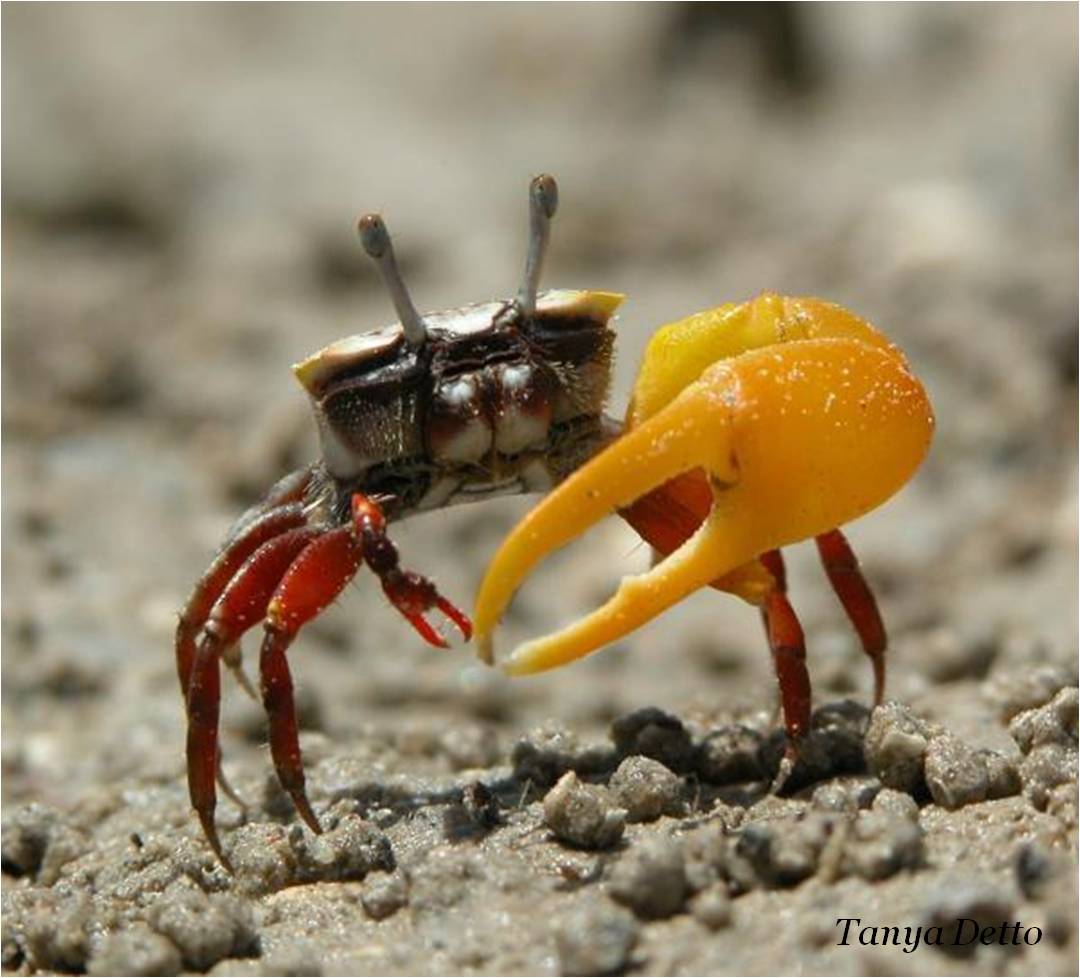
Oh, fiddler crabs, you're at it again.

"Who, me?"

You may already know that I have a deep-seeded distrust of fiddler crabs (despite this story I made up about one), but this next bit of science takes the cake. Few animals in the animal kingdom are monogamous. Hey, they all can't be like the mantis shrimp, right? But female fiddler crabs take this idea of polygamy to a whole new level! Female Uca mjoebergi will mate outside of their burrows on the sand flat for all the world to see. This rather public display with a male fiddler crab will secure that male's devotion in protecting her burrow. She trades sex for protection!

However, this broad's not finished with getting her, er, crab on. She'll next mate with a male inside her burrow, which is protected by her first mate. So the first male gets to mate, but it's the last male that will likely fertilize the majority of her eggs!

"There's nothing going on behind MY back, right? Right?"

The Slatyer et al. (2012) paper observed that the neighboring males were significantly more inclined to help after mating, so really the males are just as sleazy as the females.

cute, but still sleazy

Thanks to Meghan Garrison for telling me about this incredible crab behavior!

Read more:
Slatyer, R.A., M. D. Jennions, and P. R. Y. Blackwell. 2012. Polyandry occurs because females initially trade sex for protection. Animal Behviour 83: 1203-1206.

Thursday, February 14, 2013

Happy Valentine's Crabday!

I hope you are all having a lovely day! To celebrate Valentine's Crabday, I thought it would be perfect to introduce you all to the incredibly lovely

Heart Crab
Phyllolithodes papillosus

I *heart* this crab!
 
Imagine my surprise and joy when I found out this beauty is an Alaska native! Heart crabs, or flatspine triangle crabs (yawn), spread the love from Dutch Harbor, Alaska all the way to southern California. They're lithodids, meaning they're related to the king crabs we know and love. The red hearts are actually large bumps, or 'papillae', hence their species name papillosus. The neat thing is that, while the adults are beautiful in their own Valentine-themed way, the juveniles have white, purple, and orange markings too!

"Yar, check out me orange beard!" - juvie heart crab

If you haven't already, don't forget to make someone (or some pet) a special card for today:
 
Lobster Love (a bit risque)

Share the Crab Love!

Friday, February 8, 2013

I *crab heart* you!

Valentine's Day is coming up, which means it's time for another crustacean-themed card for your sweetie! I was thinking about crab hearts a while back (when discussing pain in crustaceans) and realized they're just as beautiful as the fake hearts we see everywhere around this time of year!

 The blue really catches the eyes, but check out that fun shape!
(drawing from here)

Inspired by the ol' crab circulatory system, I decided to keep this year's Valentine's Day card simple and sweet:


To make your own, simply download the pdf here, print it out, fold in half, then write something sweet or snappy inside! Your loved ones will love it!

You may be asking yourself: what are those little holes in the crab heart drawing? Those are the ostia (singular = ostium) through which hemolymph, or crab blood, is pumped. When the heart is in its relaxed state, the pores open and pull hemolymph in. The hemolymph gets oxygen, then the heart pumps it back out to all the crab innards and extremities to deliver that oh-so-important O2. You see, crabs have an open circulatory system, as opposed to people: blood just goes everywhere and isn't limited to blood vessels like mammals (which is why it was so easy for me to take hemolymph samples, but you wouldn't want to count on me drawing your blood). In my mind, a card with a crab heart representing an open circulatory system is WAY better than one of those "Keep an open heart" necklaces Jane Seymour's been peddling! And you can quote me on that!

Saturday, February 2, 2013

Crab Bowl

Are you ready for some football!?!?!?!

This year's Super Bowl features two teams from very crab-centric cities: the Dungeness crab loving San Francisco and the blue crab loving Baltimore!

Metacarcinus magister vs. Callinectes sapidus!

Both crabs are pretty awesome in their own ways, but in a Crab Bowl, who do you think would win? The defensively strong Dungies or the quick swimming blues? Weigh in at the poll on the sidebar!

Update:
Well, everyone who voiced their opinions were on Team Dungie, but Crab Bowl did not reflect Super Bowl. I guess the Ravens were lucky they weren't a team of swimming crabs. Good job, boys. Good job.

P.S. Remember that blue crabs are really Bears fans anyways? Go Bears!